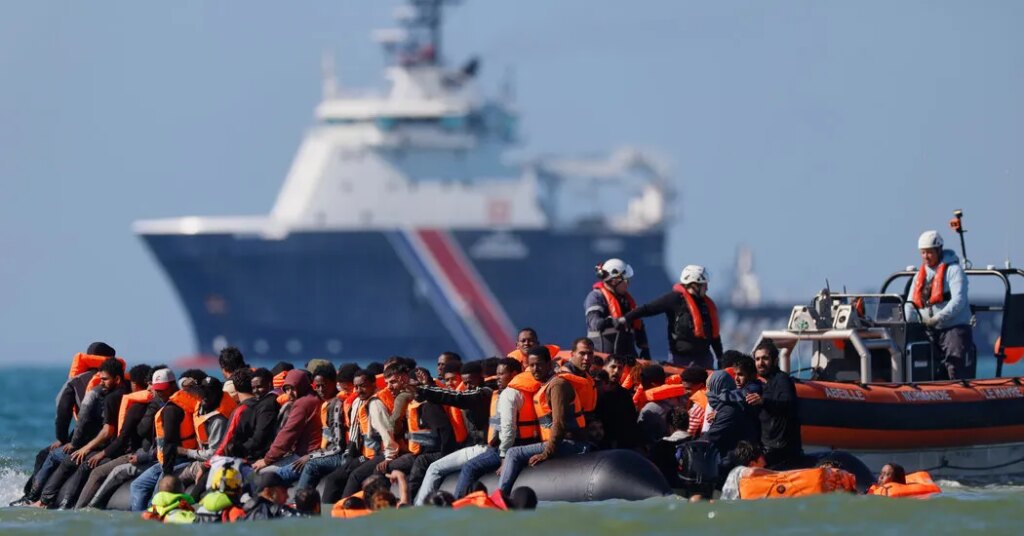
France and Britain are abandoning a landmark migration deal that allowed the British to return migrants who crossed the English Channel illegally in exchange for those who applied to enter via official means.
The deal, known as “one in, one out,” struck in the summer of 2025, was intended to deter dangerous illegal crossings of the channel, which have roiled politics in Britain and raised tensions between London and Paris. The original deal was struck for one year and was extended by a month, until Oct. 1, but will not be renewed.
France pulled the plug despite entreaties from London to keep it in place, according to officials in both countries, in part because the French government wants Britain to strike a broader deportation deal with the 27 countries of the European Union.
“Why do we have to manage this border on our own?” the French interior minister, Laurent Nuñez, said at a parliamentary hearing this year. “We believe that France should not have to bear the burden alone, and that it would be better to incorporate it into an agreement between the European Union and the United Kingdom.”
British officials acknowledged that they would have liked the program to continue. A spokesman for the Home Office, which oversees deportations, said on Wednesday that the department would use “lessons learned from the pilot to accelerate efforts to return small boat migrants with no right to remain in the U.K.”
Both sides hailed a sharp decline in clandestine asylum seekers reaching British shores, down 43 percent through August of this year compared with the same period in 2025. But experts said the reduction had little to do with the deal, attributing it to other factors, such as increased French policing of the beaches and weather patterns.
Expensive and bureaucratically cumbersome, the “one in, one out” program never reached a significant scale. About 1,400 people had been returned to France under the policy by September, according to the Home Office. That was a small fraction of the more than 41,000 people who arrived in Britain on small boats last year, and tens of thousands have been deported through other arrangements with other countries.
The agreement was particularly divisive in France, where critics accused the government of going too far in allowing Britain to return illegal migrants.
Still, the agreement had represented a diplomatic success for the two countries, one that helped ease the raw feelings left by Britain’s departure from the European Union. The accord was signed by President Emmanuel Macron of France and Keir Starmer, then the British prime minister, during a state visit by Mr. Macron to London in 2025. The leaders also used that trip to celebrate France’s loan of the Bayeux Tapestry to the British Museum.
Mr. Nuñez, in his parliamentary testimony, said that cutting the numbers was never the only point of the agreement. “Rather,” he said, “it aims to serve as a deterrent by introducing an element of uncertainty: successfully making the crossing does not guarantee the right to settle in the United Kingdom.”
He cited information from the United Nations High Commissioner for Refugees, which he said showed that the deal had prompted a number of migrants to abandon their plans to make the journey.
Humanitarian workers cast doubt on the deal’s effectiveness. They said little or no information about the arrangement had been circulated in informal camps in the north of France, where larger numbers of migrants wait for a window to cross the channel.
There were also growing concerns about human rights violations in how migrants were selected and treated during the process.
“We are concerned about the lack of clarity in selecting individuals to be returned to France and, relatedly, the risk of arbitrariness and discrimination,” seven United Nations special rapporteurs and an independent expert on human rights wrote in a letter in December 2025. They warned of “a greater risk of systemic unfairness” and even “arbitrary detention.”
For those eager to apply for legal entry, the procedure was taxing: Asylum seekers had to keep their cellphones with them at all times so the British government could locate them, and be able to pick up a call from the British authorities at any time for a three-month period.
“This is truly an extremely dishonest agreement,” said Diane Léon, a coordinator in northern France for Médecins du Monde, a French advocacy group. “If this agreement had truly been fair, outreach efforts would have been put in place to allow people to actually apply through this agreement, which was not the case.”
Michael D. Shear contributed reporting from London.
The post Britain and France Give Up Landmark Migrant Agreement appeared first on New York Times.