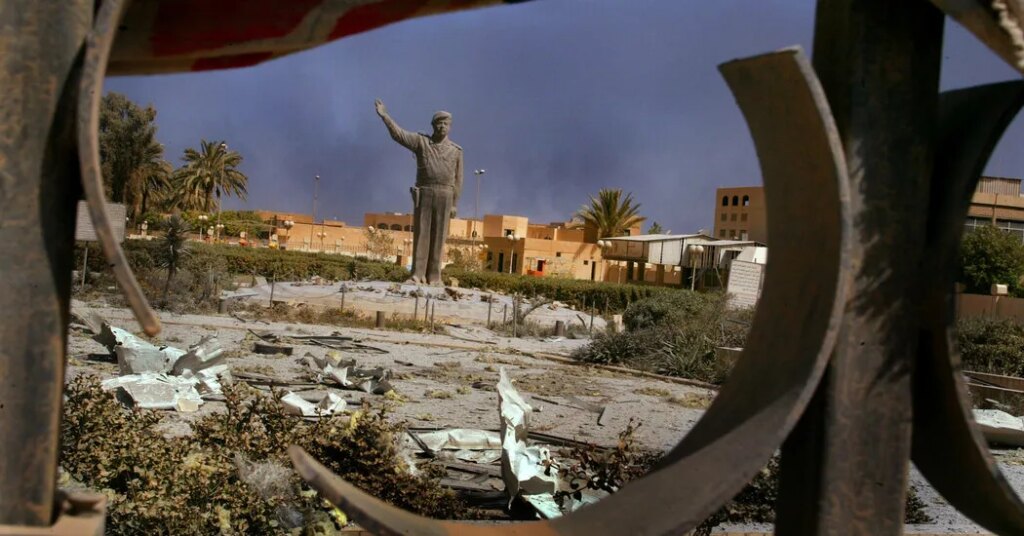
I got to Iraq a few weeks after the U.S. Army did. It was just a couple of days after the statue of the Iraqi dictator Saddam Hussein was pulled down in Baghdad by a crowd that included U.S. Marines.
That was April 2003.
I had assured my family that I would stay for maybe a week. At the time a correspondent for The Los Angeles Times, I recall telling relatives that I just wanted to “get the lay of the land and take a look around.” That ended up taking longer than I thought.
From the beginning, the United States did not understand the country it was storming into. Twenty-three years later, as it pulls the last of its forces out, it probably still does not. I know I am still working to fully grasp it.
There were so few U.S. service members left in Iraq at the end that when the last ones officially withdrew on Wednesday it made little difference in the daily lives of Iraqis. But that was hardly the case when the first American forces arrived on March 20, 2003.
The early days of the invasion, which toppled a hated despot, were so heady with possibility that it was easy to dismiss the warning signs.
Driving over the border, through the yellow desolate scrub of the country’s western desert, I passed blackened and twisted Iraqi military vehicles hit in American strikes. On the horizon I could see smoke still curling into the air from recent attacks. And everywhere was the smell of burning rubber.
Amid all this wreckage, I wondered, what sort of welcome could an American expect?
When I reached Baghdad, the capital, there was hardly anything to eat in the shops except out-of-date Cadbury toffees and canned tuna, which no one seemed to be buying except foreigners. In the streets, the mood was charged, watchful. But the Iraqis seemed not so much afraid of the invaders, even those in Humvees, as curious.
I do not want to suggest the Americans were greeted with flowers — let alone as “liberators,” as the American vice president had predicted. But the Iraqis I met in those early days were intrigued at finally getting a glimmer of a future not defined by the brutality and restrictions of the Hussein regime. And it was the Americans who had helped bring that change.
But the reason for the American invasion and the rationale for the occupation that followed seemed like a moving target.
The Bush administration had justified it initially with the claim — later discounted — that the Hussein government was developing chemical weapons.
But the military officers and policymakers who had moved into the so-called Green Zone palaces had a new set of rationales for the war: It was not that Hussein was a danger to mankind, nor a brutal dictator. Now, they said, the United States and the military coalition it formed were there to bring democracy to Iraq. Or, as President George W. Bush put it: “to help the Iraqi people build a lasting democracy in the heart of the Middle East.”
This began the pattern of adjusting or changing altogether the justification for the continued U.S. presence in the country. Along the way, the U.S.-led coalition made one disastrous misstep after another, starting almost from the first weeks after the invasion.
One moment stands out.
I remember vividly the order from Paul Bremer, the chief civilian administrator, to disband the Iraqi Army. “Do you mean, disband the whole army?” I asked a military press attaché.
He said he would get back to me.
Iraq had some 400,000 troops.
Stunned, baffled and increasingly angry, dismissed Iraqi soldiers began to gather every morning at the gates of the Green Zone. When I asked what they thought about the order to disband, some shrugged and walked away. Others had a message for Washington.
“Tell your president that we had to fight for Saddam,” one told me. “We are glad he’s gone.”
Another, a veteran of the eight-year war between Iraq and Iran, said he was 51 and could not make ends meet without his pension. “I have five children,” he said. “My son lost his leg. I work as a janitor. I am too old to find a new job.”
And there were even clearer signs of the trouble ahead.
One man wearing a long, dark gray dishdasha robe — I still see his face in my mind’s eye — asked the interpreter where I was from. When he heard “U.S.,” his face twisted in disgust and he spat a stream of liquid at me.
Some landed on my shoe. I stared at it, unsure whether to wipe it off. What message might that send? Would it seem as if I was ignoring what he had to say?
I wondered if no one saw the widening gap between Iraqi hopes for a post-Hussein future and what the United States was actually offering.
Yes, many Iraqis had unrealistic expectations. They wanted America to transform their country overnight into a Middle Eastern version of the shiny, idealized American world they knew from the bootlegged movies they had watched secretly under Hussein.
But what many more Iraqis were unprepared for was America’s disregard for the economic realities of their lives. They were unprepared for the Americans’ failure to realize that when you take away a person’s job, you often take away their ability to navigate day-to-day life, their dignity, their place in their community, their family.
Only much later did I connect the fury of the man who spat on me with his feeling of having been disrespected. I could see that a dangerous dynamic had already begun.
A fast-growing and increasingly angry Sunni insurgency was becoming shrewder and more technically adept at taking on the American occupiers. The insurgents bombed U.S. checkpoints and military vehicles; they laid ever more sophisticated road bombs.
That made the U.S. troops, many of whom were unprepared for the fraught mission handed to them, more skittish. The U.S. troops fired upon speeding cars near traffic stops, believing they were targeting them, even when they were just carrying families trying to get to safety. Some engaged in human rights abuses, among them the sexual violence and torture at the Abu Ghraib prison and the killing of civilians in Haditha.
Not only did this fuel the insurgency, it helped lay the groundwork for a forerunner of the Islamic State terrorist group.
And when the United States ousted Hussein, it created not just a political vacuum but, with the dismantling of the army, a security one. A U.S. nemesis, Iran, methodically set about backing Shia politicians with whom it shared common ground. Now, 23 years later, its allies are embedded in many Iraqi government agencies and politicians close to Iran have become kingmakers.
The outlines of an emerging sectarian divide were already clear not long after Hussein’s fall. So was the specter of deepening fundamentalism among both Sunnis and Shiites.
Some three weeks after I arrived, Iraqi Shiites were able for the first time in more than a decade to freely celebrate one of the holiest days in the Muslim year, Ashura. Thousands trekked from their homes for days — the old, the young, some in wheelchairs — to reach the city of Karbala in southern Iraq and its elaborately carved shrines with their soaring gilded minarets.
I was unprepared for the religious intensity of the pilgrimage. The women wore long black abayas and tight black veils. The men carried prayer beads.
Jotting down notes near one of the shrines, I did not at first realize that the shouting I was hearing was coming closer — and was directed at me. A group of clerics was bearing down, and other pilgrims were beginning to gather.
What had I done?
I looked for my interpreter, but he was nowhere in sight. As the men shook their fists, I felt a strong grip on my upper arm. It was a woman in an abaya. She nodded to the men and pulled me away.
My offense soon became clear.
The woman led me to a small group of other women sitting with children on a blanket, with small bowls of raisins and nuts. They pointed to my veil, which I had draped over my head in the style I had learned in Afghanistan. Then one pulled on a wisp of my hair that had escaped into view.
The women never looked disapproving, but it was clear how seriously they took the situation. For half an hour they worked to refold and pin my head scarf so that not one hair could work its way out.
When they were finished, one reached into her pocket and pulled out a small mirror to show me their handiwork.
Then one smiled and handed me back my notebook.
The post What I Saw as the U.S. Debacle in Iraq Unfurled appeared first on New York Times.