Durant is hardly a busy crossroads on the midterm map.
It’s in the southeast corner of Oklahoma — the reddest part of one of the reddest states in the country.
Right now, that’s where President Trump thinks he can be useful.
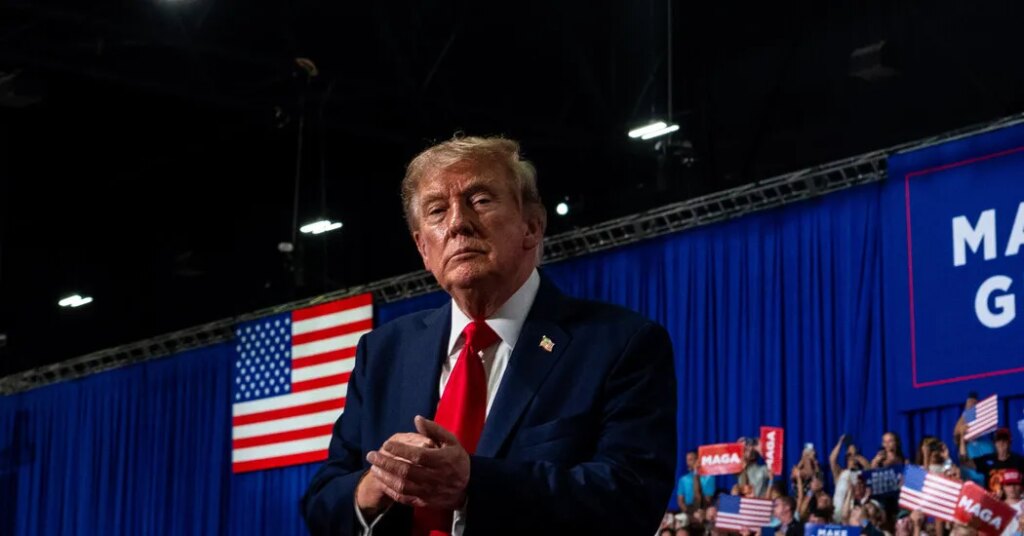
He’ll deploy there tomorrow night for an event on a midterm tour that is as crimson as a maple tree in the fall. His Friday plans? Alabama. On Monday, Nebraska. (He’s making less surprising stops in the coming days in Texas and Ohio, where there are fierce Senate races to sway.)
It might seem like Trump is simply picking safe spaces to rally in. But his itinerary reflects Republicans’ need to boost the enthusiasm of their base — to play defense, even in MAGA strongholds, at a moment when voters are angry over high prices, beef imports and immigration raids.
“My polling numbers show Trump still positive in the state, but they are down from where they have been,” said Pat McFerron, a Republican pollster in Oklahoma. “It’s now acceptable to disagree with the president on some specific issues.”
Divides on immigration and the economy
Those disagreements are flaring up in some of the reddest parts of the country. Senator Jim Justice of West Virginia — a Republican and a die-hard Trump ally — told Politico yesterday that the administration’s ICE raids have become too disruptive.
“You’re dragging people away that have lived on your street corner for 15 years, and I don’t know that we need to be doing that stuff,” Justice said. (He later released a statement saying he supported the administration’s policies.)
Last week, Senator Roger Marshall of Kansas, a Republican facing a tighter-than-expected re-election battle, admonished ICE for not communicating with local officials before conducting raids in his state.
Representative Don Bacon, a Nebraska Republican who is not running for re-election, said both inflation and the immigration raids had combined to create stiff headwinds for even the Republicans running in deep red Nebraska.
“I think we took something that was a huge political advantage for us two years ago, a two-to-one political advantage, and now we’ve turned it into a two-to-one disadvantage, and it’s because we went from one extreme to the other extreme,” Bacon told me, referring to immigration.
Plus, he said, the president’s tariffs have raised prices on agricultural equipment and fertilizer, walloping farmers in his state. “I think it was a policy error on tariffs,” he said. “A mistake.”
Potholes all over the map
The deep-red states on Trump’s schedule have each presented their own surprising challenges for Republicans this year.
-
In Oklahoma, Trump backed the construction of an aluminum smelter plant that has engendered fierce local opposition, and he endorsed a candidate for governor, Mike Mazzei, only after he reversed his position and came to support the smelter, too. Now, the two need to keep voters motivated.
-
In Alabama, Republicans are worried that low enthusiasm among their supporters could imperil their ability to pick up the freshly gerrymandered district currently held by Representative Shomari Figures, a Democrat — especially after Democratic turnout rose during the primary. (Trump’s rallies there and in Oklahoma are also near borders with states that have drawn more political attention.)
-
In Nebraska, Senator Pete Ricketts is facing a difficult re-election campaign against an independent candidate, Dan Osborn. Ricketts has struggled to defend the war in Iran as it pushes up the price of fuel and fertilizer in his state.
Bob Vander Plaats, an influential evangelical leader in Iowa, is crossing his fingers for a Trump visit to his state, too, where the Senate race, the governor’s race and three of the four House races appear tight.
He believes that it could be harder than it has been in years to get conservative voters to the polls — and that Trump is still a help, not a hindrance.
“I’m feeling like the coach in the locker room. It’s going to take everything we got to get over the finish line,” Vander Plaats said.
Quote of the Day
“When we did that convention — it dropped our numbers. Everybody’s numbers dropped.”
That’s Ken Paxton, the Republican candidate for Senate in Texas, talking about Trump’s midterm convention in Dallas, according to audio from a private fund-raiser that The Times obtained.
It’s notable because of the source: Paxton has been a loyal Trump ally and was heavily featured at the convention. But it echoes a broader feeling among Republicans that an event celebrating Trump’s presidency during a period of low approval ratings might have been a mistake.
Get Caught Up
On the campaign trail
-
James Talarico, the Democratic candidate for Senate in Texas, visited New York City this week for two fund-raisers. One of them, held in support of both Talarico and Sherrod Brown of Ohio, featured a star-studded guest list and an intro by Robert De Niro.
-
For our California readers: Xavier Becerra and Steve Hilton, the two candidates for governor of California, will face off in a nationally televised debate tonight at 6 p.m. Pacific.
On Capitol Hill
-
Senate Democrats blocked a bill that would have limited stock trading by members of Congress. Chuck Schumer, the Democratic leader, criticized it as “toothless.”
-
In a contentious Judiciary Committee hearing, Senator Eric Schmitt, a Missouri Republican, accused the Biden-era special counsel Jack Smith of lying about attending a basketball game. It turned out that Schmitt had mixed up the Atlanta Hawks and the Iowa Hawkeyes.
Around Washington
-
Thousands of legal immigrants and refugees across the U.S. are set to lose access to Medicaid tomorrow, as Republican-led cuts to the program take effect.
-
The Supreme Court said the Trump administration could, for now, resume its policy of deporting immigrants to countries other than their own. The justices will hear arguments in the case later this year.
In One Graphic
The arguments in Washington over the past few weeks have appeared to break along partisan lines: Trump favors unfettered A.I. progress and Republicans follow suit, while Democrats urge a slowdown.
But the chart above, which shows spending on ads and campaign outreach by A.I.-aligned super PACs, is a reminder that the split isn’t so simple. Money from these groups flowed to both Democrats and Republicans during the primaries — often in support of candidates who went on to win.
postcard from Colorado Springs
Victor Marx, the Republican nominee for governor of Colorado, knows how to weave a wild story. He has said that his stepfather forced him to kill a man at age 7, and that he once cast a demon out of a teenage girl. I asked The Times’s Jack Healy to tell us what it was like to interview this singularly polarizing figure.
I’ve interviewed politicians in farm fields, on airplane tarmacs and from the beds of bouncing pickups. But Victor Marx offered me a new one as I was reporting on his quixotic campaign to be the next governor of Colorado: Would I like to drive to Colorado Springs to meet him at his ministry training compound, which features a gun range and urban-combat “shoot house?” Um, yes I would.
Marx’s career running a “high risk” Christian ministry is central to his appeal to the grass-roots evangelical voters who helped him win the nomination. But it is also the source of many questions about his truthfulness, and whether the jaw-dropping stories he tells about his life match up to reality. He was eager to talk and led me around the five-acre grounds, showing off photos of his ministry crew in conflict zones. I drove away still skeptical about some of his stories. But what puzzled me most: Why hasn’t Marx agreed to get on a debate stage and make the same case to every other person in Colorado?
Where in the World?
The perks of being a politics reporter: Emily Davies sent us this video from the Delaware County Fair, where her coverage of a pivotal Senate race included watching the wiener dog race. Can you guess which state she was in?
Click an answer, and we’ll take you to Emily’s story so you can see if you’re right. The article is free to read.
Taylor Robinson contributed to this newsletter.
The post Trump Is Playing Defense in Trump Country appeared first on New York Times.