This essay was originally delivered as a speech at the Wharton Center for Performing Arts at Michigan State University on Tuesday.
Let me start in the year 2004. The New York Times is a thriving company in a thriving industry. It boasts a best-in-class product, an esteemed brand and a uniquely influential readership. Many call it the greatest newspaper in the world. But it has grown to be much more than that: a diversified media conglomerate with over 12,000 employees and $3 billion in revenue. It’s an auspicious time to break ground on the construction of a grand new headquarters designed by one of the world’s most acclaimed architects.
What could possibly go wrong?
Well, at the same time, this disruptive force called the World Wide Web was gaining steam, ready to plow through any tradition-bound incumbent standing in its path. In the next decade, The New York Times Company lost about three-quarters of its work force. Revenues dropped by over half. The stock price fell from $48 to $4. That fancy new headquarters? Desperate for cash, the company sold it, just two years after it opened. We were reduced to renting back space in the building bearing our name.
Remarkably, the situation looked likely to get even worse. Modest gains in digital revenue were not close to offsetting the continued decimation of the print newspaper business. A new crop of internet-native start-ups like BuzzFeed and The Huffington Post were attracting far more readers. And creative and forward-thinking colleagues — the very people The Times needed to help find a way out of this mess — were quitting because the company culture was stifling innovation.
Xerox. Kodak. Blockbuster. The New York Times looked to be another once-great company that became too comfortable, too complacent, too slow to change. One of yesterday’s firms — a cautionary tale to be taught in lecture halls like this one. The conventional wisdom that the paper was destined to fail was best captured in a 2009 story in The Atlantic titled “End Times.” It asked: “What if The New York Times goes out of business — like, this May?”
But against these long odds, The Times is still standing. Indeed, not just standing but thriving — heralded as a case study in how to transform a legacy company for a new era. In a period when most news organizations watched their audience and revenue collapse, our company has grown from about one million paying subscribers to more than 13 million. Revenue and profit are also growing steadily, enabling an unprecedented expansion of our newsroom. The stock price — now higher than it was at our pre-internet peak — suggests that investors believe that this old newspaper’s best years are still to come. And, yes, we own our headquarters again.
Which raises the question: How on earth did The New York Times, a seemingly ossified institution in a dying industry, survive the most destabilizing period in its history — and emerge stronger?
On Sept. 18, 1851, the first edition of The New-York Daily Times rolled off the press. In a crowded field of sensationalist newspapers, The Times stood out immediately for prioritizing serious journalism on serious issues. It earned a reputation for quality, sobriety and fairness.
The New York City of the day lacked a single building taller than a church spire. America consisted of just 31 states and 24 million people. Indoor electricity wouldn’t be widely available for decades — let alone wonders like radio, telephones, cars, television, airplanes and computers. The rise of all these new technologies would be chronicled in the pages of The Times as they upended culture, politics and, of course, the world of business.
With each disruption, legacy companies that long dominated their industries faltered and failed, much as The Times nearly did following the arrival of the internet. Those that survived found the sweet spot between continuity and change — grounded in institutional history yet propelled forward by the fresh energy of innovation.
On the occasion of our 175th anniversary, I want to talk about the secret recipe behind the endurance of The New York Times. At the heart of our success — as a journalistic enterprise, as a business, as an enduring American institution — is to approach our work as stewards guided by two foundational, ironclad commitments: to value and to values.
Value is about the product you make. In our case, journalism. To prioritize value is to obsess over quality, to focus relentlessly on delivering the most useful and rewarding experience possible. It means never trying to game your way to success by chasing the latest fad or riding buzzy marketing. Value requires knowing your craft and caring, in a deep and authentic way, about your customers.
Values are less tangible. They’re easier to write off as impractical idealism. In today’s business environment, with its short-term focus and frenetic, Slack-driven pace, too many people see values as liabilities rather than assets. Our experience has taught us the opposite. At The Times, values like independence, integrity and public service are central to our work. And we have found that staying true to them is not just the right thing to do but also central to our business success over the long term.
Value and values alone are not enough to sustain a thriving company. You also need talented people, a strong business strategy, effective operations and an adaptable culture. But our focus on making a product that the public needs — and doing so with values that elevate principle above profit and put the public interest before self-interest — has been central to our business success.
That brings me to stewardship. Stewardship is a model of leadership that puts the long-term health of an enterprise first. A steward must have the humility to recognize that a great institution is bigger than any single person, that one’s own tenure is just a chapter in a longer story. But stewards must also understand the ways in which their chapter is distinct — the unique challenges they must overcome, the unique changes they must embrace. Great leaders can be measured in many ways. They can drive revenue growth, increase share price or achieve market domination. Great stewards must do something singular: hand their enterprise to capable successors, stronger and more resilient than it was handed to them.
My family, the Ochs-Sulzbergers, has stewarded The Times for 130 years. How that looks behind the scenes is much less interesting, thankfully, than anything you might have seen on “Succession.” That is not just because we’re boring, though being boring helps. It’s because our family’s ethos is far too idealistic to survive a TV writers’ room. Our mission is not to seek great fame or fortune. It’s not to dominate politics or culture. It’s to protect and strengthen an essential American institution. Each generation teaches the next — maybe indoctrinates is a better word — that The Times doesn’t serve the family; the family serves The Times. And, as my great-grandmother Iphigene often reminded us, “No big heads allowed.”
For this reason, my family has preferred to stay out of the spotlight and let the work of our journalists take center stage. But The Times’s big anniversary arrives amid an epidemic of distrust in America’s institutions — as well as increasingly direct attacks on the rights and legitimacy of news organizations. So I thought I’d use the occasion to share more about how The Times works as an institution and how the family works to support the paper’s mission “to seek the truth and help people understand the world.”
To be clear, my predecessors and I have made mistakes of all types, including some big ones. Some areas of coverage have aged poorly; as a business, we’ve pursued any number of dead ends. But you don’t get to be this old without getting some big things right. Each of the five generations of family leaders has had to transform The Times while also ensuring that it endured with its soul intact. Through two World Wars, economic booms and busts and the arrival of the internet, we’ve stuck to our central formula — a stewardship mind-set guided by value and values — because long experience tells us it works.
Adolph Ochs, my great-great-grandfather, was the last member of my family who could fairly claim to have pulled himself up by his bootstraps. A high school dropout and the son of immigrants, he had worked his way up from manning the printing presses at newspapers in his home state of Tennessee to owning The Chattanooga Times. Then he wanted to take on the nation’s biggest and most competitive market. The New York Times may have seemed like a surprising candidate for such a conquest. It had a circulation of just 9,000 and was teetering on the edge of bankruptcy. But Ochs was drawn to its reputation for quality journalism. In 1896, he pulled together money and loans to purchase The Times for $75,000, the equivalent of about $3 million today.
As part of the deal, Ochs had to hit several challenging financial targets before he could secure his ownership. That was no sure thing, given the paper was hemorrhaging money. To stem those losses, he cut business and administrative positions.
But he also did something counterintuitive. He expanded his spending on journalism, including new features, like a book review and a magazine. Then he dropped the price of The Times from three cents to one cent. While the added journalistic costs combined with the price drop would hurt profits in the short term, Ochs was confident that these moves would encourage more people to try The Times and recognize it as a superior product, propelling the business in the long term.
Thus was born my family’s formula for doubling down on value in periods of economic pressure.
Ochs was equally radical in the emphasis he placed on the paper’s values, particularly journalistic independence. In his first day as publisher, he promised readers that, unlike the partisan press of the day, The Times newsroom would “give the news impartially, without fear or favor.” The editorial pages, rather than just parroting one point of view, would provide a forum for “intelligent discussion from all shades of opinion.” That commitment to ensuring the independence of news coverage — the insistence of putting values like fairness and accuracy above personal views, political affiliation and financial interests — changed the direction not just of The Times but also of American journalism.
This commitment would be tested almost immediately, when Ochs received a written demand from a prominent banker who was also one of his most important shareholders. The banker believed that The Times’s finance reporter was too focused on corporate wrongdoing, and he told Ochs to fire him. Ochs’s response was direct. “I am very sorry that you believe you can write such a letter to me,” he wrote. “I do not understand that you have any control whatsoever of the editorial conduct of The New York Times.” The Times was willing to say no to anyone who attempted to influence its coverage, no matter how powerful he was or how much he mattered to its bottom line.
None of that is to say Ochs wasn’t a canny businessman. He was a relentless innovator who embraced new technologies like photography and radio. He was a brilliant marketer who rebranded his neighborhood as Times Square and created the New Year’s Eve ball drop to draw attention to the newspaper. During his tenure, he grew daily circulation 50-fold. But he was first and foremost a steward. Under Ochs’s ownership, nearly all of the newspaper’s profits were reinvested to improve and expand its journalism. The strength and resilience of the business today owes much to that farsighted approach.
Ochs was succeeded as publisher by his son-in-law, Arthur Hays Sulzberger. Arthur Hays used the financial success of The Times to continue investing in journalism and to add new features, like a food column and a daily crossword puzzle. But the true test of his commitment to value came, as such tests usually do, under pressure. In World War II, the government began rationing the paper that newspapers were printed on. Publishers faced a quandary: fewer articles or fewer ads? Journalists were taking great risks to bring wartime news home to readers; several Times reporters were killed or taken prisoner while covering the conflict. So Arthur Hays turned away advertising to offer the public more news instead. By the end of the war, readership was soaring.
A generation later, Arthur Hays was succeeded first by his son-in-law who died just two years later and then by his son, Arthur Ochs Sulzberger, better known as Punch. Facing the brutal 1970s economy and the consumer shift to television, newspapers struggled for revenue and relevance. Punch met this pressure by embarking on a historic expansion of the paper’s offerings, doubling the number of daily sections, with new ones focused on science, sports and lifestyle. When others are thinning the broth, he believed, it is best to put more tomatoes in the soup. As a result of those investments, The Times became more valuable to subscribers and advertisers alike, driving a period of historic business growth.
That brings us to my father, also named Arthur. And I do apologize for our lack of creativity with our names — Sulzbergers are nothing if not consistent. My father became publisher at the dawn of the internet. He recognized that this was not just another technological shift — it was the end of our 150-year model of making money by printing and distributing newspapers. To position The Times for this new world, my father made two brave bets: putting the entire newspaper online before there was a proven business model and, 15 years later, charging for digital subscriptions while industry experts still insisted that “information wants to be free.”
But his bravest bet came amid the collapse of our longstanding business model. My father oversaw the sale of more than 40 properties owned by the Times Company — newspapers, magazines, television stations, websites, even a chunk of the Boston Red Sox — effectively every asset that wasn’t The Times itself. The company also laid off a huge percentage of its business staffers at the paper. Between the divestment and the layoffs, our work force shrank by nearly three-quarters to 3,500 employees.
Yet — and this is the brave bet — he held the head count in the Times newsroom flat, even as revenue and profits continued to fall. This steady investment hid a major shift, with investigative reporters and foreign correspondents suddenly joined by a new breed of video, audio and multimedia journalists. Media pundits scoffed at this strategy of continuing to pour money into an apparently failing business. But my father believed that the key to a successful news business in the digital age, as it had been in the print age, would be offering something worth paying for. Thanks to that stubborn commitment to value, The Times now has more paying digital subscribers than any news organization in the world.
One reading of this history is that the three Arthur Sulzbergers who preceded me were maverick business geniuses who zigged when others zagged. In truth, they simply did what good stewards do. They didn’t just focus on short-term profit. They also stubbornly insisted, even under great pressure, that good journalism has value — to its readers and to society at large. They were confident that if The Times continued to invest in creating this value, the company would benefit over the long term.
Making hard choices to uphold the values of The Times shows a similar through line across generations. The most fundamental of these is journalistic independence, the commitment to following the facts wherever they lead. Independence requires a stubborn insistence on telling the whole story, even the parts some people don’t want to hear. It demands that we be willing to upset the powers that be by asking questions they may not want to answer or publishing facts they may not want the public to know. And more often than you might imagine, it necessitates that we be willing to pay a clear financial price to ensure the integrity of our journalism.
The Times regularly publishes stories we know may lead readers to cancel subscriptions and businesses to pull ads, that may lead activists to protest outside our headquarters and powerful people to take us to court. We even insist on investigating our own mistakes, believing we owe readers a full airing of where we went wrong, no matter how uncomfortable those revelations might be for us. Our editors and executives — and, yes, publishers — have all received unflattering coverage in our own pages.
Over the years, politicians, business leaders and others have tried unsuccessfully to stop such coverage by attempting to buy our silence or threaten us into submission. In the 1870s, New York’s most powerful politician, known as Boss Tweed, offered a bribe that today would be worth well over $100 million in a failed attempt to stop The Times from exposing his corruption, which would soon land him in jail. Nearly a century later, Alabama segregationists weaponized the local courts, filing a wave of dubious lawsuits intended to halt The Times’s civil rights coverage or, even better, bankrupt the paper altogether.
Our interactions with American presidents tell a similar story. President John F. Kennedy once invited my grandfather to the White House to suggest that he reassign a reporter whose Vietnam War coverage was a bit too honest for the administration’s taste. Punch refused. He proceeded to stand up to even greater pressure from President Richard Nixon after The Times obtained the government’s classified history of the Vietnam War, which documented how politicians and military leaders had misled Americans about the conflict. Despite the risk of imprisonment, Punch decided to publish what became known as the Pentagon Papers.
Decades later, President George W. Bush, sitting in the Oval Office, asked my father not to publish a story disclosing that his administration was secretly wiretapping Americans’ phone calls, in apparent defiance of the law. If The Times wrote about the antiterrorism program and another attack occurred, the president warned, he would regard the paper as responsible for the deaths of Americans. After long and careful consideration, the story was published, enabling an important debate about how to balance national security and civil liberties.
I have sat across from President Trump — who has sued us three times, used multiple government agencies to target our business, expelled journalists from the Pentagon and now the White House and insulted us more times than anyone can count. I told him that a free press is an essential part of our national fabric and that our journalists will not be deterred by his attacks. And they have not been. Just this year, our investigative reporting exposing how Mr. Trump has used his power to enrich himself and his family was awarded a Pulitzer Prize.
The independence of our journalism extends to our own commercial interests. Harvey Weinstein’s status as a major advertiser, for instance, did not insulate him from our reporters exposing allegations of extensive sexual misconduct against him. Similarly, in 2012, after we had just spent millions to start a Chinese-language website, one of our reporters discovered that the family of the Chinese premier had secretly enriched itself during his tenure. Despite explicit threats of retaliation from the Chinese government, The Times still published the story. The government immediately shut down all access to our website and, eventually, our apps. Years later, both remain walled off there.
From time to time, I’ll meet with a billionaire who has just purchased a news organization. These are generally people who have had far more business success than I ever will. But I offer them one bit of advice: Running a news organization is unlike running any other company. It requires an unabashed love of and respect for journalism. There are far easier ways to make money and friends. News requires an almost counter-evolutionary willingness — insistence, even — to do things that may appear to be damaging to the company and its interests. To publish articles that will upset readers, enrage advertisers and be weaponized by your fiercest critics. Each hard choice in favor of value and values is a deposit that strengthens the bond of reader trust and is the lifeblood of a news organization that succeeds over the long term.
Which brings me back to stewardship. Although my family is often said to own The Times, the reality is more complicated. Roughly 100 members of my extended family are actually the controlling shareholders of the company through a family trust. This isn’t your typical family trust — the sort that’s mainly worried about how to pass on a fortune. Our trust’s primary obligation was first laid out in the will of Adolph Ochs. It called on his descendants to maintain the editorial independence and integrity of The New York Times and to continue it “as an independent newspaper, entirely fearless, free of ulterior influence and unselfishly devoted to the public welfare.”
That mandate, which explicitly puts the best interests of The Times and its readers first, still guides us.
One of my aunts frequently says that if losing her leg would help The Times, she would saw it off herself. And that’s actually an apt metaphor for what she and her generation did financially to ensure The Times would continue to benefit from its special governance structure. Having watched other newspaper families splinter amid arguments about wealth, Ochs’s great-grandchildren decided to lock up the controlling shares in a family trust for another century. And they adopted creative provisions to further strip any temptation their descendants might have to cash out. Perhaps the most remarkable move was combining four trusts held by different — and differently sized — branches of the family into a single trust. That act meant that some gave up nearly half of their holdings to establish the truly shared control they hoped would foster family unity.
The result of these moves is that the family effectively eliminated any potential windfall for generations. Instead, the family’s central reward is the knowledge that its stewardship model — its commitment to the paper’s value and values — continues to be of service to an important institution, the journalists who work there and the public that depends on their reporting.
Having spoken about the family at length, I should also say that the family leadership gets more credit than it deserves. One of the most important decisions any good steward can make is to surround oneself with smarter and more talented leaders. Our brilliant chief executive, Meredith Kopit Levien, is the most impressive business leader I’ve ever seen. Our steel-spined executive editor, Joe Kahn, is similarly the best in journalism. Our board of directors is majority independent, ensuring the company benefits from the expertise of a wide range of accomplished leaders from other fields. And below these top executives are countless other best-in-class editors and business leaders. Though family leaders like me are deeply involved in strategy and operations, our most important contribution is as a permission structure: encouraging leaders at all levels to place big bets, to stay strong under pressure, to do the right thing, to take the long view.
A 175th birthday certainly offers some evidence that our model continues to work. And that our work continues to matter. But we take no false comfort from our longevity. Simply having been around a long time is not a guarantee of a bright future. The Hudson’s Bay Company made it twice as long — 355 years — before closing last year.
Tradition, legacy, even consistent excellence can be powerful forces to discourage change. But good stewardship requires recognizing the ways an institution must evolve to keep pace with changing times, technologies and consumer preferences.
That’s why I often tell colleagues that the main thing we’ve won over our last decade of transformation and growth is the right to compete for the next decade. We must remain oriented toward the future, awake to both its opportunities and its risks. We must remember that though we may be a success story in our industry, the industry is systematically failing. We are a fraction of the size of the tech giants that dominate the flow of information and attention. Google makes more profit every day than The Times does in an entire year. Not only do Netflix, Amazon and Spotify have hundreds of millions more subscribers, The Times also lags streaming platforms like Starz and Crunchyroll.
My generation is about a decade into our chapter of stewardship. My job — in partnership with my cousins Sam Dolnick and David Perpich, both driving forces in the transformation of The Times — is to shepherd the paper through the next round of challenges and opportunities this era presents, from standing up to attacks on press freedom to navigating the emergence of artificial intelligence. Our formula will be the same one that has served the place for five generations.
First, we’re adding value. We’ve nearly doubled the newsroom’s head count in the last decade. This includes significantly expanding our national and international coverage and more than tripling the ranks of investigative reporters. It also includes embracing new formats. “The Daily” and The Morning are now the largest news podcast and the largest newsletter in the country, each reaching far more people than the print newspaper ever did. Our video operation has more than doubled in the last two years. We’re using A.I. in ambitious ways, from helping our reporters comb through large data sets to creating an audio version of every story we publish.
At the same time, we’ve transformed how we support audience interests and passions. Once constrained to publishing a few recipes a week in the newspaper, our NYT Cooking app now serves as a comprehensive, interactive guide through 25,000 handcrafted recipes. The Athletic boasts the largest roster of sports reporters in the world, while Wirecutter offers the most rigorously tested product reviews. Our NYT Games app has expanded from the Crossword to a broad suite of beloved offerings like Connections, Spelling Bee and Wordle.
To accomplish all this, we’ve had to transform large parts of our culture. The Times is far more creative, collaborative, diverse and innovative than it was two decades ago. But we’ve held tight to the company’s guiding values, making clear that any change that requires The Times to compromise on independence or integrity isn’t a change worth making.
In a media ecosystem increasingly overrun by pundits and influencers, The Times is investing more in original reporting than ever. As others chase what’s trending on social platforms, we still focus first and foremost on the issues that really matter. As polarized groups protest journalism that challenges their preferred narratives, we maintain our stubborn belief in the importance of providing different perspectives, even — perhaps especially — those you may disagree with. And as the rights and freedoms of journalists face growing pressure, no news organization has proved more willing to stand strong — and, when necessary, to fight the government in court — to ensure that the press is able to continue to ask important questions on behalf of the American public.
As The Times celebrates its 175th birthday, the United States is celebrating its 250th. It’s no overstatement to say the story of our great nation and its paper of record are bound up together. America’s commitment to free expression and free inquiry enshrined in the First Amendment has enabled The Times’s model of journalism “without fear or favor.” In turn, our journalism has provided the public a reliable source of news and information that has strengthened our country — its economy, its security, its civic bonds — in countless ways.
A disproportionate amount of what the public knows about this moment — and the 175 years that preceded it — they know because our journalists went to places, talked to people, asked tough questions and shared what they learned with the public as fully and fairly as possible. We have spent many billions of dollars and taken great risks to build the definitive archive of America’s history, one that is cited everywhere from college essays to Supreme Court rulings.
Along the way, our work has helped expose miscarriages of justice, save taxpayer dollars and lead to lifesaving reforms. But our main purpose has always been to help people of all stripes better understand what’s happening and why it matters, to help them engage more deeply with their world. Every president, regardless of his party or his complaints, reads our work. So do millions of others, from the leaders of Wall Street and Silicon Valley to the teachers, librarians and professors nurturing the next generation of minds. Which is a reminder that success takes many forms.
I can’t pretend all this has been easy. And it’s a safe bet that even larger challenges loom. But if I can complete my tour of service by handing off a stronger company to a capable successor, then I’ll have done my job. And it will be up to the next generation to push the place to new heights. That is what it means to be a good steward.
So let me ask all of you, particularly those of you preparing to embark upon a career, to borrow from the recipe that has served The New York Times — and our nation — so well.
When you build, build something of value. When you face hard choices, face them with considered values. And when you lead, lead in the spirit of stewardship.
Your investments may take a while to pay off. But when they do, your reward will be that highest of professional achievements: being part of something worthy and enduring.
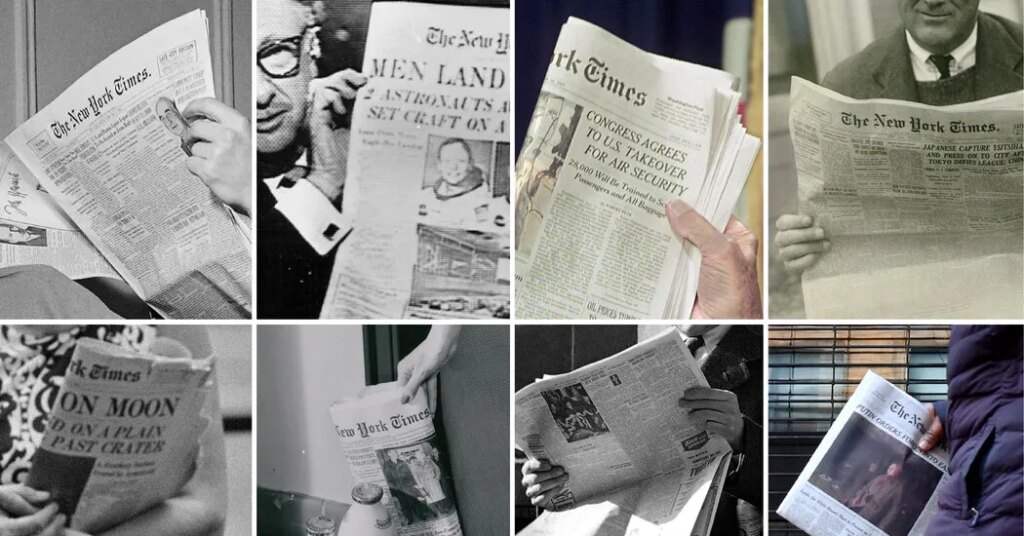
Source photographs, from top left to right: Eric Schwab/AFP, via Getty Images; CBS, via Getty Images; Stephen Jaffe/AFP, via Getty Images; The New York Times Photo Archives; Michael Evans/The New York Times; Angela Weiss/AFP, via Getty Images; Alexi Rosenfeld/Getty Images; Rae Russel/Getty Images; Bettmann/Getty Images; Victor Llorente for The New York Times; Eddie Hausner/The New York Times.
A.G. Sulzberger is the publisher of The New York Times and the chairman of The New York Times Company. He is the sixth member of the Ochs-Sulzberger family to lead the company since it was purchased in 1896.
The Times is committed to publishing a diversity of letters to the editor. We’d like to hear what you think about this or any of our articles. Here are some tips. And here’s our email: [email protected].
Follow the New York Times Opinion section on Facebook, Instagram, TikTok, Bluesky, WhatsApp and Threads.
The post So You Want to Publish a Newspaper appeared first on New York Times.