After a fire destroyed her home in Philadelphia, Aquitia Harley moved to Maryland to stay with friends temporarily. The divorced mother of four later bounced around hotels before she was able to get into a shelter in Prince George’s County.
Harley said she had many fears and faced a lot of unknowns moving into the Shepherd’s Cove shelter with her two younger, autistic children, one of whom is nonverbal.
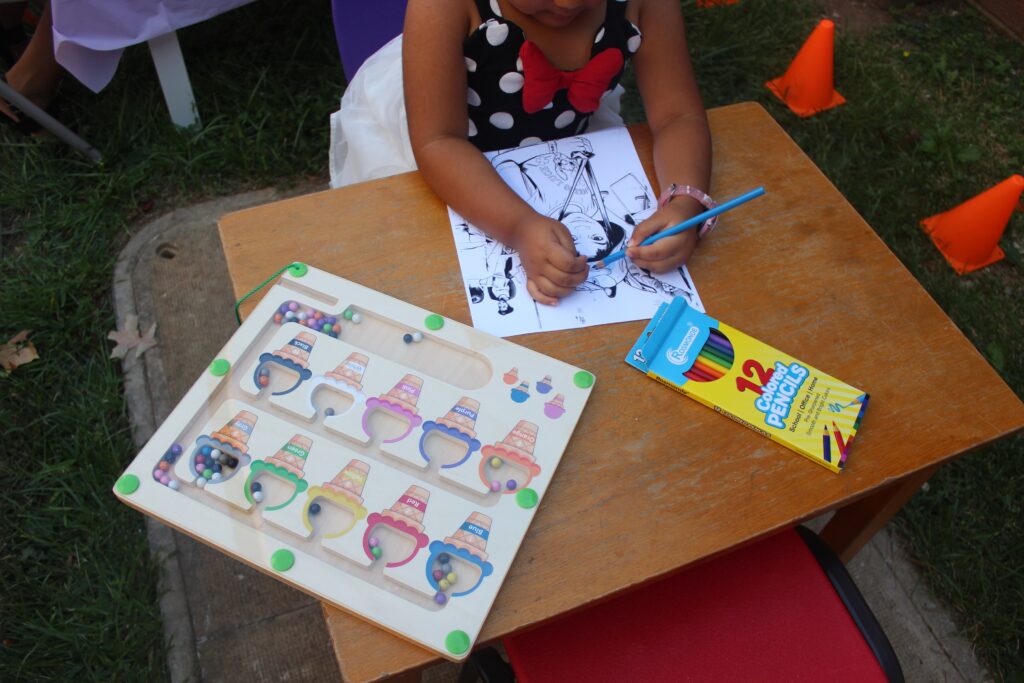
Then she got connected with the Playtime Project, a local organization that uses structured play and other programs to try to help children from unhoused families briefly escape that reality.
“Being in a shelter is scary enough for kids,” Harley said. “To have a program like [the Playtime Project], it kind of allowed the kids to really be kids.”
After participating in the program the year the family was at the shelter, Harley said her 9-year-old daughter is more confident socializing with other kids and her 4-year-old son also is more engaging and able to focus on activities for prolonged periods of time.
For two decades, the Playtime Project has worked with families experiencing housing insecurity or homelessness with one aim: to give children a chance to play. They have worked out of shelters, schools and community centers.
Now, the organization finally has a home of its own. Earlier this month, the organization opened its first stand-alone site: a 800-square-foot space at Beltway Plaza in Greenbelt.
Jamila Larson started the organization in 2003 after she toured a shelter in the District where she saw half-dressed children in a room filled with rows of metal bunk beds, sheets for doors and no stepstools in the bathrooms to help children reach the sink.
There also were no signs of toys, Larson recalled.
The sight of the children and the environment they were in was disorienting, Larson said. But the inability to play and find a sense of joy even in grim surroundings was also something she couldn’t stand for.
Larson didn’t want to just donate toys for the children. She and other volunteers wanted to play along with them.
“We need to advocate for child-friendly spaces in shelters,” she said. “ … and then we need to not only create play spaces, but we need to staff those play spaces.”
Not only did the Playtime Project bring in stepstools — it also brought in antibacterial soap with sparkles and snacks to appease children’s growing appetites. The program put electrical covers on the outlets and had volunteer groups visit to sanitize toys.
Partnering with shelters ensured access to those with the most need. The organization also didn’t want to add a transportation barrier for families to participate in its programs, Larson added.
Being in the shelters also made it easier to alleviate parents who might just need a moment to themselves. While the kids had playtime, parents would be able to take care of other needs, such as making dinner or meeting with their caseworker on site.
In recent years, however, Larson said the organization began expanding its work outside shelters.
Larson said the idea arose while helping families at Shepherd’s Cove, where she kept hearing about people transitioning from the shelter to Franklin Park, a large apartment complex within walking distance of the Beltway Plaza.
“Those [children] were asking their mom if they could go back to the shelter to go to playtime,” Larson said. “They just kept staying on my mind. They’re not kids you can easily just forget about.”
To help serve the families, the organization started hosting pop-up play programs at Beltway Plaza about five years ago.
Ivory Williams, 34, a mother of three, stayed at Shepherd’s Cove for six months between 2023 and 2024. There her children participated in the Playtime Project.
Williams, who transitioned to Franklin Park in 2024, reconnected with Playtime staff at Beltway Plaza at its annual back-to-school event, where she was able to get her children bookbags and school supplies. The organization also helped her furnish her new home and help her move into her apartment.
“It was just so nice,” Williams said. “Ms. Jamila and the playtime, has always been so helpful.”
Eager to help more families like Williams’s, Larson decided to open the Playtime Project’s first physical space. They looked at more than 30 sites in the Greenbelt area over three years before securing the Beltway Plaza space.
The new space includes a kitchenette to provide snacks to the children, a play kitchen and books in a reading corner with a small purple couch for children to unwind on. The space, which used to be a storage room of the mall, features one glass door and no windows except for a painted one in the kitchenette.
The site, called Playtime at the Plaza, has partnered with Greenbelt Middle School to ensure preteens and teens have a communal space.
“We believe that they’re children, too, and deserve to play and not just take care of their siblings.” Larson said. “A lot of teens’ needs go unmet.”
Greenbelt Mayor Emmett Jordan said finding more ways to keep young people engaged is important.
“This mall is a real hub for young people, so having the programming here and also having some support for families, it makes a big difference,” Jordan said.
The post How a storage closet became a needed play space for kids in Maryland appeared first on Washington Post.