One of the worst things about our public discourse is that parts of it are often unspeakable. I can’t write some of its most profane terms in this newspaper, yet they make up much of this era’s lingua franca. And slang, especially the racist and misogynist stuff, has power to change those who use it: If you learn enough to understand the jargon (incel, looks-maxxing, simp), it may have already begun altering your mind.
The playwright Else Went has written much of her sometimes astonishing, nearly three-hour play “Degenerates” in this new lingo. After a frightening prologue — we sit in the dark for long minutes, listening to a man call a suicide hotline — the breathtaking first act unfolds among incels in an audio-only Discord chat.
The main contributors to the conversation are the fragile Kemp (Tyler Nowell Felix), whose voice we recognize from the desperate hotline call; the casually cruel shut-in Target (Christopher Dylan White), and the chat’s rabid leader, Miller (Zachary Desmond). The Discord users are lonely, but they find a kind of ecstasy in describing women as sheeplike femoids — a term for women that refigures them as subhuman — and insisting on the permanence of their own abjection. (To be “hope-pilled” is sneered at as “cope.”)
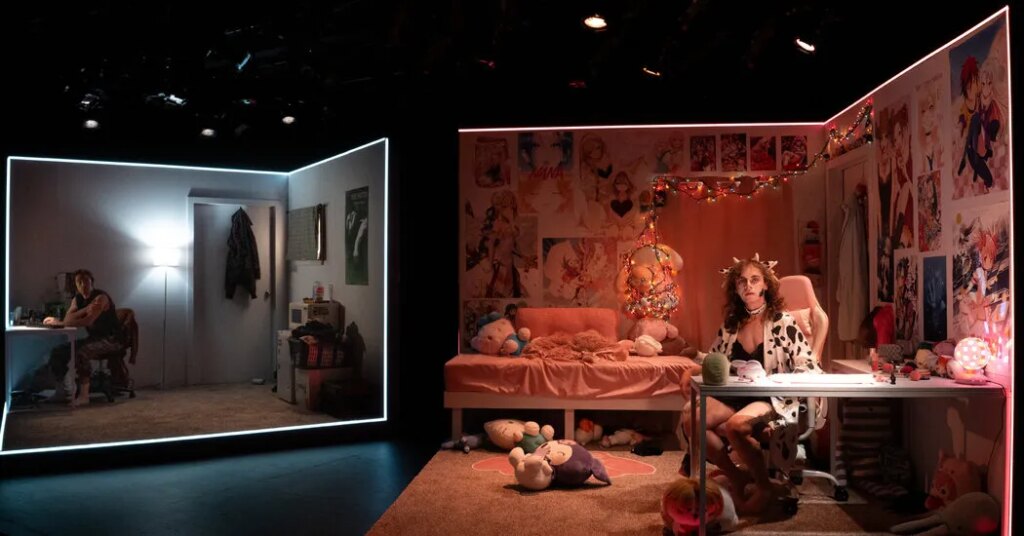
The small upstairs theater at Playwrights Horizons has been divided by the set designer Mikiko Suzuki MacAdams: on the left side, Miller’s room (microwave, dirty clothes, the Smiths poster); on the right, Target’s room (manga art, plushies, gaming chair). Kemp and other figures in the Discord are mainly heard, not seen.
The long-ebbing chill of the prologue sets the temperature, not to mention the life-or-death stakes, and it takes a long time for the show to warm back up. But somehow the play is, despite its horrors, a comedy. Punctuating the welter of male voices, an offstage woman (Olivia Rose Barresi) reads stage directions with droll disdain. “Miller burns his mouth on his Hot Pocket,” the voice says. (Watching Miller try and fail to eat is one of the play’s forms of sport.)
And Went finds other ways to make us laugh. For instance, Miller is irate that left-wing women blame male virgins for the incels’ inability to have relationships: “Supply is dwindling and I’m the starving class! So if you’re such a woke communist, why don’t you prioritize the collective and distribute some resources?” he shouts. “You just say things so clearly,” marvels Kemp’s disembodied voice. “Just data and theory,” Miller says, shaking his head sadly. “Nobody reads theory anymore.”
Went is curious about what might happen to a hateful (and self-hating) community that is offered love. So into this heated agar, Went pipettes a potential romance and a gender transition. It turns out that not all the men in the group are incels, nor are the incels all men. Target and Miller’s terrified desire for contact eventually spills over the barriers the two frightened misanthropes have built. We see them finding various kinds of gratification, alone and together. (The staging of this can be graphic.)
It was only in the less torrential third act that I wondered if there was a little too much “cope” in the plot itself. Target manages to shift from blithe nastiness to a cracked-open kindness that I think slips into wishful thinking. But even as Miller screamed invective, I believed the fantasy anyway: The extraordinary White imbues Target with a beautiful, faraway, not-quite-thereness, which in turn creates a paradoxical intensity onstage.
The show’s director, Emma Rosa Went, is married to the playwright, and there’s a sense of family mission in their work. Last year the Wents staged, with some of the same cast, their epic high school drama “Initiative,” which also dealt with young people raised in a world full of dangerous online portals. The Wents see liberation in some aspects of the internet — Kemp and Target find a way to communicate other than the Discord, for instance — but the show is also frank about the web’s nihilist strain of death-worship.
This type of worst-case generational portrait is a proper topic, maybe the topic, of narrative art. I was reminded several times of Anthony Burgess’s “A Clockwork Orange,” particularly the nausea I always feel at its ultraviolence. It’s an interesting coincidence, too, that Desmond, superb here, was terrific earlier this year as the title character of “Ivanov,” Chekhov’s 1887 portrait of a “superfluous” Russian man whose untreated depression harms everyone around him. (The loneliness crisis isn’t new.)
Else Went has a sure touch for dialogue and event, particularly across extremely long scenes; she has a precise ear for the sadness under the bluster. And she’s also courageous — if I found it difficult to bear “Degenerates,” it must have felt hellish to write. It’s a strange play to recommend because it forces an audience to listen to ugly and violent language and then to somehow find compassion for its speakers. But this is the world as it is! Logging off cannot be our answer.
(If you are having thoughts of suicide, call or text 988 to reach the 988 Suicide and Crisis Lifeline or go to SpeakingOfSuicide.com/resources for a list of additional resources.)
Degenerates Through Oct. 18 at Playwrights Horizons, Manhattan; playwrightshorizons.org. Running time: 2 hours 50 minutes.
The post ‘Degenerates’ Review: The Longing Beneath the Hate and Self-Hate appeared first on New York Times.