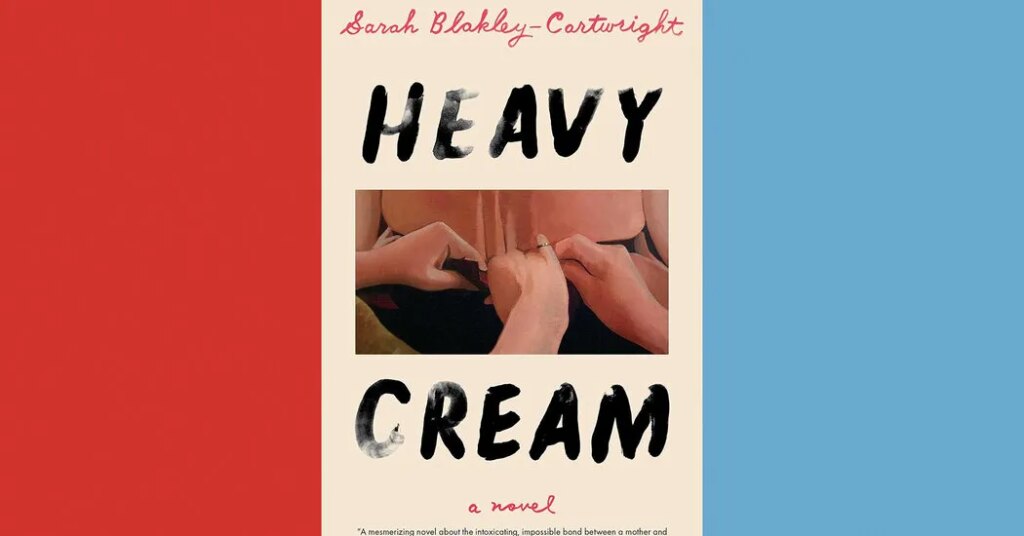
HEAVY CREAM, by Sarah Blakley-Cartwright
When the painter Alice Neel’s daughter Isabetta was 18 months old, her father took her away from Neel in New York to live in Cuba. Though Neel was so distraught she attempted suicide, she never tried to bring her back to the United States. “I loved Isabetta, of course I did,” Neel later said. “But I wanted to paint.”
In Sarah Blakley-Cartwright’s new novel, “Heavy Cream,” 16-year-old Gerry, freshly abandoned by her own mother, Helene, considers the story after attending an exhibition of Neel’s work. “She had needed to be free of constraints in order for these paintings to exist. I wondered what, if anything, would exist because I’d given up my mother,” Blakley-Cartwright writes. “Because my mother had parted ways with me.”
Like her earlier novel “Alice Sadie Celine,” “Heavy Cream” explores the enmeshment of mothers and daughters, the promises and pain that thicken and curdle between them over time. It is a dazzling, unconventional coming-of-age story that charts, with precision and humor, the many ways to be a woman.
Gerry and her mother live on warm soda, 7-Eleven sandwiches and Helene’s whims as they travel across the American West in an old Mitsubishi Diamante. Helene runs red lights, says whatever comes into her head and pulls Gerry out of class “at odd hours for no reason other than having missed me.”
Helene’s mental health diagnosis is never revealed, but she hallucinates “bugs crawling on her scalp” and is prone to bursts of mania and depression. In the dizzying moments when she becomes venomous toward her daughter, Gerry braces for impact, then reaches for tenderness, as though “my mother’s happiness was a firefly I’d tasked myself with taking into custody.”
After meeting an Australian stranger in a motel Jacuzzi in San Diego — never mind that he checks out before Helene can get his number — Helene buys a ticket to Melbourne and sends Gerry to her friend Bonnie’s house in Connecticut for “a few days” of fuzzy socks and “The Bachelor” reruns. After three weeks, Helene stops answering her phone; and when it’s clear she isn’t coming back, Bonnie sends Gerry to New York to live under the care of Helene’s estranged artist sister, Nell. At an art party Gerry meets Finley, a wealthy, widowed socialite who pays for her to attend an elite high school.
Gerry is perceptive and chameleonic in the way some neglected children learn to be, attempting to please each of her surrogate mothers as they try to shape her into their own image. She jots down “a compendium of conduct” in a Hello Kitty notepad as part of her “identity shopping spree,” Goldilocks-ing through the worlds of suburban comfort, downtown bohemian cool and Upper East Side privilege.
But Helene isn’t the bear about to walk in the door; she’s the empty house.
If her presence once clouded Gerry’s life, it’s her absence that defines it. Blakley-Cartwright tactfully charts the girl’s complex loyalties as she decides whether to defend or reject her mother, finding the weight of shame and obligation even heavier than the crushing codependency once was. And as the reader learns more about Helene, Blakley-Cartwright poses thorny questions of motherhood: Is living life on your own terms — not for the sake of art, but purely for oneself — defensible?
At times, the three surrogate mothers lean toward caricature. Nell canvasses for Zohran Mamdani and carries a squeeze bottle of oat milk in her purse; Finley hires Gerry a private cotillion instructor; Bonnie frequents Starbucks drive-throughs and wears blinking deer antlers on Christmas.
Occasionally Blakley-Cartwright passes up an opportunity to more deeply excavate Gerry’s feelings in favor of humor, her numbness making it hard for the stakes to reach their full gravity.
Gerry worries she has her mother’s mania, or will become what Helene hates most: conventional. It’s tempting to believe that access to upper echelons of cultural and financial privilege will save her. But the reader knows something Gerry doesn’t, which is that this is only the first chapter of her becoming.
HEAVY CREAM | By Sarah Blakley-Cartwright | Simon & Schuster | 290 pp. | $28
The post Abandoned by Her Mother at 16, She Goes Out in Search of a New One appeared first on New York Times.