Oanh Ngo Usadi is the author of the memoir “Of Monkey Bridges and Banh Mi Sandwiches: From Sai Gon to Texas.”
As summer crowds wane in September, many U.S. cities see “restaurant week” launched by businesses hoping to keep the good times going. Even with the enticement of reduced menu prices, many diners won’t choose a place to eat until they have checked the online reviews — the modern-day gustatory oracle.
But when it comes to ethnic restaurants, there’s a more trusted judge: someone who grew up with the food.
Born and raised in Vietnam, I often find myself the arbiter of Vietnamese restaurants among friends. They say they want a taste of real Vietnamese cooking, untouched by Americanization. Their question isn’t necessarily whether the food is good, but whether it’s authentic — a replica of some imagined ideal of the dish back in Vietnam.
I don’t have a simple answer. For starters, rare is the country that is just one big kitchen with one cuisine. Most have regions, each with its own local ingredients, traditions and tastes.
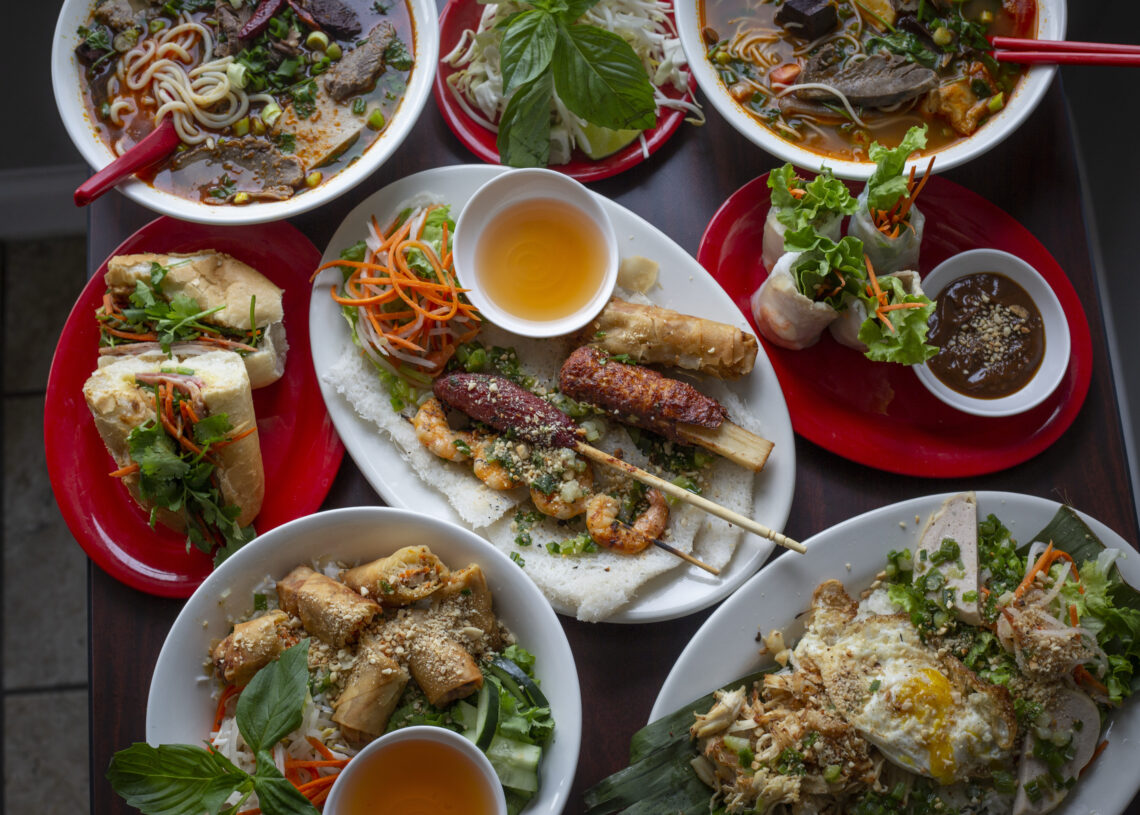
Consider pho, a dish that friends often ask me about. Vietnam’s iconic beef noodle soup varies widely, from Hanoi’s simpler version, with fewer garnishes, to Saigon’s sweeter, more flavorful take, served with a plateful of fresh herbs and condiments. And in between, from North to South, there are countless variations. There is no single “authentic” version of pho.
Then there’s the inevitable change when a cuisine migrates. Ingredients that were once readily available may be hard to find. Cooks have to substitute and improvise. A dish rarely stays the same in its new place. Sometimes, a new ingredient can even transform an entire food tradition. Tomatoes, native to the Americas, became such a part of Italian cooking that it’s hard to imagine the cuisine without them. Cacao and vanilla, also from the Americas, helped reshape European sweets and baking.
And sometimes the changes have less to do with what cooks can find than with what diners want. Vietnamese food is known for its generous use of fresh herbs. These herbs add fragrance and flavor, though some may not be especially appealing to those who didn’t grow up with them. Sawtooth herb, with its serrated edges, and fish mint, which actually smells like fish, can be a challenge. Basil and cilantro, which restaurants often substitute, may be more enjoyable.
Though every group of newcomers has ultimately added to America’s table, the food they bring is not usually love at first bite — or smell. Many immigrant children know what it’s like to have food that other kids find weird. Maybe you cover your lunch at school, as I did, and hope nobody asks, “What’s that?”
But at some point, someone asks for a taste. Maybe they like it and even ask for another bite. Eventually, the initial awkward question might even give way to “Where can I get this?”
Some immigrants in entrepreneurial America decide to open restaurants, adapting old recipes to new ingredients and tastes. Often, those first ethnic restaurants don’t do especially well. My parents’ banh mi sandwich shop in a small Texas town in the 1980s was no exception. But restaurants like theirs helped make what was once unfamiliar become familiar.
And once a cuisine becomes familiar, another question follows: “Wouldn’t ‘this’ taste good with ‘that’?”
In any diverse country, the mash-up of cuisines is almost inevitable. But in America, successive waves of immigrants have taken it to another level, including Tex-Mex fajitas, Korean kimchi burgers, Greek gyro pizza and Minnesota sushi. Some combinations are self-explanatory; others need a little explaining. Minnesota sushi is a dill pickle wrapped in cream cheese and ham.
Along the Gulf Coast, an influx of Vietnamese refugees beginning in the 1970s led to spicy crawfish cooked with butter and lemongrass, boudin egg rolls — Cajun sausage tucked inside a crisp egg-roll wrapper — and the birth of Viet-Cajun cuisine.
The possibilities for fusion are endless, and the boundaries between cuisines are becoming harder to discern.
Maybe that’s how the circle closes. When people go from asking “What’s that?” to “What’s the authentic version?,” the food has become part of the American palate, and the people who brought it have crossed deeper into American life.
Assimilation can sometimes seem like a shorthand for loss, of culture and customs. But food tells a truer story of gain, one that extends beyond cuisine. You can bring something with you, change it, mix it with something else and end up with something entirely new — and entirely American.
I still can’t give my friends a short answer about what’s authentic Vietnamese food. But here’s a tell to look for when choosing a pho restaurant: A number in the name is pretty promising. Using an address, significant year or lucky number is a naming practice common in Vietnam and likely to appeal to Vietnamese patrons. “Authentic” in the name? Maybe not so much.
The post When an ethnic food has officially entered the American palate appeared first on Washington Post.