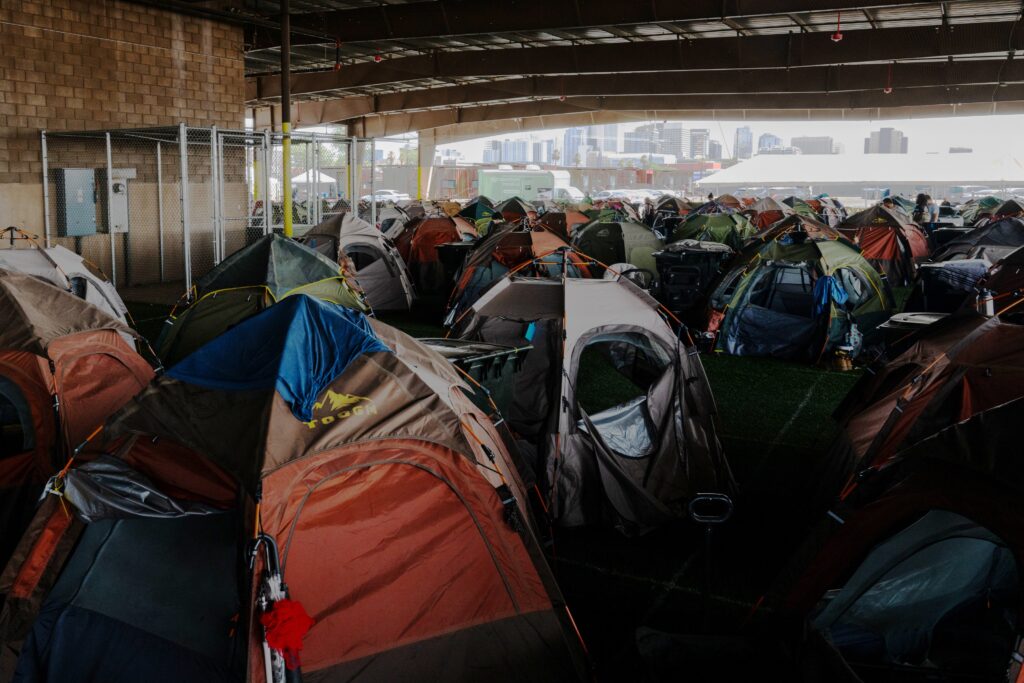
PHOENIX — The 200 multicolored tents are set up in rows, each pitched inside a 10-by-10-foot square, spaced less than an arm’s length from the next.
It costs Phoenix about $6.5 million annually — $27,000 per structure — to operate the Safe Outdoor Space site, including providing meals, showers, security and an air-conditioned recreation room for about 300 people, some of whom come from outside the city.
The space is an example of how Phoenix and nearly a dozen other U.S. cities have sharply increased spending on homelessness in recent years, a Washington Post review found. The site was created around the same time Phoenix and other cities were clearing unsanctioned tent encampments after the U.S. Supreme Court and other courts ruled that officials could ban homeless people from sleeping outside.
Phoenix leaders say boosting homeless spending — which grew roughly fivefold between 2020 and 2025 — helps keep people off the streets. Despite the increased spending, homelessness has continued to rise in Phoenix and nationwide, with the U.S. homeless population reaching 745,000 last year, according to the Department of Housing and Urban Development — up from 580,000 in 2020. Phoenix’s homeless population rose more slowly, from 6,900 in 2021 to 7,330 last year.
Residents here described how quickly life’s obstacles — illness, family disputes, evictions — can push someone into homelessness. And once they are on the streets or in a shelter, they say, the nation’s affordable housing crisis makes it harder than ever to find a home.
The Post reviewed the budgets of 12 U.S. cities with large homeless populations and found a 75 percent jump in spending on homeless services over the past five years — on top of millions in capital projects fueled by the Biden administration’s pandemic-era American Rescue Plan.
The increases have fueled debate over whether cities are spending effectively, with conservatives — including some Trump administration officials — arguing that money devoted to shelters would be better spent on psychiatric care, substance-use treatment and other efforts aimed at the root causes of homelessness. Homelessness advocates say the money spent on shelters is saving countless lives by shielding people from heat, cold and filth. But the advocates believe even more needs to be done to keep people in their homes while also broadening access to job training and social service programs.
“There is a hole in the ship, and we are bailing it as fast as we can, but no one is patching the hole,” said Tom Murphy, a vice president at the National Alliance to End Homelessness. “Until we are making investments to actually keep people in their homes … it’s incomplete to simply analyze how much we are spending on people already homeless.”
Devon Kurtz, director of public safety policy at the Cicero Institute, a conservative think tank that is helping shape the Trump administration’s response to homelessness, said leaders are spending money on “the wrong interventions.” Cities should prioritize treatment for drug addiction and mental health issues, and criminal justice interventions, he said.
“All of this is a perfect storm that has led to us incinerating several billion dollars, all the while we are seeing the human suffering get much worse,” he said.
‘This is not perfect’
When Justin Tellez started living in a tent at Phoenix’s Safe Outdoor Space, he expected his stay to be brief. Eighteen months later, he is still there.
Tellez, 22, has epilepsy and uses a wheelchair. He has been homeless since aging out of the foster care system at 18 and is one of many people at the site with health problems.
Tellez said it sometimes feels like the nation’s social safety-net programs have let him down.
Medicaid covers his medical bills, but Tellez said he has twice been denied Social Security disability benefits due to insufficient documentation about his medical condition.
“I keep trying to get it, but I can’t get enough info for them,” Tellez said.
He wonders whether the money being spent to operate the site could be used to help people in other ways. The tents are hot — a metal overhang blocks some of the worst effects of Arizona’s sweltering heat, but the thin layer of artificial turf below does little to cool the ground. There’s little privacy, and others in the outdoor space can be rowdy.
Tellez says he wants more assistance finding permanent housing but still appreciates having a tent. “Sometimes it’s uncomfortable, but we learn to suck it up,” he said.
Amy Schwabenlender, executive director of Keys to Change, a homeless-services provider, said Phoenix has been “behind on housing for a long time.”
“We don’t have enough of anything,” she said, adding that for every homeless person in Phoenix who finds permanent housing, two others lose their homes. “We don’t have enough prevention. We don’t have enough shelter. We don’t have enough housing.”
Schwabenlender and other advocates say finding permanent housing for those in need is especially hard in Phoenix, the nation’s fifth-most populous city.
Arizona’s historically conservative, anti-tax politics have limited tax revenue and the support for the public-housing investments made by some other large cities. Phoenix public-housing programs serve about 35,000 people, less than half the number served in similarly sized Philadelphia.
Despite rampant development in recent decades, a recent study by the Morrison Institute for Public Policy found that Arizona has a shortage of 270,000 homes. And there are only about 24 available homes for every 100 low-income renters in the state, according to the study.
Demand for housing assistance exceeds the available aid. Phoenix has not accepted applicants for Section 8 housing vouchers since 2023, when 43,000 people applied for assistance. Nearly all of them are still on waiting lists, local officials said.
Those who do get government assistance are stretched thin financially, advocates said, noting the average monthly Social Security disability payment in Phoenix is about $1,600. The average monthly rent for a one-bedroom apartment is about $1,200, according to Zillow.
Phoenix spent about $42 million — more than 10 percent of its American Rescue Plan funds — expanding shelters and creating facilities for homeless residents. The city also created an Office of Homeless Solutions to coordinate its response. And in its latest budget, the Phoenix City Council approved nearly $10 million for affordable housing production and emergency financial assistance for residents facing housing instability.
The Safe Outdoor Space was one of the city’s largest investments.
Rachel Milne, director of the Office of Homeless Solutions, said people usually stay for about two months, though some, like Tellez, are there much longer. The city also spent about $5 million on the land, tents and 40 air-conditioned shipping containers known as the X-Wing, where medically vulnerable residents stay. Residents pass through a security checkpoint to enter the site. They may bring pets, and couples can share tents.
“This is not perfect,” Milne said, “but it’s helping individuals every single day.”
Like Tellez, several residents expressed gratitude for the Safe Outdoor Space. Yet many said they never imagined it would be so difficult to find permanent housing after a health crisis or family tragedy left them homeless.
Andrew Wakeham, 32, pushed his mother in a wheelchair from a Phoenix suburb to the Safe Outdoor Space this summer in hopes of finding a place to live. The trip took several days. They became homeless about three years ago, when his father left and the money he earned as a laborer was not enough to cover rent for himself and his mother, who has kidney disease.
His mother has a bed in the X-Wing. Wakeham and his Australian cattle dog, Shadow, who is disabled and rides in a grocery cart, stay in a tent.
“It’s just hotter than hell and I wake up in a pool of sweat and [Shadow] will be breathing on me,” Wakeham said. “But I can shower every day and get clean, and the dog can stay with me, 24/7.”
Wakeham said he’s looking for work as a laborer and is waiting for a promised job fair at the site.
Irma Mendoza, 49, has been staying at the outdoor space since February. Mendoza has congestive heart failure and has had five heart attacks over the past five years. Her health problems left her unable to work, and she and her husband could no longer afford their apartment. They now share a room in the X-Wing.
She’s hoping Social Security disability benefits will help them get back into an apartment. “I am trying to get out of here,” she said. “I want my own space.”
‘A structural problem’
Phoenix is not alone. Other cities have also sharply increased homelessness spending over the past decade, even as their homeless populations grew.
New York City, which has the nation’s largest homeless population and the largest homeless services budget, allocated about $1.4 billion for its homeless services department in fiscal year 2016. That budget has increased almost every year since, peaking at just under $4 billion in 2025. At the same time, the homeless population grew from about 73,500 to more than 125,000, according to Department of Housing and Urban Development data.
San Francisco has made similar investments, more than doubling spending on its department of homelessness and supportive housing over the past decade. Yet the city’s homeless population grew from just under 7,000 to more than 8,600 during the same period.
Phoenix has increased spending to operate shelters and facilities after pandemic-era federal aid ran out. This spring, the Phoenix City Council allocated $18 million in local funds to maintain its expanded shelter network, including the Safe Outdoor Space.
“We spent a huge amount of the [American Rescue Plan] money building up resources,” Milne said. “We needed to do that and now we are spending a lot more on the operations. … We didn’t use to have places for people to go.”
Phoenix now directly funds about 1,600 shelter beds, up from about 200 in 2020. Officials said the expansion helped the city reach a milestone this year: About 55 percent of its homeless residents were sheltered.
Not everyone is convinced the investments are sustainable, though. Joel Coplin, 71, is one of several business owners who sued the city in 2022 over a 15-block outdoor homeless encampment known as “The Zone,” where drug use, violence and property damage were rampant. The area became a national symbol of cities’ failure to address homelessness.
A judge eventually ordered Phoenix leaders to clean up the encampment.
“People came here because it became a good thing to be homeless,” said Coplin, who owns an art gallery in the area. Since then, Coplin said, the city “is trying awfully hard.” Officials have “put their money where their mouth is,” he added, though he questions whether the approach will last.
City and county leaders are hopeful increased spending on homelessness services can reduce heat-related deaths and illnesses. Homeless people account for about half of all heat-related deaths in and around Phoenix. In both 2023 and 2024, there were more than 600 such deaths, an unusually high number. Last year, the number dropped to 430.
Nicole Newhouse, executive director of the Arizona Housing Coalition, said since the pandemic, there has been “rapid-fire” spending to create shelter space for people living on the streets. But Newhouse said the spending “has not been coordinated” with housing and social service programs that prevent people from becoming homeless.
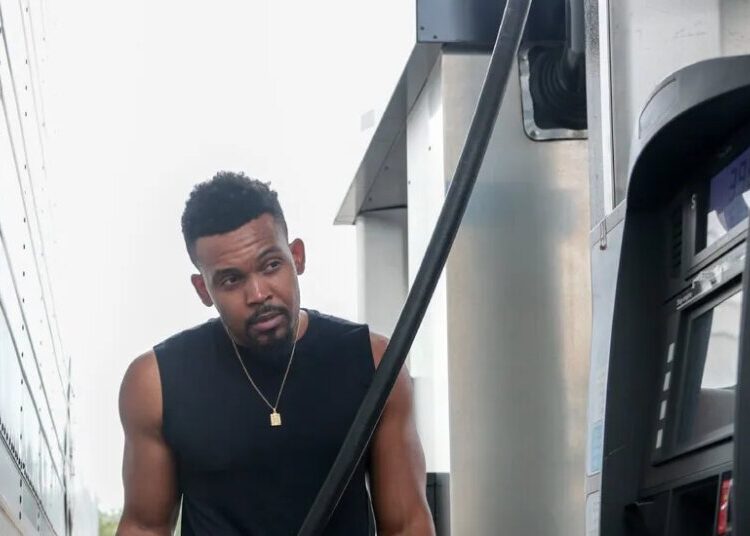
“We have a structural problem in the system,” Newhouse said. “Phoenix has done an exceptional job responding to homelessness,” she added, but the agencies responsible for prevention, affordable housing, health care and social services remain poorly coordinated.
Phoenix City Council member Anna Hernandez, a progressive Democrat who pushed to increase spending on homeless services, agreed that better coordination is needed.
Yet Hernandez said federal policy changes are straining city resources in ways she believes will worsen homelessness. She said more than 400,000 Arizonans lost Supplemental Nutrition Assistance Program, or SNAP, benefits over the past 14 months because of federal policy changes.
“Now people are left having to choose between paying for rent and paying for food,” Hernandez said.
Kurtz, from the Cicero Institute, said his organization wants to help people “who fall on hard times.” But money would be better spent on “other interventions,” he said, including supervision by corrections departments for homeless people with criminal records and placement in residential treatment programs.
“We have to look at how much of the homelessness crisis is being contributed to by other systems that we then label as homelessness,” Kurtz said, adding that he believes some in the shelter system don’t want assistance finding jobs or permanent housing. “The thinking that you can only reduce the homeless population through homeless services is foolish.”
As night fell on a recent evening in Phoenix, John Solano walked into an overnight shelter about three blocks from the Safe Outdoor Space. The city recently expanded the shelter, which provides sleeping spaces for about 900 people.
As he passed others who were preparing to sleep on the streets, Solano, 70, said he was relieved to have a bed that night.
He’s applied for an apartment in a senior housing complex. But he had been told the wait could be another year or two.
The post This U.S. city is spending 5 times as much on homelessness. Is it too little or too much? appeared first on Washington Post.