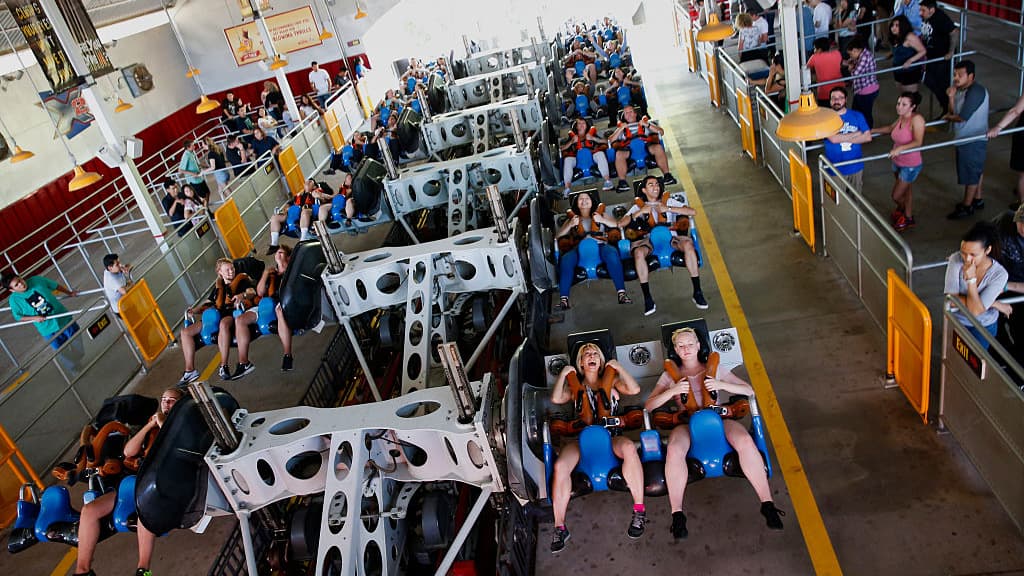
The Six Flags theme park company announced on Tuesday that it would permanently close the X2 roller coaster at its Magic Mountain park in Valencia, Calif., following allegations of serious brain injuries linked to the ride.
The closure has renewed questions about how the intense forces generated by extreme roller coasters can affect the brain. Experts told TIME that abrupt acceleration, twisting, and changes in direction can stretch brain tissue and blood vessels, potentially increasing the risk of concussions and bleeding.
Three lawsuits filed in late September allege that riders suffered brain injuries after riding X2, and attorneys told CNN that more than 100 people have contacted them with similar allegations. The suits came in the wake of a CNN investigation published in August about the ride’s long history of incidents, including at least two deaths.
“After almost 20 years, we have decided to permanently retire X2,” wrote Magic Mountain president Brian Oerding in a blog post. “While X2 consistently passed a multitude of safety tests, we have decided to close the ride because we believe it’s the right thing to do. Ride safety is a cornerstone of our business, and when we see guest confidence affected, we take it seriously.”
X2 was a two-minute thrill ride that reached a top speed of 76 miles per hour and opened in 2002, according to a Six Flags webpage about X2, which is no longer online. In July 2026, two women—six days apart—were hospitalized after riding X2, CNN reported. Both suffered from a subdural hematoma, or bleeding on the brain.
The first woman, who was 40, had emergency surgery and was unconscious for two weeks. Upon awakening, she had to relearn how to walk and talk. She is “very lucky to be alive,” one of her surgeons told CNN in August. The second woman, 26, underwent similar surgery and is still in a coma, the news outlet reports. On July 12, Six Flags closed X2 indefinitely—a closure made permanent at the end of September.
Billed by Six Flags as a “fifth-dimension wing roller coaster,” X2 ran along 3,610 feet of track. Its seats did not sit directly on the track. Rather they were mounted on wings on either side of the track—essentially suspending riders in space—and rotated 360 degrees. “Your body will be flipping around the entire time,” the now-removed Six Flags website says. “Quite simply, you will be spun into another dimension.” (Earlier this month, in response to a request from TIME for more details about the ride, a spokesperson for Six Flags said only that “the ride remains closed at this time.”)
The troubled history of roller coasters
“You are supposed to have a good time,” says Brian Avery, a faculty member at the University of Florida who teaches legal and risk management in the attractions, sport, and entertainment industries. (He does not have ties to Six Flags.) “You are supposed to walk away with enjoyment and a great experience. You aren’t supposed to leave in an ambulance or potentially dead. This is a serious problem that the industry needs to contend with.”
X2 is not the only American roller coaster that has caused concern—and alleged injury. In 1895, developers opened what was named the Flip Flap Railway—a short, single stretch of wooden track notable for a tight, tear-shaped loop in the middle—at Captain Paul Boyton’s Sea Lion Park in New York. Given the narrowness of the loop, the ride has historically been said to have produced a crushing amount of G-forces—or the pressure a rider feels relative to Earth’s gravity.
Designers of early roller coasters like this “didn’t know from a ride’s dynamics perspective and the tolerances on a person’s body,” says Avery, “and unfortunately, a lot of people were injured as a result.” By 1902, the ride had closed.
Wooden roller coasters don’t have anywhere near the flexibility of steel roller coasters. First introduced in 1959, and throughout the second half of the 20th century, a “roller coaster arms race” took off, Avery says, with designers building tracks “taller, faster, more extreme.”
X2 was part of this boom, going into operation in 2002 and undergoing an upgrade in 2008, during which the rotating seats were introduced. Brain-injury allegations linked to the roller coaster date back to at least 2009 when, according to the CNN investigation, a 62-year-old man alleged he suffered a brain bleed as a result of the ride, recovering after surgery. The next year, a 28-year-old woman died on X2 when a congenital vascular abnormality in her brain ruptured after the ride, medical experts suspected.
What roller coasters can do to the brain
The shearing, tearing, and torquing forces at work on extreme roller coasters affect the brain, experts say.
“Brain tissue has very low rigidity (similar to jello), so it is prone to shearing and twisting during head motion,” wrote Lyndia Wu, an associate professor in the department of mechanical engineering at the University of British Columbia who studies the mechanics of brain injuries, in an email to TIME. “The tissue shearing and twisting can be amplified when the head rapidly accelerates or decelerates, such as when it moves in one direction and then abruptly whips in another during a roller-coaster turn, or when it strikes a headrest or another object. Blood vessels can also be experiencing stretching and twisting, posing risks of rupture and bleeding.”
The high levels of acceleration the coasters generate are a complicating factor. The head, which moves and swivels throughout a ride, may take more of a pounding than, say, the relatively stationary torso. G-force calculations, Wu says, only apply to “whole body accelerations that can be measured [or] estimated at the seat level when the roller coaster is designed. The head can be experiencing different acceleration profiles during a ride, which bring about additional brain injury risk considerations.”
While these forces can be damaging when an adult is in the coaster seat, they can do even more harm when the rider is a child. “Roller coasters are inherently higher risk in children than adults,” says Dr. Michael McDowell, associate professor of neurosurgery at Penn State Hershey Medical Center and Penn State Children’s Hospital, and a co-author of a 2025 paper in the American Journal of Emergency Medicine on roller coaster injuries in minors. “Children are simply physically smaller on average and the forces they are subjected to are higher relative to their body mass. [In addition], the head is disproportionately larger in a child than an adult. The head and neck are functionally a bowling ball on a toothpick. A high energy turn on a roller coaster can snap the head in a direction which stretches the neck beyond the normal limits.”
Dr. James Mooney, assistant clinical professor of neurosurgery at Virginia Commonwealth University and another author of the 2025 paper, adds that “concussions have been documented in children after roller coaster rides, including in our study.”
Even if it were possible to model and correct for all of these factors perfectly when a roller coaster is being designed, not every set of metrics applies to every rider equally. “It could be just how you sit in a seat, how you’re striking your head on the back of the seat,” says Avery. “It could be the height that you are in relation to a piece of the seat.”
The question of how to make roller coasters safer
What this means for the safety of roller coasters is uncertain. Wu suggests that research being conducted on brain injury in sports such as football may offer some “transferrable considerations” that can help in making roller coaster rides safer. “More research needs to be done to investigate possible head accelerations during rides beyond the seat acceleration levels, and the effect of factors such as neck strength [and] control to stabilize the head during rides, as well as possible impact of the head with the headrest.”
At the very least, operators of other roller coasters around the world can—and should—see the X2 as a cautionary tale. Even before Six Flags shuttered the ride, Avery thinks the damage had already been done. “I would have a complete review before this thing is reopened to see if they can isolate the cause,” he said at the time. “If they can, and it can be corrected, fine, correct it and move forward. [But] usually, when you’ve gotten to a point where a ride has made this much noise…the ride could be tainted in the sense that the public perception of it is deemed, ‘Hey, this is not for me.’”
The post Six Flags Closes Its X2 Roller Coaster After Brain-Injury Lawsuits appeared first on TIME.