Marine plastic pollution is rampant. That’s nothing new. Plastic waste has been found in a variety of marine ecosystems, including beaches, coral reefs, and even some of the ocean’s farthest depths. While a precise measurement is difficult, it’s estimated that several million metric tons of plastic lie on the seafloor.
Scientists have been recording marine animals entangled in or consuming plastic debris for over half a century, some even proposing the term “Plastocene” (the Plastic Age) to denote the geological epoch spanning from the 1950s onward. And now researchers have discovered a new way these substances are polluting the environment: Plastic is fusing with corals.
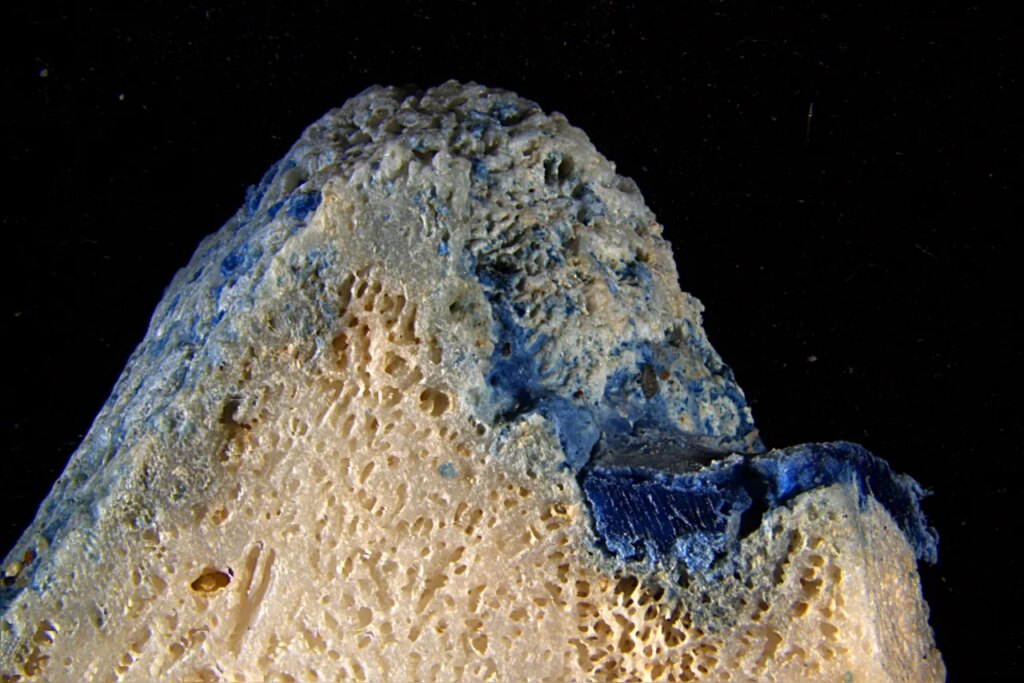
The discovery of this conglomerate—which researchers have dubbed “plasticoral”—was made during a survey of the beaches of the Ryukyu Islands in southern Japan. The scientists noticed small, brightly colored spots embedded in the white coral gravel. They collected samples from three beaches on the main island, Okinawa, and brought them to the lab where spectroscopic analysis revealed there were polymers derived from common household plastics.
Using micro-CT scans, the researchers determined that the polymers had melted into the microscopic pores in the fragments of coral skeleton, becoming so integrated that the two could no longer be separated.
This is also not the first time plastic has been found enmeshed with the natural world, though this phenomenon usually involves nonliving things like rocks. In 2019, another group of researchers found a thin layer of degraded plastic coating mussels and large algae in tide pools, which they called “plastiskin,” but this new study marks the first time plastic has been seen fused with corals.
And while coral rubble is no longer itself a living organism, even after being washed ashore, it often returns to sea later and plays an important role in coral reef ecosystems. It forms a stable foundation for new corals to settle on, and the irregular shapes make essential hiding places for small marine organisms to protect themselves from strong currents and predators.
How exactly the plasticorals may impact their living bretheren is unknown, though previous research has shown that some chemicals that can leach from common plastics inhibit coral reproduction. Other studies have found that plastic fragments can carry pathogens to corals.
Scientists are also not yet certain how the plastic is fusing with the corals. Though the temperatures of our oceans are ever increasing, they’re not quite hot enough yet to melt plastic. Ultraviolet radiation can also contribute, but the researchers consider beach bonfires to be the leading candidate.
Further investigation is needed to confirm this, but given plastic’s pervasiveness as a pollutant, it’s not unlikely that fires in even seemingly pristine areas are creating unintended fusions.
This story originally appeared in WIRED Japan and has been translated from Japanese.
The post Plastic Is Melting Onto Corals appeared first on Wired.