Driving through the Navajo Nation, you might spot one of Chip Thomas’s large-scale photo murals at an abandoned shopping center along the highway. His work has graced numerous other buildings across the sprawling reservation.
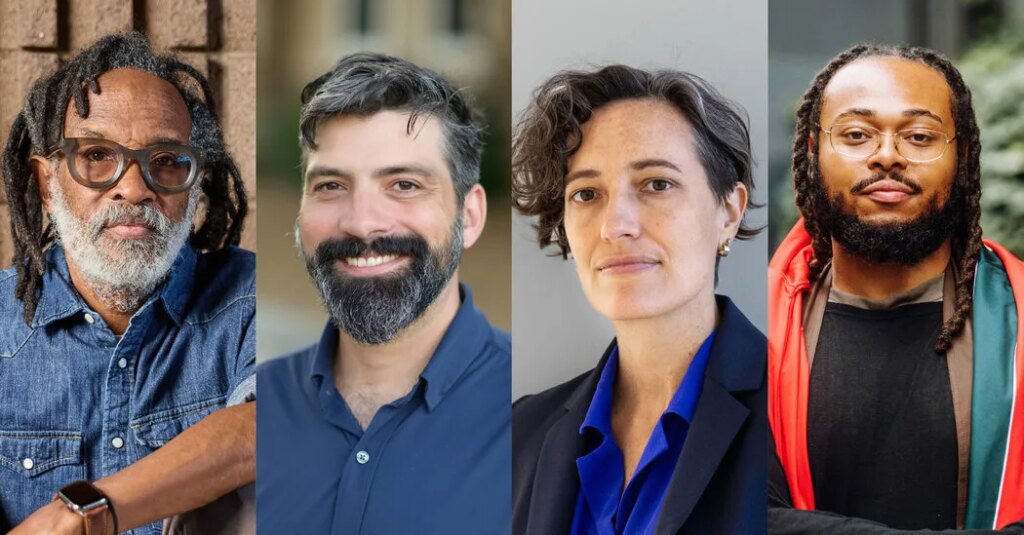
When Thomas, 69, was still in the early stages of his work, a friend told him he should get a MacArthur grant, he recalled, though he brushed off the comment at the time. On Tuesday, he received one.
Thomas along with 19 others was a recipient of the annual “genius grants” presented by the John D. and Catherine T. MacArthur Foundation across the arts, sciences and humanities. The award, recognizing “exceptional creativity” according to the foundation’s website, comes with a no-strings-attached stipend of $800,000, disbursed over five years.
The Navajo Nation, the country’s largest Native American reservation, stretches across Arizona, New Mexico and Utah. Thomas, who is not Navajo but who worked as a physician there for 36 years, centered his photographic work on the Diné, as the Navajo people call themselves. When he learned of his MacArthur selection, he said, he became emotional, wishing his parents and grandmother were still around so he could tell them.
With the foundation’s funding, he said he hoped to resurrect his Painted Desert Project, a collaborative public art campaign.
“I’m looking at a revival,” he told The New York Times. He also said that he would like to bring arts programming to students on the Navajo Nation.
Because fellows neither apply for the honor nor receive any notification they are being considered, their selection comes as a complete surprise. The foundation takes careful measures to keep its process shrouded in secrecy, including using ruses to get grantees on the phone for a private conversation.
Holly Jean Buck, an associate professor of environment and sustainability at the University at Buffalo who is among this year’s recipients, said she was under the impression that the foundation was calling to talk about climate change and energy technology: “They kind of tricked me.”
Felipe De Brigard, a professor of philosophy and of psychology and neuroscience at Duke University, said he ignored the first call he received from the foundation, thinking it was spam. When he answered the next day from a faculty retreat, the person on the other end of the line suggested that he get away from the group by telling them the call was about taxes.
“All I could think was: What did I do with my taxes?” he said, laughing.
Immanuel Wilkins, an alto jazz saxophonist and composer who also received a grant this year, said the fact that the foundation operates so undercover has “mythologized” it in the world of artists.
At 29, Wilkins is this year’s youngest recipient. And as someone still early in his career, he said he sometimes had felt pressure to prove himself.
Now, he said, “I’m just able to take risks in a different way because the MacArthur gives me the benefit of the doubt.”
Christine Sun Kim, an artist interested in the politics of sound, said her list was long when it came to ways she imagined using the grant funding. But she also was looking forward to slowing down.
Kim, who lives in Berlin, said she has been traveling a lot for work in the past two years. An exhibition surveying her oeuvre came to the Whitney Museum last year. She is also the mother of two children.
“With this, I believe that I will be able to scale back on taking opportunities or thinking about how to pay my bills as much,” Kim said, “and be able to be a little bit more of a mom with more flexibility in her life.”
The MacArthur Fellowship does not require recipients to produce anything specific with the funding, nor does it evaluate their performance during the fellowship term.
Elizabeth Ellis, a 2026 MacArthur grantee and an associate professor of history at Princeton University, said she was used to grants’ requiring a final product. At times, that mandate has felt disruptive to her while in the field.
“I’m sure you’ve heard people say, in academia, we publish or we perish,” she said, but flexible funding takes that pressure off.
Ellis said the foundation’s support felt especially meaningful after seeing the effects on her peers of cuts to federal funds from sources like the National Endowment for the Humanities (NEH) grants.
“It’s just really nice to have these opportunities to recognize and support work that can be very difficult in this moment,” she said.
The other 2026 fellows are:
Ellora Derenoncourt, a labor economist and economic historian
Kaiyu Guan, an environmental scientist
Trajal Harrell, a choreographer and dancer
Marika Holland, a climate scientist
Song Lin, an organic chemist
Layli Long Soldier, a poet
Rodney McMillian, an artist
Maaza Mengiste, a fiction writer
Ariel Ron, a historian
Kate Spradley, a forensic anthropologist
Vincent Valdez, a visual artist
Vincenzo Vitelli, a physicist
Bryan Washington, a fiction writer
Liangfang Zhang, a chemical engineer and bioengineer
The post MacArthur Foundation Announces 2026 ‘Genius Grant’ Winners appeared first on New York Times.