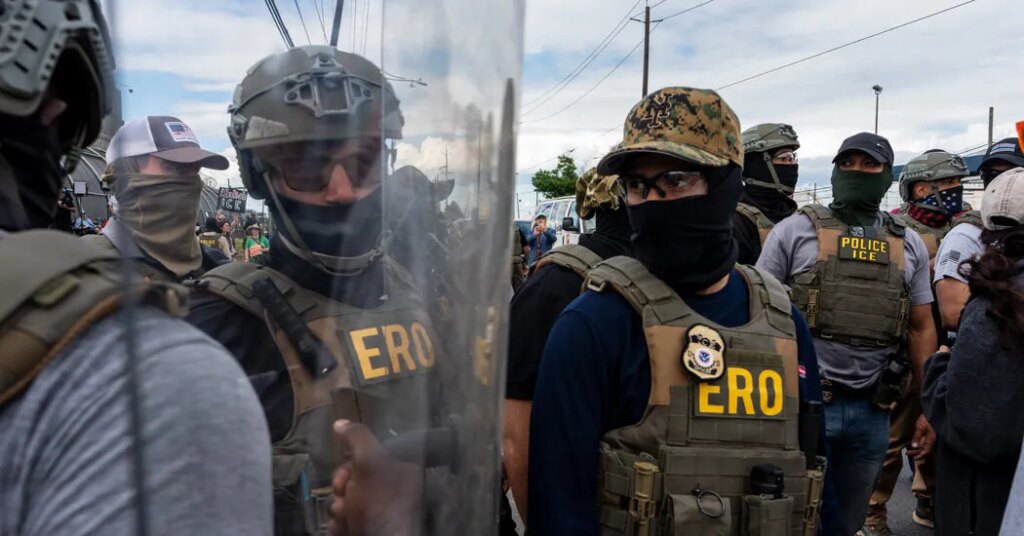
Immigration and Customs Enforcement is preparing for another hiring surge to support President Trump’s deportation campaign, with a goal of bringing on 5,000 new employees by the end of the year, according to four people familiar with the plans.
The hiring would expand the agency’s work force by around 17 percent and draw on substantial new funding provided by Congress. The agency had already staffed up drastically since President Trump took office, growing by about 8,000, to reach 29,000 employees as of July, according to federal data.
Most of the recruits are expected to be deportation officers, who participate in a variety of enforcement activities, from arresting targets to case management.
ICE has sharply ramped up its enforcement in the past few months with an aggressive arrest campaign bolstered by an infusion of more than $100 billion from Congress. Amid the campaign, agents have been under pressure to work seven days a week, and ICE offices have assigned more agents to immigration enforcement.
Last year’s hiring effort drew criticism for its size and speed, as officers were let into the agency with limited or no initial vetting. By the spring, hundreds of those new hires had been removed.
This time, the agency plans to employ stricter standards for checking out new hires, one person familiar with the procedures said. But it is unclear if ICE can adequately vet and hire an onslaught of new applicants or will run into some of the same concerns.
“Adequately vetting people takes time,” said Deborah Fleischaker, a former acting chief of staff at ICE under the Biden administration. “It’s more important to get it right than do it fast.”
In a statement, the Department of Homeland Security said the newest hiring efforts were an outgrowth of the new funding allocated to D.H.S. and unrelated to attrition from the previous surge in hires. The agency said it planned to maintain rigorous standards.
Federal law enforcement agencies have historically struggled to fill positions rapidly and under pressure without letting in people with problematic pasts, said Daniel Altman, a former U.S. Customs and Border Protection official who oversaw internal investigations for the agency’s Office of Professional Responsibility.
“Over time we tend to see an increase in excessive force and other types of misconduct that can happen when you hire someone not suitable for a position.” Mr. Altman said.
The agency is still digging itself out of a vast backlog in vetting the backgrounds of officers and others who were brought on last year. Nearly 7,500 people are still waiting for the extensive background checks required for their positions, with an ability to work on a limited basis in the meantime, according to two people familiar with the process who were granted anonymity to be able to speak freely.
While it is not unusual to be in training or even sometimes put to work before a full background check, the number of hires still needing to be checked is far more than is typical, the people said.
The extensive checks are aided by third-party contractors but analyzed and reviewed by federal employees, who determine whether the person can continue working. There is intense pressure to get the checks done while the new hires are still in a probationary period, when they are easier to fire.
Normally, new hires receive preliminary checks before a full background check, which can take months. But last year, the agency began to make the initial determinations on recruits without completing a full security form, fingerprints or any polygraph testing.
The New York Times reported earlier this month that a high-level official who oversaw preliminary vetting in August 2025 filed a whistle-blower complaint with the inspector general at the Department of Homeland Security raising concerns about the practices. He wrote that the Trump administration was giving final job offers without proper preliminary vetting or any at all, violating the law and fast-tracking unqualified, “improperly vetted” candidates into ICE’s ranks, exposing the agency to “grave national security risks.”
Such concerns have come to the fore amid actions from some of the recruits hired last fall. Among them are David Brouillette, a new officer whose ex-wife identified him as the person who fired the fatal shots that killed Johan Sebastián Durán Guerrero, a Colombian immigrant, in Biddeford, Maine, on July 13.
The Homeland Security Department did not make Mr. Brouillette available for an interview. In a statement, the department criticized efforts to publicly identify ICE officers.
Albert Sun and Michael Gold contributed reporting. Sheelagh McNeill contributed research.
The post ICE Plans 5,000 New Hires to Help With Deportation Drive appeared first on New York Times.