From the first primaries in March through the final ones in September, Democrats’ turnout outpaced Republican voters in many key states that will decide congressional majorities next year.
In red states like Texas, battlegrounds like Georgia and bluer ones like New Hampshire, Democrats have raced to the polls to choose their nominees, while Republicans have not kept up.
“There’s been historic enthusiasm gaps this cycle, that are real reasons to be optimistic,” said Meredith Kelly, who was a top official for the House Democratic campaign committee in 2018, the last midterm election with President Trump in office.
Furious Democratic voters emerged during that campaign’s primary season and maintained their energy into November. The party flipped 42 House seats, taking the majority. Republicans gained Senate seats that year in deep-red states like Indiana, Missouri and North Dakota where they ousted Democrats who had been elected during Barack Obama’s second presidential campaign.
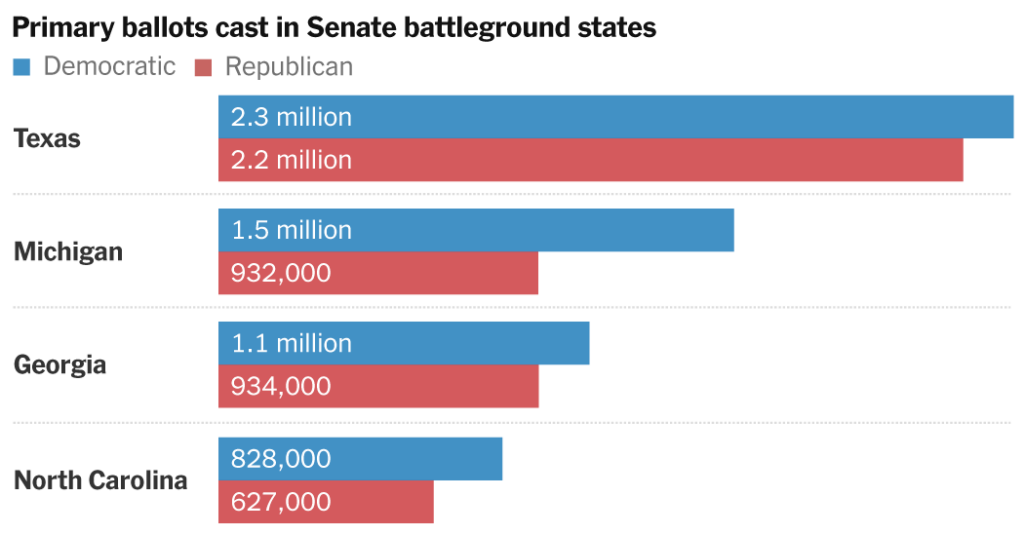
This primary season, perhaps the starkest example of Democratic enthusiasm came in Texas, a state Mr. Trump carried by 14 percentage points two years ago. Both parties had hard-fought and expensive Senate primary campaigns there this year.
About 150,000 more people voted in the Democratic primary between James Talarico, the victor, and Representative Jasmine Crockett than in the Republican contest between Senator John Cornyn and the state’s attorney general, Ken Paxton, who would go on to win in a runoff.
That’s a major change from four years ago, when there were 900,000 more votes in the state’s Republican primaries for state offices than in its Democratic contests. Even in 2018, during the last Democratic wave election, 500,000 more people voted in the Republican Senate primary than in the Democratic one. That year, the last midterm election with Mr. Trump in office, Democrats flipped seats across Texas as Beto O’Rourke came the closest any Democrat had gotten in decades to winning a Senate race in the state.
The lopsided Democrat turnout didn’t extend to every state, and was most notable in battleground states.
Compare 2022 to 2026: Twenty-two states held contested primary elections in both parties for governor or Senate. Democratic turnout increased in three-quarters of those states this year over four years ago, while dropping in two-thirds of those states for Republicans.
Going back farther, Michigan and Wisconsin held competitive Democratic primaries in both 2018 — which drew record turnouts at the time — and 2026, and both saw huge turnout increases this year.
In Wisconsin, David Crowley, the Milwaukee County executive, narrowly defeated Francesca Hong, a state legislator from Madison, in a race that saw turnout jump by more than 250,000 votes — a 47 percent increase. Both the winning and losing candidates got more votes than the winner in the 2018 primary.
Michigan’s numbers were nearly as striking. The state’s 2018 competitive Democratic primary for governor drew 1.1 million voters. The Senate contest last month had 1.5 million.
Eight years ago, on the eve of the 2018 primaries, Nate Cohn wrote in The Times that the vote in primary races generally provides “a rough if imperfect indicator of the national political environment.”
But Republicans are better prepared for a wave of Democratic enthusiasm than they were during the “blue wave” in 2018. Republicans redrew House districts across the country to create more potentially safe seats for their candidates, and the party has a large cash advantage. As in 2018, this year’s Senate battleground is being fought in red states Mr. Trump carried two years before, giving his party a distinct advantage.
Tom Perez, who was the Democratic National Committee chairman in 2018, acknowledged that voter enthusiasm among Democrats wouldn’t go as far in the new political environment.
“I really do believe that people are going to come out in abundance,” he said, but he added that it would require more financial investment in potentially competitive races.
“You don’t want to wake up the day after and see that you lost by three points somewhere because you didn’t do anything,” he said.
The post Democratic Turnout Surged in the Primaries. Will It Matter in November? appeared first on New York Times.