Santiago Oría, the personal filmmaker and media strategist for President Javier Milei of Argentina, was captivated when he saw the young influencer’s Instagram videos. The woman was articulate and eloquent while making pro-government points.
“She is smart, she is super beautiful,” Mr. Oría said in an interview, “I said — we have to give her a bigger spotlight.”
Except the influencer, Libertarian Lucía, was an A.I. fabrication. Mr. Oría, having realized that, said he lost interest, but he wasn’t troubled by the ruse.
“It’s totally inoffensive,” he said. “There is nothing harmful.”
Mr. Oría’s perspective reflects the Milei administration’s broader hands-off approach toward artificial intelligence. Mr. Milei is pitching Argentina as a sanctuary for unregulated A.I. as many Western leaders struggle toget a handle on a technology many fear poses existential threats to humanity, and even tech chief executives urge guardrails.
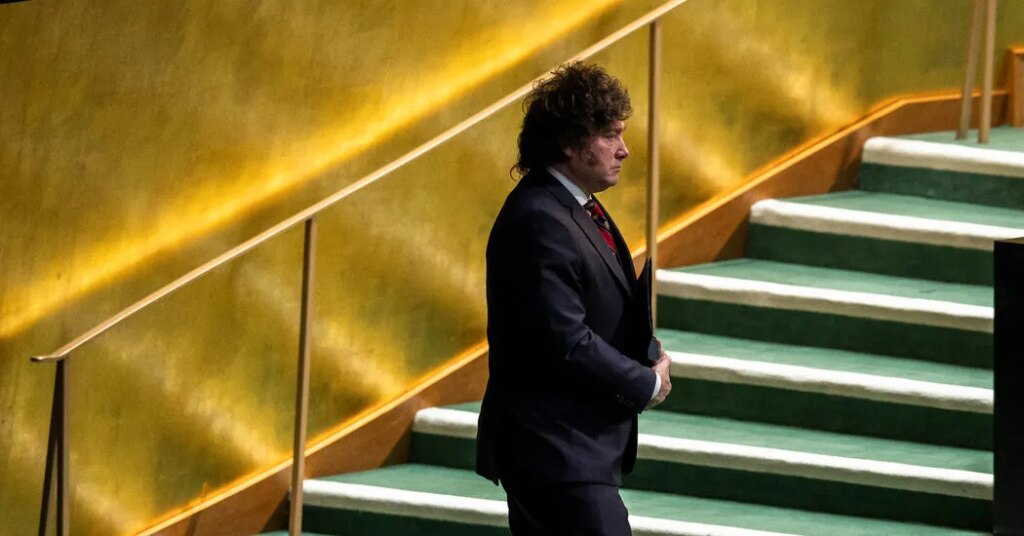
“On artificial intelligence, Argentina will stand at the forefront of freedom,” Mr. Milei told the United Nations General Assembly in New York last week, while asserting the country’s “commitment to not preemptively regulate A.I.”
Mr. Milei, who has proposed creating “nonhuman corporations” run by A.I. agents, is seeking to lure foreign investments to build data centers in Patagonia. He also relentlessly posts A.I. generated content on social media.
At last week’s U.N. assembly, many world leaders agreed on addressing A.I. risks, but across the world strategies diverge.
Mr. Milei’s view, in some ways, mirrors that of his political ally, President Trump, who argues that regulation stifles innovation and economic growth and favors China. The European Union has introduced some rules, but for the most part a vacuum exists between government policy and rapidly advancing A.I. capabilities.
Argentina sits thousands of miles away from the epicenters of A.I. development, the United States and China, and is not a significant player. It remains unclear whether Mr. Milei’s proposals, and A.I. investments in the country, will ever take root.
But Mr. Milei, the world’s only libertarian president, is seeking to earn Argentina a spot in the global conversation with the audacious pitch of going all in.
His government sees A.I. as a great opportunity to bring investment to the long financially troubled country. The energy-rich nation with vast open spaces, government officials say, is an ideal location for data centers, and regulatory innovation could help place Argentina at the forefront of the technology.
Many have raised warnings about this approach.
Yuval Noah Harari, an Israeli historian and future philosopher, said Mr. Milei’s idea to create nonhuman corporations risked creating an “A.I.-state” where algorithms operate beyond the reach of criminal law. Agents, he wrote, cannot be deterred from engaging in illegal activities “because the ultimate sanction that deters human executives and employees — jail — is irrelevant to A.I.s.”
On the side of freedom
At the U.N., Mr. Milei compared the fear of A.I. to resistance to earlier technologies like the steam engine, electricity and the internet, and dismissed the concerns as Luddite fear mongering. At a time when superintelligent systems are escaping human control, the Argentine government has stayed staunchly optimistic.
“Where many see a threat, we see a frontier,” Mr. Milei said.
Mr. Milei’s deregulation minister, Federico Sturzenegger, said the idea to introduce nonhuman corporations operated by A.I. agents came from Emiliano Kargieman, one of Argentina’s most successful tech entrepreneurs.
“I kind of pitched them on my craziest idea,” Mr. Kargieman said in an interview. Argentina, where the work force numbers around 15 million, could have millions of robots producing revenue for the country, he said. With that, he said, Argentina “could play a far more important economic role in the world.”
The government liked the proposal. “I said, ‘this is kind of cool,’” Mr. Sturzenegger said.
Mr. Milei announced that he would pursue a law allowing the creation of companies whose operations could be carried out by AI agents without human staffing.
Members of the Argentine opposition and legal experts have raised alarms. While A.I. cannot be held accountable, “the consequences of its errors are suffered by very real individuals,” Alan Daitch, an Argentine A.I. expert, warned on the news website Infobae. He called for regulation.
Mr. Sturzenegger said the government tweaked the bill to try to pass it through Congress. Under the updated draft, companies can be operated entirely by A.I. agents, but must retain a human who holds the ultimate legal liability. The legal framework, he said, is primarily designed to grant tax incentives to firms operated by A.I. agents.
“We want Argentina to be a place where you find it attractive to incorporate,” Mr. Sturzenegger said. If European nations and U.S. states impose strict guardrails, Argentina could became a land of deregulated possibilities, he said.
Data centers in Patagonia
In the United States, the boom in data centers has provoked increasing backlash across the political spectrum over concerns about electricity and water demand and more generalized fears over the impact of A.I. on jobs and society.
Argentine authorities are pitching their country as an alternative. Patagonia — a dramatic expanse of sweeping arid plains and glaciated mountain ranges — is sparsely populated, has an expanding supply of energy thanks to vast reserves of shale oil and gas, and a naturally cold climate that can help cool large server facilities.
With a relatively small data-center industry, Argentina lags far behind the region’s established hubs, such as Brazil and Chile, but a growing number of companies are showing interest in the country. Last year OpenAI signed a letter of intent with an Argentine company to explore a large A.I. data-center project.
Many challenges remain, including the country’s fragile power grid, currency controls, and a high cost of building transmission infrastructure. But Mr. Milei has proposed a generous tax incentive aimed at attracting significant investments in artificial intelligence and other emerging technologies, with a particular eye on large-scale data centers. The program needs to be approved by the Senate.
Blurring the Lines
Argentina’s potential as an A.I. hub faces an uncertain future, but for now, Mr. Milei has proved to be an enthusiastic adopter of the technology. He has embraced A.I. as a key tool of political communication, using it to help fuel his viral success on social media.
“We have to embrace it without fear,” said Mr. Oría, the media strategist.
Mr. Milei often posts his synthetic alter ego, which is generally younger-looking, more muscular and more square jawed. He has appeared as Spider-Man, as a soccer player alongside Lionel Messi and, more recently, engaged in a conversation with Domingo Faustino Sarmiento, an Argentine president who died in 1888.
His communications team says that the images are not an attempt to deceive, but a tool to supercharge Mr. Milei’s online presence with an overflow of content. The goal is to create images that Santiago Pacheco, who handles the production of A.I.-generated content for Mr. Milei’s social media, called “weird,” “heroic” and “epic.”
Still, Mr. Milei’s habit of reposting fan made A.I. images frequently blurs the line between creative satire and deception. In January, as wildfires swept Patagonia, Mr. Milei shared an image of him alongside firefighters battling the flames, even though he had not traveled to the fire zone. Many criticized that in the digital fabrication, Mr. Milei was shaking hands with a firefighter while in real life his administration slashed funding for the agencies battling the blazes.
On the eve of a local election last year, prominent social media accounts supporting Mr. Milei circulated A.I.-generated videos falsely showing a rival candidate dropping out of the race and urging voters to support Mr. Milei’s candidate instead. Although Mr. Milei did not post the video, he defended it as an exercise of freedom of expression and rejected the idea of penalizing this type of content.
But even within his own team, A.I. experts urge caution.
“The line is getting increasingly blurred,” said Mr. Pacheco, adding, “we need to be well aware of the risks.”
The post As A.I. Fears Grow, President Milei Pitches Argentina as a Rules-Free Haven appeared first on New York Times.