Outside the Barclays Center in Brooklyn on Thursday evening, just before the first of Phoebe Bridgers’s three sold-out shows, people were using their phones with a frenzied urgency. Some chatted with loved ones in that hurried, “if I make it to the other side” tone normally reserved for the moments right before a plane is about to take off. Others frantically snapped selfies and photos of their friends’ outfits, many of which nodded toward Bridgers’s macabre aesthetic and penchant for wearing skeleton suits.
Though it was well outside of business hours, I quickly thumbed out a work email that probably could have waited until morning. I then joined the long, crawling line to surrender my electronic devices into a securely locked Yondr pouch and, for the next three hours or so, mandatorily live in the moment.
Bridgers has banned phones (and AirPods, smartwatches and Meta glasses) from all stops on her 45-date Lost Tour, on which she is playing material from her excellent and emotionally wrenching new album “Lost Weekend.” In the middle of her set, Bridgers — clad in a long, black lace dress — thanked us for setting aside our phones for the night and explained the decision as one of self-preservation.
Bridgers’s recent successes — her 2020 breakout album “Punisher,” the rise of the Grammy-winning folk-rock trio boygenius, in which she plays with Lucy Dacus and Julien Baker — brought her “a lot more attention than I was used to,” she said. They had also coincided with “a shitty couple years” in her personal life. (Many songs on “Lost Weekend” grapple with her father’s death.) The pressure of visibility had led the 32-year-old singer-songwriter to consider quitting music entirely. The only way she could feel comfortable returning to the stage, and sharing such personal material, she told the crowd of 14,000, was to play phone-free shows. Unencumbered by hand-held devices, we applauded.
Phoebe Bridgers is hardly the first musician to ban phones from her concerts. Alicia Keys, Childish Gambino and Jack White were all early adopters of Yondr pouches — the fabric satchels also used in Broadway theaters, comedy clubs, classrooms, courtrooms and even wedding venues.
Other artists opt for softer bans. Bob Dylan has used Yondr pouches, but when I saw him at Forest Hills Stadium this summer, the phone-free experience was enforced by ushers who chastised anyone sneaking pictures or recording video — and by the social pressure of not wanting to be seen doing something that Bob Dylan did not think was cool.
Still, Bridgers’s phone ban has been debated more vehemently than any other in recent memory, perhaps because her audience is younger than, say, Dylan’s or White’s, and more likely to contain digital natives who can’t remember a time before smartphones.
When she announced the ban, a small but vocal contingent online criticized the choice as classist (those who could not afford tickets would not be able to vicariously experience the concert via videos or FaceTime calls) and ableist (attendees reliant on phones to monitor medical conditions worried they wouldn’t be able to attend).
Neither argument proved persuasive. People have been enduring the indignity of not being able to afford a concert ticket since long before smartphones existed, and venues are required to allow concertgoers to access phones for medical reasons.
A more convincing argument: It is not very rock ’n’ roll to tell people what they can and cannot do. Of Dylan’s phone policy, the ever-contrarian rocker Damon Albarn mused in a 2024 interview: “If you start banning things, where does it end? I think you’ve just got to turn up and do your thing. People won’t want to be on their phone if you’re engaging with them correctly.”
I have witnessed some lovely live moments made possible by phones. I will never forget an awed Joni Mitchell, returning to the stage in 2023 for a nighttime concert at the Gorge Amphitheater, telling a crowd that held its cellphone lights aloft, “You look like a fallen constellation.” When I saw Charli XCX in mid-September, her opening act, the hyper-pop artist Underscores, asked audience members to shine their phone lights on her before a ballad. The rapt crowd’s sudden illumination was visible evidence of how completely she had won it over.
Still, I have attended plenty more shows at which I have been distracted, or even appalled, by fellow concertgoers’ inconsiderate phone use. I have watched too many performances through the screen of a taller stranger’s phone or even — the horror! — iPad. I have made unwilling cameos in other people’s selfies or mid-concert FaceTime calls. Earlier this year, when I saw the British pop sensation Olivia Dean at Madison Square Garden, a woman seated next to me spent most of the set posing for photos taken by her husband. She spent the entire encore lip-syncing into his camera with — the horror! — the flashlight on.
Enough is enough, and the recent discussion surrounding the disruptive behavior of influencers at this year’s U.S. Open Tennis Championships suggests that a tipping point could be approaching.
I admit that I usually use my phone to take a few photos or videos at concerts, sometimes for reporting purposes, but mostly just to remember I was there. I like being able to flick back through my camera roll and determine exactly when something, like a Phoebe Bridgers concert, happened. What I don’t like is how much of my memory I have outsourced to my phone. I used to have heaps of ticket stubs and a better sense of recall. Now I have a collection of shaky digital videos, the creation of which might have annoyed the people around me or the artist I was there to see.
So, for one night, I gladly submitted to Phoebe Bridgers’s social experiment.
At first, I experienced a few banal pangs of curiosity that would have normally sent me fumbling for my phone. What time did the Walgreens across the street close? Could [REDACTED] believe that [REDACTED] was here, with [REDACTED]?! Had that colleague replied to the inconsequential email I had sent after the workday was supposed to be over?
These thoughts subsided quicker than I expected. For the rest of the night, I did not really wonder what sort of apocalyptic news was possibly breaking outside, or what was being discussed in my text threads. Between sets, I visited a friend whose section, row and seat number I memorized before the show, and we enjoyed a pleasant conversation that did not rely on my illustrating anecdotes with pictures on my phone.
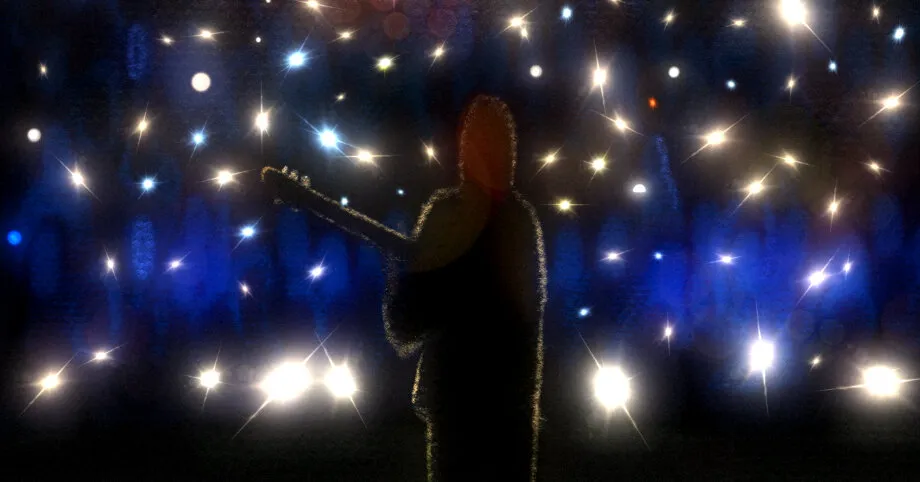
Bridgers’s staging featured laser lights, strobes and a U.F.O.-like half-bubble that sometimes flipped open to show a projection of what looked like the surface of another planet. It would have looked cool on Instagram. She brought out the other members of boygenius for an unannounced two-song reunion, a surprise that was greeted with eardrum-shattering screams. It was the sort of FOMO-inducing moment ready-made for mediation through thousands of tiny phone screens. But Bridgers forced us to be present — and to not miss out on the reality of our own experiences.
The absence of glowing blocks in our palms did not suddenly turn a massive arena into an intimate club, and it also did not magically turn everyone into well-behaved, meditatively present concertgoers. Three men behind me still talked loudly about nothing throughout most of the set until I asked them, in the middle of a piercingly poignant song about Bridgers’s dead father, to stop. It was almost refreshing to be reminded that phones aren’t always the problem. Take them away and the person still remains.
I sneaked out toward the end of the last song because I had been dreading the line to unlock my Yondr pouch, but it was a surprisingly quick and uncomplicated process. Outside, in the digital freedom of the open air, my reunion with my phone was anticlimactic. My colleague had not yet replied to my email. I did not have to look up when the Walgreens closed, because I could see that it was still open.
As I waited to cross the street, a young girl walked past me, breathlessly filming a front-facing video. “Phoebe Bridgers at Barclays Center, Night 1, and she was rocking,” she said. She was right. But you really had to be there.
The post What We Gain, and Lose, at a Phone-Free Concert appeared first on New York Times.