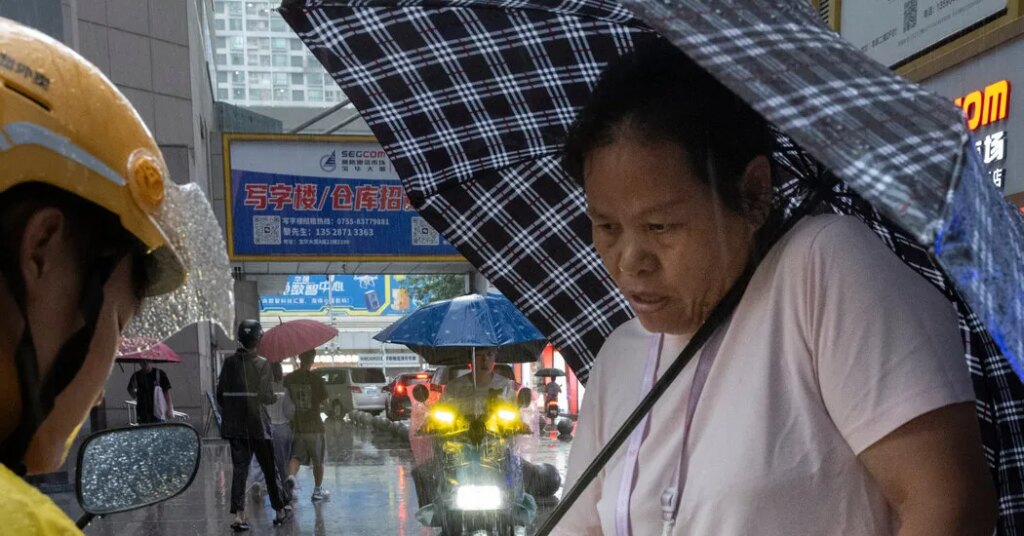
When British authorities passed laws targeting working-class pamphlets during the Industrial Revolution, they did so because they knew that words can be powerful. The poetry and writing of those who experience hardship can be galvanizing.
In China, the People’s Republic, a genre of literature known as “workers’ literature,” written by gig-economy and factory workers, is becoming increasingly popular. It’s also under increasing government scrutiny. Today my colleague Yan Zhuang writes about the fine line that Chinese worker-poets have to walk.
‘I am a Chinese worker’
By Yan Zhuang
In Seoul, where I live, it’s normal to place an online order on Korea’s equivalent of Amazon a little before midnight and have it arrive at your door before 7 a.m. It’s a striking example of the convenience made possible by the gig economy that so many of us rely on to keep our lives running smoothly.
But around the world, the human cost of this ultraconvenience is increasingly hard to ignore. To understand what it looks like in one country, I’ve recently turned to a growing body of books, essays and poems out of China, known as migrant workers’ literature.
These stories, written from factory floors and, in more recent years, from the front lines of the gig economy, tell of the harsh realities of a work force of over 400 million people who moved from the countryside to cities like Beijing to seek better lives. The stories have started to attract attention outside China, with English translations of books like Hu Anyan’s “I Deliver Parcels in Beijing” and Xiao Hai’s “Adrift in the South.”
For many readers, including me, the attraction is learning about the lives of workers whose presence is ubiquitous but whose voices are rarely heard. For some Chinese readers, that curiosity is also tinged with anxiety about their own futures. The country’s economy is stagnating, jobs are drying up, and the once-solid promise that hard work will lead to a better life feels increasingly uncertain.
The genre’s growing popularity has meant more recognition from China’s literary establishment. But that recognition has also come with more state control, from a government that has always seen literature as political, and that is wary of the power of workers’ grievances to illuminate class disparities.
Masters of the country, once
Literature by the working class has a long history in China. Under Mao Zedong, the state held up workers and peasants as the masters of society and encouraged them to “speak bitterness,” or tell the stories of their past hardships in order to cultivate class consciousness and solidify allegiance to the Communist regime.
But the workers writing about their experiences today have a much lower standing in society than under Mao, who died in 1976. “Before the 1980s, the working class was proclaimed to be the master of the country,” said Xin Yang, a professor and expert in Chinese literature at Macalester College. “Today, however, workers have become an underclass under the new socioeconomic order.”
Some of this literature speaks of the hopelessness and despair of being consumed by the backbreaking demands of factory work — like Xu Lizhi, a 24-year-old Foxconn worker whose poetry was widely circulated after he leaped to his death in 2014. Others take a more hopeful tone, writing of how they maintain their humanity in the face of dehumanizing labor — such as Wang Jibing, the 57-year-old food delivery driver and poet, who in July won the Lu Xun Literary Prize, one of China’s most prestigious literary honors.
Dignity, resilience — but no system critique
Wang’s prize signifies the highest institutional recognition for the genre yet, and his win has been celebrated widely in Chinese state media for embodying a shift in the literary landscape, in which publishing opportunities are not limited to the elite.
But experts I talked to also noted that Wang’s poems are the kind of politically benign worker narrative the government is keen to promote. Wang speaks of his desire to be known by his name instead of “that guy”; he describes the experience of always trying to squeeze an extra second out of every minute. His poems have a tone of dignity and resilience; they do not, however, focus on inequality, or criticize the system.
The workers’ literature movement grew organically over several decades through writers groups and was largely self-published in online spaces. The government’s move to bring it into the world of mainstream publishing will create more opportunities for writers, experts told me. But they expect those opportunities will mostly fall to the writers whose perspectives the government wants to highlight.
Still, the government’s moves to shape the genre are a testament to the resonance of these stories in an era of economic uncertainty. For some readers, the lives depicted in this literature could well represent their own futures if something goes wrong, said Ping Zhu, a professor of Chinese studies in the department of literature at the University of California, San Diego.
I’ll end here with a couple of lines of a poem by Xiao Hai that I like. It throws into relief the realities of some of the workers who powered China’s rise:
I am a Chinese worker Lurking inside the desire of tall mansions in steel and concrete is our captive cut-price Youth The changes of the season are not ours Food and vegetables don’t need our attention All we can do is let the mystery of the words Made in China Fiercely flood every river leading to the four oceans and seven continents
— “Chinese Workers,” translated by Tammy Lai-Ming Ho
MORE TOP NEWS
-
The British police released five U.K. nationals arrested over a possible terror plot targeting a military base.
-
China and the United States agreed to lower tariffs on $60 billion worth of goods in a bid to ease economic tensions.
-
Pope Leo praised Europe’s efforts to unify and democratize the continent, in what experts said was a rebuke to President Trump.
-
More than 800 people have been killed in the renewed Houthi-Saudi war in Yemen, the World Health Organization said.
-
Nvidia said it would use some of the vast profits from the A.I. boom to buy back $235 billion of its own shares.
-
Two leading electric carmakers in China said they would combine their battery-charging subsidiaries.
-
In the middle of the workday, a Russian drone hit Ukraine’s National Academy of Sciences, in the heart of Kyiv.
WHAT ELSE IS HAPPENING
-
SpaceX’s Starship circled Earth for the first time in a test flight, but had to return early because of engine problems.
-
The Mighty Sparrow, Trinidadian titan of calypso, died at 91. “It was used to make fun of the masters, to relieve oppression and bring the news of the day,” he told The Times in 1992 about the genre he helped make famous. “It finally emerged as the mouthpiece for the underprivileged.”
TOP OF THE WORLD
The most clicked link in your newsletter yesterday was about the rise of catios.
SPORTS
Cycling: Brandon McNulty became America’s first men’s world champion since Lance Armstrong.
Football: Vozinha, the Cape Verde goalkeeper who became an overnight World Cup star, described his struggles with fame.
VIRAL HERO OF THE DAY
The In-N-Out spatula guy
A bizarre late-night standoff at a California fast-food joint briefly took over the internet this month. My colleague Thomas Fuller decided to dig deeper and found a uniquely American story: A young man trained in parkour who vaulted through a drive-through window to defend workers there from an assailant, wielding only — you guessed it — a spatula.
To fully appreciate this story, you really need to read the whole thing.
MORNING WATCH
The “tradwife” — internet shorthand for “traditional wife” — is a new word for an old archetype. The modern icon is Hannah Neeleman, the Mormon homesteader who has nine children, millions of Instagram followers and ultrarich in-laws, and who sells protein powders and other products under the name Ballerina Farm.
But the trad trend is showing its cracks. Our writer at large, Amanda Hess, gives us the lowdown on the ex-tradwives rejecting the movement.
AROUND THE WORLD
A very important cocktail
Singapore has one of the world’s most vibrant cocktail scenes, but one drink casts a very long shadow: the Singapore Sling, made with cherry liqueur, pineapple juice, Cointreau and gin. It was invented in 1915 by the Hainanese bartender Ngiam Tong Boon as a means for respectable ladies to disguise the fact that they were drinking in public.
Tourists start lining up early in the morning to enter the Long Bar at Raffles Hotel, the purported birthplace of the Sling. One cocktail costs more than 50 Singapore dollars (about 40 U.S. dollars) but that doesn’t stop customers from consuming around 1,000 at the Long Bar every day. Read about the origins of the classic cocktail.
RECOMMENDATIONS
Read: The Palestinian activist Mahmoud Khalil details his detention in a new memoir.
Watch: Parisian artists and chefs share their favorite films set in that cinematic city.
Travel: Here’s where to eat, sleep and shop on the Greek island of Crete, according to locals.
Be careful: Here’s how to keep artificial intimacy with A.I. under control.
RECIPE
A beloved “fast food” chicken kebab, shish tawook (also spelled “taouk”) is popular across the Middle East. The name is Turkish in origin, with shish meaning “skewer” and tawook “chicken.” The marinade base of yogurt, lemon juice and garlic is brightened with a medley of fragrant spices. Serve over rice, or in a wrap.
WHERE IS THIS?
Where is this downtown area?
TIME TO PLAY
Here are today’s Spelling Bee, Mini Crossword, Wordle and Sudoku. Find all our games here.
That’s it for today. See you tomorrow! — Katrin
Yan Zhuang was our guest writer today.
We welcome your feedback. Send us your suggestions at [email protected].
The post The Voices Behind ‘Made in China’ appeared first on New York Times.