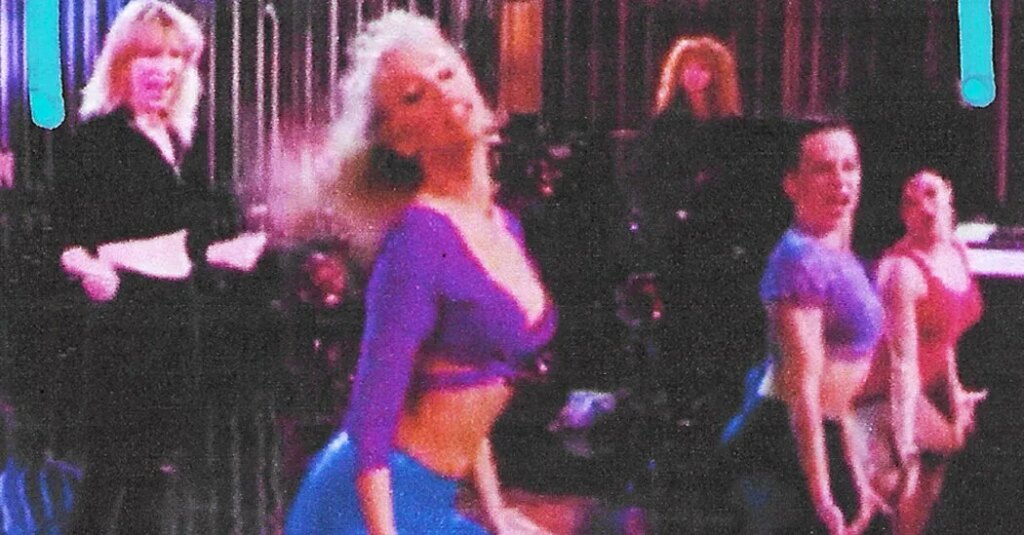
What’s a “good-bad” movie? It’s the kind of flick that might have you cackling, hollering or groaning, one that is not necessarily great cinema but is great fun. It’s highly watchable even though — or maybe because — it’s memorably ridiculous. And it always has at least one element that pushes it into absurd territory.
It didn’t take long for Elizabeth Berkley’s career to crater after “Showgirls” hit theaters in September 1995. Her agency immediately dropped her and potential opportunities shriveled.
Paul Verhoeven, the Dutch director known for pushing themes to cartoonish lengths in service of satire, felt remorse for the fallout. “If somebody has to be blamed, it should be me,” he said in 2015. “I asked Elizabeth to do all that.”
“All that” indeed. In this NC-17 film, Berkley stars as Nomi Malone, a young woman who yearns to dance under the glittering Las Vegas lights. But Nomi is not your typical starry-eyed dreamer.
She flings and flails her limbs in every direction. She thrashes like a fish out of water while giving a nude lap dance to Kyle MacLachlan’s character, an opportunistic bigwig. She licks a stripper pole.
The explicit, herky-jerky performance was particularly jarring right after Berkley’s fame-making run on the wholesome teen sitcom “Saved by the Bell.”
“It was really painful at the time,” Berkley said in 2021 of the backlash. “I was a very young woman.”
Over the last 30 years, though, “Showgirls” has done the almost impossible by becoming one of MGM’s best sellers, undergoing a critical re-evaluation and maintaining a legion of devotees.
“Tonight is like this magical full-circle moment,” Berkley said to a crowd of thousands at a 20th-anniversary screening in 2015. “I really do want you to know this movie is something I love, but I love it because you love it, too.”
What Makes It Good
A Daring Satire About Exploitation
Aside from the haywire overacting, “Showgirls” feels familiar at first: a tale about a fresh-faced ingénue who wants to make it big and the men who control all avenues to success. These men are surrounded by women we’re led to believe are one-dimensional bimbos competing mostly for their attention.
Eventually, a shift takes hold. These men, none of them redeemable, flatten into a single interchangeable sleazebag. Meanwhile, the portrayals of Nomi, Cristal (Gina Gershon) and Molly (Gina Ravera) deepen. Remarkably, the film passes the Bechdel test in spades.
“Showgirls” is also not sexy in the slightest, a main criticism initially but perhaps the entire point. That it was marketed to young men (ads promising a sexy romp were placed near box scores in newspaper sports sections) feels intentional, part prank and part lesson.
Some critics, spotting its subversive streak, have defended the movie along the way. In 1998, Jacques Rivette called “Showgirls” a great American film “about surviving in a world populated by assholes.” In 2006, the critic Michael Atkinson said Verhoeven “may be the bravest and most assured satirist in Hollywood.” And a 2020 headline in The Guardian called the movie “a misunderstood gem.”
What Makes It Bad
The Violent, Abrupt Rape Scene
Nomi’s evolution, and the film’s overall vibe shift, is hastened by the shocking sexual assault of her best friend, Molly, in a highly debated scene that seems to come out of nowhere. It was also not lost on many that Molly is a woman of color.
Jeffrey McHale, the director of the 2019 documentary “You Don’t Nomi,” called the scene unnecessary and “completely offensive.”
On a podcast this year, Gershon recalled butting heads with Verhoeven about it: “When I saw that rape scene, I’m like, ‘Are you insane? You have to take this scene out.’”
With the benefit of hindsight, though, she said she understands why Verhoeven held firm: “It’s the grossest thing in there, and the powerful men, they’re all protected,” Gershon said, which makes Nomi’s vengeance all the more significant.
What Makes It Good-Bad
Camp Gold
By early 1996, The New York Times had already declared “Showgirls” “high camp.”
It quickly became a midnight-movie darling, especially among gay audiences, and MGM leaned into the hype, hiring drag performers for the first midnight shows. “There can be nothing more hilarious than getting drunk and watching ‘Showgirls,’” a special-events director in Manhattan said at the time. “We think the script must have been written by a drag queen.”
The script was actually written by Joe Eszterhas, and it’s packed with odd, infectious phrases that were absorbed into the pop lexicon like “Versayce,” Nomi’s pronunciation of Versace.
Part of the movie’s charm, Quentin Tarantino has said, is the seemingly incongruous sensibilities of its director and writer: “I think Paul Verhoeven was in on the joke and Joe Eszterhas was not.”
While Berkley’s big-screen career never quite rebounded, she’s found success in theater, television and advocacy, and is proud of the film’s enduring relevance. “It has been embraced and celebrated by cinephiles, by the L.G.B.T.Q. community — academics investigate this film and write about it,” she said last year. “It’s incredible that it, through the years, has found its way.”
The post ‘Showgirls’: The Gratuitous, Surreal Bomb That Was Maybe Brilliant appeared first on New York Times.