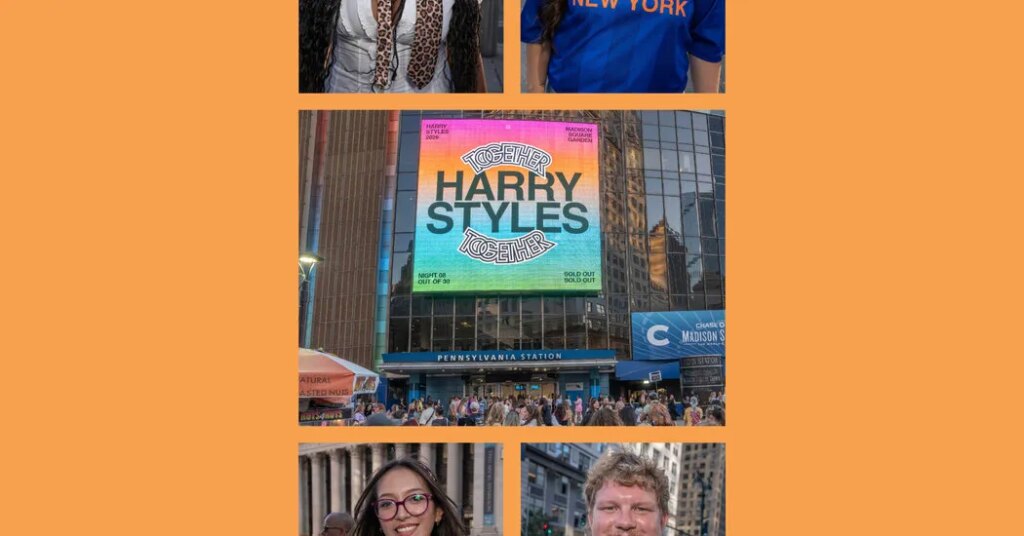
One fan has tickets to 25 shows and is aiming for all 30. Another was “scammed” by a scalper. A third sold her plasma to cover the cost.
But when it comes to seeing Harry Styles in concert, none of them had any regrets.
The hundreds of thousands of Styles followers swarming Madison Square Garden for his 30-night residency this fall are a cross-section of pop fandom in 2026, eager to be in the room with their idol at any cost they can — or can’t — afford. To get their tickets, they vied with bots on Ticketmaster, scoured resale sites and hunted social media for fan-to-fan trades, in prices that ranged from under $100 to well into the thousands.
Over two months, I spoke to 34 fans about how they got their tickets to Styles’s shows, the prices they paid and what the experience was worth to them. Their quest illustrated the paradox of attending an in-demand concert today: Rising costs have put tickets increasingly out of reach for many fans, yet those seats also seem to sell out faster than ever.
Across Styles’s M.S.G. dates, about 540,000 seats were available. But 11.5 million people — more than 20 times the arena’s capacity for the residency — signed up for presale access to compete for those seats, and there were 16 million entries to Ticketmaster’s shopping queues, the company said.
Most artists can only dream of that level of demand. But there was also no way to satisfy it all, so it was nearly inevitable that months of bitter social media commentary would follow, as fans complained about problems gaining access and blamed Ticketmaster for high prices, in what has become a recurring, almost ritualized debate over the travails of supply and demand. (In reality, artists approve how much Ticketmaster charges for their seats.)
Saumil Mehta, Ticketmaster’s global president, said that when it comes to top tours like Styles’s, “we can’t get everybody a ticket.”
“But we can build our products to give fans agency,” he continued, “to give fans a feeling of choice and to give fans real-time communication transparency.”
When Ticketmaster put Styles’s tour on sale in January, the ticket prices had not been disclosed in advance. When fans logged on, they saw that seats cost $50 to $1,182, including fees.
Lupe Labra Valencia, 24
“It took advantage of people panic-buying”
Ticket price: $201 Method: Seated wait list
A Harlem resident, Labra Valencia said 284,000 people were ahead of her in the Ticketmaster queue, and she was offered “platinum” seats as high as $1,002. “I think it took advantage of people panic-buying, feeling the need that they had to be there,” she said. She signed up for the tour’s official wait list, operated by a Ticketmaster partner, and was eventually offered a seat near the corporate suites that had an excellent view. It cost $201. “It was amazing,” Labra Valencia gushed about the show. “I am genuinely still in shock.”
María Boscán, 24
“It was like a whole war to get the tickets”
Ticket price: $548 Method: Gametime
Boscán, who is from Venezuela and works in sales in Miami, struck out on Ticketmaster. So she went to the resale market, waiting until a week before the show to buy, when prices had started to come down. In addition to her ticket, Boscán paid $670 for her travel, “not counting the outfit.” She added, “You should be able to see your favorite artists for a normal price, especially in this economy.”
The music industry has learned that a “normal” price is one that the market will bear. After decades of steady escalation, ticket prices for many tours spiked in the 2020s, particularly as artists have looked to maximize their take through upselling strategies like V.I.P. seats and dynamic pricing, in which costs can fluctuate with demand (yet mostly seem to go up).
For the first half of this year, the average price of a ticket for one of the top 100 tours in North America cost $122.15, according to Pollstar, a trade publication that tracks concert data. That is up 60 percent from the $76.55 it cost 10 years ago, an increase that is well above the rate of inflation over the same period.
Artists and their managers are acutely aware that underpricing their tours will only hand an advantage to brokers, who will find the market price on secondary platforms and pocket the difference.
But ticket prices are also at the center of the industry’s struggle to maintain some semblance of affordability while meeting the growing burden of simply keeping a show on the road.
“Is any responsible artist comfortable with the idea that their tour is now just a bastion for the wealthy?” said Bill Werde, the director of the Bandier music business program at Syracuse University. “No one would say yes to that.”
Chante Whyte, 25
“I have not calculated because I refuse to know”
Ticket price: $433 to $1,195 Method: Various
A recent law school graduate from New Jersey, Whyte had tickets to 25 of Styles’s residency shows and was aiming for all 30. She said she had paid as much as $1,195 on Ticketmaster for V.I.P. seats but had also found cheaper ones through fans on social media. “These are the moments that I look forward to,” said Whyte, who wore a leopard-print necktie and shorts. She demurred when asked what she had paid for all her residency tickets. “I have not calculated because I refuse to know,” Whyte said, shaking her head.
Still, higher prices have gradually become normalized, as fans come to value a hot show as a special, vacation-like experience that can always be justified. This summer’s World Cup, where soccer followers were willing to pay thousands for a once-in-a-lifetime game, was eye-opening to fans and entertainment executives alike.
Many Styles fans trawled the secondary market for tickets they couldn’t find on Ticketmaster. Macy and Ella Hopgood, two sisters from Saline, Mich., went to resale platforms when they wanted to add a second show to their plans. Macy paid $572 on SeatGeek, and Ella got hers on StubHub for $615.
Others had tougher luck with secondary sellers. Brooke Del Biondo, a registered nurse in Altoona, Pa., who was celebrating her 24th birthday, paid $666 on SeatGeek. “We got scammed at first,” she said, when no ticket materialized. After months of frustrating communications, she said, the company eventually delivered tickets for her and a friend, Alexis Hambleton, the day before their show.
Ella Hopgood, 21
“My major bill is Harry Styles”
Ticket price: $615 Method: StubHub
An apprentice at a hair salon in Ann Arbor, Mich., Hopgood was traveling for two shows with her sister Macy, 24, who paid $572 on SeatGeek for her seats (and said she had spent $5,653 on tickets and travel for Styles’s last tour). “Every time I leave his concert, I never regret spending the money,” Ella said. “I might as well do it all while I’m young and I don’t have any major bills to pay.”
Alexis Hambleton, 23
“I started to donate plasma”
Ticket price: $450 Method: SeatGeek
A hotel manager from Salisbury, Md., who has seen Styles 11 times, Hambleton has gone to extreme ends to cover the costs of being a fan, saying that she has been donating plasma “on and off” since last November. “Not to help pay for it, but so I’m able to do it,” she said flatly, and did not mention any regrets.
In the competition for scarce tickets, money tends to win. And fans will make sacrifices.
Baylee Kampiak, 25, who was attending with a friend, AnnaMichelle Schissel, 24, said she got lucky on Ticketmaster and found floor tickets for $450, plus “nosebleeds” for another night at a comparative bargain of $95.
How does she afford it?
“I don’t,” Kampiak answered. “A lot of that is credit card, and hoping to God that I just figure it out later in life.”
“There’s so much horrible stuff going on in the world,” Schissel added. “It’s hard to imagine we’ll ever regret paying $500 to see our favorite artist from 30 feet away.”
Yet fans still want value for their money. When Styles’s residency tour opened in Amsterdam in May, fans that had paid for floor tickets complained that the elaborate stage design resulted in poor sightlines.
Paula Antić Wilke, 26, a Spanish-born student in London who attended nine shows there and in Amsterdam, said she “felt robbed” by the experience. (The stage set was quickly adjusted.)
This month, Styles announced a wider stadium tour for 2027, and his announcement suggested that he and his managers may have heard the complaints. Financial details were disclosed well in advance, with “artist-set prices” of $60 to $300 — not counting fees — and a limited number of $20 seats.
Those dates are already close to being sold out, Ticketmaster said.
Antić Wilke, the student in London, said she had wanted to come to New York for “Harryween,” two Halloween-themed dates of Styles’s show, on Oct. 30 and 31, that will close the residency. But she eventually decided not to. “I can no longer afford it,” she said.
Besides, she was already buying tickets for 2027.
The post Here’s What Fans Paid to See Harry Styles appeared first on New York Times.