U.S. schools are facing a daunting problem. Students simply can’t read or do math as well as they used to.
Student test scores have declined over the last decade, in an academic slump that started before the pandemic and has continued since. Compared with 2015, reading scores are down in 83 percent of districts, and math declines are nearly as pervasive.
But improving student achievement is notoriously difficult. Do schools need more money? Better teachers? More standardized testing? Less?
What could actually help turn things around?
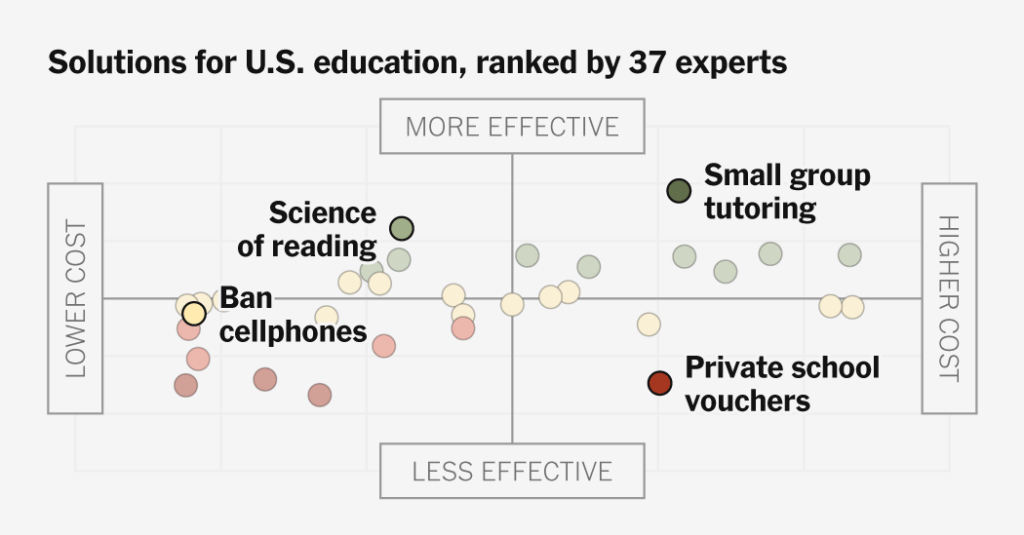
We asked 37 top academics and researchers who study education to rate a range of ideas for both effectiveness and cost, on a scale of 1 to 7.
Overall, no single idea was enough on its own, experts said. And no idea would be successful unless it was executed well. But the results showed there are a number of ideas that can work.
We asked experts to evaluate each idea for its impact on academic achievement, which is generally measured by standardized test scores.
Lots of other things matter, too, including enrichment activities like the arts, teacher work satisfaction, and student excitement about learning. Children also have other needs beyond academics, including mental health and well-being.
But given the results of the last decade, we were interested in what could lift student achievement, which is tied to many later life outcomes, for students, society and the economy.
Most effective: Tutoring, science of reading
Two ideas surfaced as most effective: small group tutoring for students who need it, and the science of reading, a systematic approach to teaching reading that puts a focus on phonics and other evidence-based practices.
Both of these ideas are already being carried out in schools, to varying degrees.
Other ideas deemed highly effective? High-quality preschool, which can help close early gaps that develop even before students start school. And paying effective teachers more to work at high-poverty schools, a strategy that is not widely used but can help encourage the best teachers to work with students who are most behind.
Notably, the most effective ideas were some of the most expensive. Some changes — like paying more for certain jobs — may also need to be negotiated with local teachers’ unions, a potential sticking point.
And all of these ideas came with an important caveat. We asked researchers to rate effectiveness “when done properly.” In the real world, a lot can fall apart because of the details.
We’ll get to more on that below.
Best value: Accountability, curriculum changes
When we compared effectiveness and cost, other ideas rose to the top.
School accountability — giving schools a rating, like an A-F letter grade, and requiring underperforming schools to make changes — emerged as highly cost effective.
It is also an approach that the federal government and many states have backed away from since the end of No Child Left Behind, the federal school accountability law from 2002 to 2015. The law was seen as punitive and overly reliant on standardized testing. In recent years, though, some states have used a model of accountability that focuses more on student progress, not just whether they’re on grade level, and gives underperforming schools support to improve.
Our experts also liked requiring schools to use research-backed, high-quality curriculums, vetted by a state or school district (as opposed to having individual schools or teachers select their own materials, the approach in some places).
Offering more access to advanced classes was another cost-effective idea.
This doesn’t mean just sorting students into gifted and talented programs, but offering more students advanced classes, such as eighth-grade algebra, or Advanced Placement classes in high school. Experts recommended expanding access at low-income schools, which tend to offer fewer college-prep classes, and choosing qualified students based on their performance, not just parent or teacher selection.
These cost-effective strategies had something in common: a focus on increasing academic rigor for more students.
Worst value: Vouchers, smaller class sizes
Some politically popular ideas — on both the left and the right — ranked as both costly and less effective, at least when it came to improving student achievement.
One high-cost, less effective idea was private school vouchers, a leading reform put forth by conservatives, now available in a growing number of states.
In this model, all or nearly all families are made eligible for taxpayer money — for example, $8,000 or $9,000 — to help pay for private school or home-schooling.
While competition can help spur broad improvements across schools, most experts said that vouchers come with minimal academic benefits, particularly compared with the cost.
In places that have tried vouchers, much of the money goes to students already in private school. And there is little evidence that students who transfer into a private school do much better academically. The subsidies can drive tuition increases, and often do not cover the full price, leaving the top private schools out of reach for many students.
On the political left, smaller class sizes are often talked up by parents and teachers, who envision less stress, better working conditions and more attention for each child.
But experts were skeptical that classes can realistically be kept small enough to reap the academic benefits, which research shows happens somewhere around 15 students. In New York City, a state law has tried to cap class sizes at 20 to 23 students in elementary school.
To reduce class sizes, districts also need to hire many more teachers. That can lead to issues with teacher quality, experts said, detracting from the benefits.
Worth a try? Going lower tech
In some cases, there was little empirical evidence that an idea was academically effective, at least not yet. But experts believed that it could work. In cases where the idea was also not expensive, they saw few downsides to trying it.
Going lower tech — limiting screen time in school; restricting A.I. in the classroom, especially for younger students; and banning cellphones — fell in this category.
We also asked experts for other ideas not on our list. Their ideas included allowing high-performing charter schools to expand and limiting children’s social media and tech usage outside of school.
Several experts also said that schools should think beyond test scores and focus on making learning less boring and more engaging — less passive listening and memorizing for tests, for example, and more open-ended research and project-based learning.
“How do we get an education system that promotes high academic achievement, but is also a place where kids really want to be?” said Chris Torres, an associate professor at the University of Michigan.
Most likely to succeed: The idea executed well
So what should be done?
The results suggest that any meaningful change will probably require multiple evidence-backed strategies, with a focus on executing them well for the long term, and based on the needs of the students and teachers in each place.
That is what has happened in places like Mississippi, which has climbed in the national rankings, and in Louisiana, which is making leaps. Both states have used several strategies our experts deemed effective, including the science of reading, school accountability and a focus on high-quality curriculum.
“The reality is that improving education at scale is incredibly hard work, but there are a lot of things that can move the ball down the court,” said Matthew Kraft, an education professor at Brown University.
It also takes a “relentless commitment to troubleshooting,” he said.
If there was one thing our expert panel agreed on, it was that how well ideas are carried out matters.
Take universal preschool, an expensive idea that our experts deemed effective. Lori Taylor, a professor at Texas A&M University, noted that “high-quality pre-K is highly cost effective,” while “low-quality pre-K is basically subsidized day care.” (It also needs to be paired with high-quality instruction in elementary school so that gains are not lost.)
This emphasis on quality helps explain why education debates can seem so intractable, and why what works in one place may not transplant easily. Success often comes down to a visionary leader — a school principal, superintendent or state chief — who can lay out a plan and stick with it.
“In practice, simply doing anything well may matter more than any handful of interventions,” said Marguerite Roza, director of the Edunomics Lab at Georgetown University. “Implementation is everything.”
See all results, and sort by effectiveness or cost:
About the data
To build our list of interventions, we consulted policymakers and researchers and pulled examples from districts and states. We also considered leading proposals by groups that leaned Democratic and Republican.
For our survey, we asked experts to evaluate each idea on a scale of 1 to 7, considering the impact on improving academic achievement. For both effectiveness and cost, we asked researchers to rate each idea assuming it was done properly and at the highest quality.
Our panel consisted of 37 academics and researchers who have studied education and who responded to our survey in August. We see our survey not as a scientific poll, but as a useful measure of how experts steeped in the research view these ideas.
The panel included: Dominique Baker, Brendan Bartanen, Phil Capin, Prudence Carter, Joseph Cimpian, Sarah Cohodes, Thomas Dee, Susan Dynarski, Anna J. Egalite, Dan Goldhaber, Eric Hanushek, Douglas Harris, Heather Hill, Ilana Horn, Huriya Jabbar, Tom Kane, James Kim, Cory Koedel, Matthew Kraft, Sarah Winchell Lenhoff, Sarah Lubienski, Robert Maranto, Sarah Novicoff, Harry Anthony Patrinos, Morgan Polikoff, Sean Reardon, Marguerite Roza, Jack Schneider, Beth Schueler, Jonathan Schweig, Jeremy Singer, James Soland, Katharine Strunk, Lori Taylor, Chris Torres, Martin West and Patrick Wolf.
The post 30 Ideas for Fixing U.S. Schools, Ranked by Experts appeared first on New York Times.