Vogue World, that nominal celebration of fashion and creativity that kicked off Milan Fashion Week and is starting to make “Zoolander” seem like nonfiction, may have been widely mocked for its mixture of Gigi-Hadid-as-a-Renaissance-princess and dancing robots. But it got one thing right: the identity crisis that fashion is experiencing in the age of technology.
How to showcase the desirability of the human — what that even means when every day seems to bring a new story about rogue A.I. and its potential to take over the world — has been a question running through almost every collection.
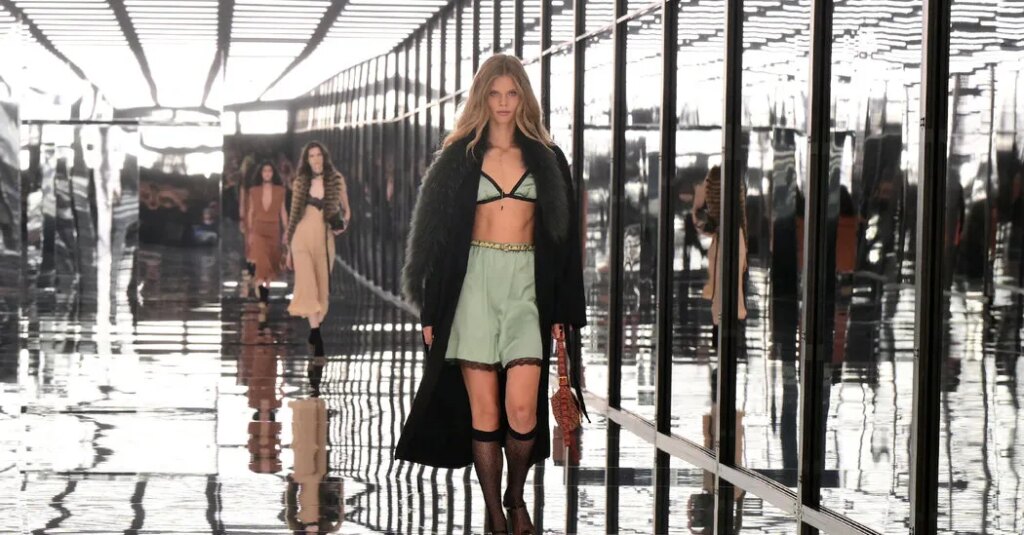
Maria Grazia Chiuri captured the confusion pretty much perfectly (if possibly not intentionally) in her Fendi show. It was supposedly all about bodies, at least according to her show notes, but featured a runway inside a simulacrum of the Italian artist Luciano Fabro’s “Mirror Cube”: a glass structure that fractured perception. As a result, the audience was superimposed on the models, as if there were two realities existing at once.
That made it hard to actually see the clothes, though they appeared to be a fierce amalgam of 1930s tap pants and lace-edged slipdresses, martinet jackets and faded jeans, ’20s flapper frocks and ’70s Afghan coats. In any case, trying to make them out was dizzying, which seemed awfully apropos. One model was reportedly so lost in the maze, she walked into a wall.
It’s hard to trust your eyes these days, after all.
The primacy of “the hand” has long been a tenet of Italian fashion: the hand that weaves the loom, wields the needle, tans the leather. So it wasn’t a surprise that many designers fell back into its embrace. Tod’s even featured an array of actual leather workers in the anteroom to its show space, as did Loro Piana, where the touch of the materials — in particular, an oil-bathed suede — were the magic.
If machines are on the rise, then pieces actually worked by people, that contain know-how and heritage, become a real luxury.
Such was the subtext at Dolce & Gabbana, where Stefano Gabbana and Domenico Dolce went into the metaphoric closets of Sicilian aristocratic families (and into their own archive) to layer generations of fashion one over the other: lacy Victorian tablecloth frocks and grande dame leopard jackets; coral-beaded boho deluxe denim and sheer poet shirting; florals and bloomers and black push-up bustiers. All of it encrusted or tatted to the extreme.
And such was the context of an otherwise mostly incoherent Bottega Veneta collection. “How do I maintain all the elements of craft and technique with the lightest hand?” was how the designer Louise Trotter summed up her challenge during a preview.
But although those elements — the brand’s signature intrecciato weave, handmade Venetian lace, long silken fringe and oversize crochet — were all clearly present, in the end they overcomplicated everything, rather than easing it up. A simple long black dress, one-shouldered, waist slightly raised, with no discernible adornment except a small twist at the strap, was the most convincing piece in the collection.
It spoke to the allure of the small gesture, and the unexpected; the resonance of the single wrong note. And that, as Simone Bellotti of Jil Sander proved in the one of best collections of the week, has its own power. He was after, he said in a preview, “something a bit dirty and less precise”; something that embraced the aberrant.
See, for example, a jacket that went from being perfectly tailored to twisted around the body to scrunched open at the front, as though the person wearing it had been in a corporate melee and then ran out the door into a windstorm. Or a satin slipdress still showing the creases of the day. Or, for that matter, pumps with an insert of pale nude leather at the heel, so it looked as though a chunk of the shoe was missing. (Bellotti called this a “broken shoe.”)
Like Meryll Rogge at Marni, a dab hand at turning the apparent fashion faux pas — linings that emerge out from under, wacko proportions, off-kilter embellishments — into a delight, Bellotti understands that what appear to be mistakes can actually be solutions.
In a moment when the ideal is seemingly both attainable and unreliable and when deep fakes mean it’s impossible to know what is real and what is fantasy, the anti-perfect may be the most strikingly human look of all.
The post What Does it Mean for Fashion to Look Human? appeared first on New York Times.