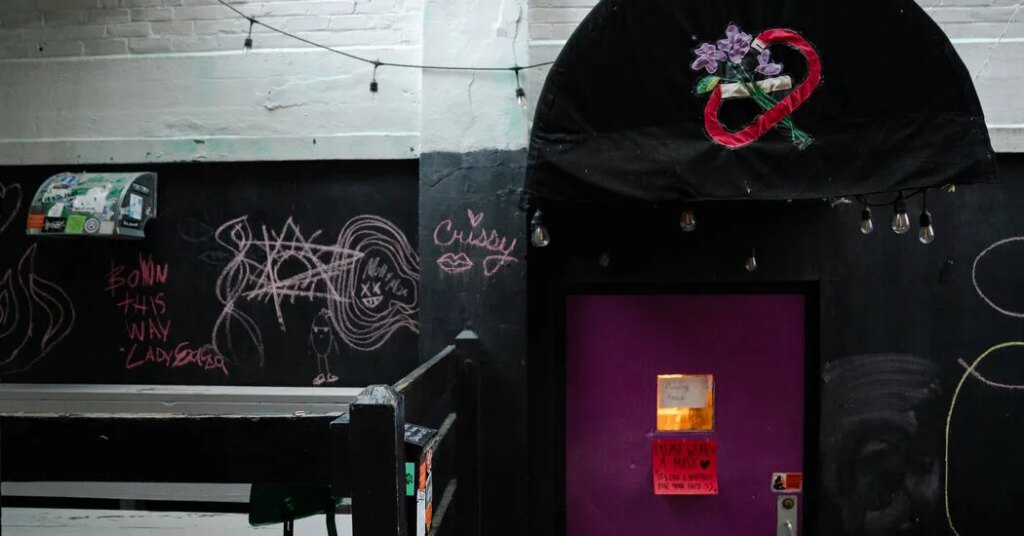
A few locals stopped by the Last Ditch lesbian bar early Saturday evening, intending to drop a few bucks to support a struggling business that had become something of a celebrity.
But the bar’s purple door was closed. Opening time was not until 10 p.m.
“I have a lot of friends in the queer community and I’d hate to see this place go under,” said Melinda McCreven, of Greenfield, who had never visited the Last Ditch, but came by to try to spend a little money.
Last Ditch, a basement bar down a set of concrete steps, beneath a Mexican restaurant, drew news coverage in Europe and the United States this week after a Boston Globe story about the bar’s plan to lift its Covid mask requirement on Saturday nights went viral.
The article came after a podcast had covered a vitriolic, hourslong meeting, when Last Ditch patrons and its owner argued over whether the bar was abandoning its mission to be welcoming to all.
Early Saturday evening, a sign on the closed door said another meeting was taking place inside.
Greenfield, a Western Massachusetts town of about 17,000, is not accustomed to the national spotlight.
As darkness fell on Saturday evening, downtown went quiet. One man with a long stringy beard sat alone on a bench, eyes cast downward. Another man in some distress yelled obscure questions at passers-by, such as “How do you build a skyscraper?” and “What kind of music is jazz?” Someone called the police on him.
A group turned away by the closed purple door at Last Ditch made their way a half-block to throw darts at the Victoria bar, a locals pub with a tiny pride flag in the window.
“Friends from all over the country have been sending me the articles about it,” said Hallie Abelman, 34, of the Last Ditch controversy. “It’s the talk of the town.” While she was being interviewed outside the Victoria bar, a man tried to bum a cigarette from her group.
“There are many different Greenfields,” said Phoebe Glick, 35, who also tried to get into Last Ditch. There are crunchy lefties, conservative MAGA fans, people of all incomes, and an L.G.B.T.Q. community migrating from places like Northampton in search of cheaper housing, she said.
Around 6:30 p.m., four people in masks came out of the Last Ditch and confronted a small group of journalists hanging around outside. When one photographer snapped a flash photo of them, they demanded he delete the picture, and threatened to call the police if other journalists didn’t leave.
Three housemates, Asa Rosario, Jackie Matellian and Sage Territo, opened the bar in 2025 as a fun place for “Dykes, Transexuals, Gender Freaks, Workers, and their friends.” Two queer bars in the region had closed in recent years, and they hoped to fill the need.
Western Massachusetts would appear to be a customer-rich environment for a such a business: Nearby Hampshire County has the largest percentage of lesbian couple households in the country, according to the 2020 census.
The bar’s sudden fame comes from the fact that it had never really left the pandemic era, even though it opened just last year.
Patrons were required to wear KN95 or better masks, the face coverings ubiquitous during the heights of Covid-19, and which most of the country had left long ago to dental hygienists and people who don’t want anyone to sit next to them on the train.
Looking back, explosive feelings over the bar’s Covid safety policy were lurking from the day the owners announced the rule on social media, shortly before opening.
One respondent posted gratitude, saying they had felt “locked out of queer spaces as an immunocompromised disabled queer.”
“With respect,” another poster wrote, unknowingly foretelling the international controversy to come, “would you consider one night per week as a mask optional evening?”
A third poster shot the argument straight to 11: “aka one night a week where disabled/high risk people aren’t welcome. where’s the respect you mentioned?”
The new bar maintained a busy event schedule after opening, with dance and karaoke parties, drag shows, watch parties for WNBA games, and a variety show billed as “Not your grandmother’s burlesque.” Promotions for Last Ditch events on social media often contained the reminder to mask up.
But in time, business fell off and the bar felt a financial squeeze. Looking to attract more customers, ownership announced on social media on Aug. 31 that the Last Ditch would go mask optional on Saturday nights.
Hundreds of comments poured in, many accusing ownership of being ableist and risking the lives of immunocompromised customers.
The anguish was catnip for online trolls. In the days after the Globe story went viral, an anti-backlash backlash emerged, with people mocking the bar’s patrons with cruel social media quips and long think pieces.
As the evening approached 10 p.m., several dozen people — couples and people in small groups — walked through light rain to Last Ditch.
Patricia Sonaike, 24, a University of Massachusetts-Amherst student, said she had become interested in visiting Last Ditch after the bar had announced its relaxed mask policy, and before the controversy had made the news. The new policy, she said, is a bid to broaden the bar’s customer base.
“People are forgetting that this is a business that needs revenue,” she said.
While she was speaking to reporters, a man approached and asked if anyone could give him exactly 55 cents. He accepted a dollar, and offered to give back change.
Two visiting professors at Smith College, LeiAnna Hamel and Gianna Albaum, said they tried to get into Last Ditch but were turned away because they didn’t already know anyone who was inside. They were told the event was a “private party.”
Come back on another day, they were advised, once the hubbub has died down.
The post The ‘Last Ditch’ Effort to Save a Lesbian Bar and How It Backfired appeared first on New York Times.