Hard by the murky brown water of the Kuskokwim River, in a region reachable only by plane or boat, past weather-stunted willows and crude seasonal fish camps, dogs roamed muddy, rutted roads under low, dreary skies.
Here in the small village of Kwethluk in the vast tundra of southwestern Alaska, in the window of a house with unpainted sides and rotting wood steps, was a campaign placard for Mary Peltola.
“We are related,” said the man inside.
James Nicori, 77, sat in his chair and unspooled his Alaska Native connection to Ms. Peltola, the Democrat running for the Senate.
“Mary’s great-grandma and my grandpa were half sister, half brother,” Mr. Nicori said. Her mother was a girl here, Mr. Nicori said. She was a girl here.
“She understands how we struggle,” he said. “She is one of us.”
Ms. Peltola, a former congresswoman, is an uncommonly capable candidate. In Alaska, where Republicans far outnumber Democrats and independents far outnumber both, she is the rare member of her party who has proved she can win statewide. This year, she has campaigned on four-wheelers and floatplanes, in Xtratuf boots and traditional kuspuk shirts worn by the Indigenous Yup’ik people of Alaska. she has made stops in locales as isolated as an island 30-some miles from Russia, curating social media snippets while playing hard-to-get with most of the mainstream press four time zones away. The approach has been largely effective. Ms. Peltola beat the Republican incumbent, Dan Sullivan, in the nonpartisan primary in August, and polling and fund-raising suggest she could do it again in November.
But in ways that have not been aired until now, Ms. Peltola, 53, is also an uncommonly complicated candidate. Genial and unassuming in public, she can be crass and apoplectic in private. Her campaign has been marred by accounts of her outbursts that left some aides unnerved. When she served in the House, she had one of the highest staff turnover rates on Capitol Hill.
The daughter of a Yup’ik woman from Alaska and a white man from Nebraska, Ms. Peltola grew up in three villages and the port city of Bethel, population 6,000, some 70 miles upcountry from the Bering Sea. She went to three different high schools and four different colleges. She has had three husbands — two children from her first, two more from her second, three stepchildren from her third — and moved from Bethel to Juneau to Anchorage and back.
Her politics are complicated, too, reflecting the idiosyncrasies of her state: She is pro-gun, pro-oil and pro-gas — but also pro-environment and especially pro-fish.
And she is, at root, a person whose people’s way of life is dying after decades of disruption to salmon fishing, the cascading consequences of climate change, corporate excess and government restrictions. There are fewer fish and more limits on fishing. People smile, but grievance stews.
In the Kwethluk Native Store, next to the sparse shelves with $6 canned chili and $7 jars of jelly, a sign warned that it was illegal to sell food stamps. In the Kwethluk Sport Store, a hand-drawn notice urged shoppers to stop huffing gas to get high.
Along another dirt road, in the house of another one of Ms. Peltola’s many relatives in Kwethluk, almost 1,000 miles from the state capital of Juneau and almost 4,000 from Washington, D.C., a wood stove burned.
“It’s getting to be hard to live,” said Alexie Nicolai, 73.
A single bulb lit the room, and a cross hung on the wall.
“My uncle, he used to tell us, ‘All the animals will go toward the ocean to die,’” Mr. Nicolai said. “He would tell us, ‘When starvation comes, it will come not just overnight, but slowly.’”
‘To know who you are’
On her first political campaign, she was in the womb.
In early 1973, in the special election that kick-started the congressional career of Don Young, Alaska’s longtime Republican representative, two of his most ardent aides were the expectant parents of Ms. Peltola.
Ward Sattler, a teacher and small-plane pilot from the Great Plains, was Mr. Young’s district chairman. Liz Ann Andrew, “an Eskimo interpreter,” in the phrasing of a local newspaper, was an indefatigable canvasser, snowmobiling from village to village in subzero conditions.
Ms. Peltola was born five and a half months after Mr. Young won.
She grew up in Bethel, Kwethluk (with a population of roughly 500 at the time), Tuntutuliak (300), Platinum (50) and Bethel again, as her parents split up. She ate moose and seal and spent her summers on the Kuskokwim, captaining tender boats and cleaning, drying and smoking salmon.
“She was doing the things that I would traditionally put in the male category,” one of her best friends, Ana Hoffman, said this month in Bethel. “She didn’t wait for a guy to come back up the boat. She would back up the boat.”
Ms. Peltola spent her sophomore year in high school at a boarding school in Bethlehem, Pa.; her junior year at Bethel Regional; and her senior year in Fort Collins, Colo., where her grandmother lived.
She went to the University of Northern Colorado, the University of Alaska Fairbanks, the University of Alaska Southeast and the University of Alaska Anchorage — but never graduated.
As a college student, she was the runner-up for the Miss World Eskimo-Indian Olympics in 1993 and then crowned Miss National Congress of American Indians in 1995, performing two Yup’ik dances and wearing a wolf-hair headdress when she won.
In an article about her achievement, she said she wanted to get into politics. “I just have this fire inside me,” she told The Juneau Empire, “when I start reading these cases about Indian rights.”
She was an intern in the State Legislature in 1996. That year, at the age of 23, she ran to be a representative herself and barely lost. In 1998, the year she married for the first time, she ran again.
Then known as Mary Sattler, she campaigned for the State House as a Democrat, prioritizing would-be voters in villages. “Villagers say Sattler is a kass’amirteq, meaning someone who acts like a white person,” a reporter from The Anchorage Daily News wrote that August. Her campaign manager, who spoke better Yup’ik than she did, doubled as her interpreter.
She gave birth to a son in October, posing with him and her husband in an ad in the local newspaper, The Tundra Drums. “I will work hard to make sure our rural way of life is protected,” she wrote. “Our people need protection from outside interests determining how we hunt and live.”
She was elected that November.
“I’d explain that my mom is from Kwethluk, my dad was a schoolteacher in these villages,” Ms. Peltola said this month in Fairbanks in an interview with The New York Times.
“I think it’s important for people to know who you are,” she said, “so they understand your back story.”
‘I am made of fish’
In the 10 years she spent at the Capitol in Juneau, Ms. Peltola was chair of the “bush caucus,” the bipartisan group representing Alaska’s most remote regions. She worked to reduce teen alcohol abuse, stressed the importance of teaching the Yup’ik language and appealed for more state aid for rural areas. “We’re sitting,” she told a local reporter, “on a powder keg of poverty and resentment.”
She started meetings in her office, where she served her colleagues salmon. She befriended Lisa Murkowski, then a fellow state representative, now Alaska’s other Republican senator.
“She was very sure of herself,” said Ethan Berkowitz, a former state representative and the minority leader at the time. “She’s incredibly proud of her Yup’ik heritage, but she was able to walk in both worlds.”
Along the way, too, she had another son, divorced, remarried and had a third son and a daughter. Managing an increasingly topsy-turvy personal life, she also missed votes nearly 20 percent of the time, according to records — in part a result of having and caring for her kids.
She did not run for re-election in 2008. She separated from her second husband in 2009 — the same year she got together with her third.
In 2010, she helped Ms. Murkowski with her Senate campaign, and she was on the Bethel City Council from 2011 to 2013. She helped the community get a public indoor pool but missed more than a third of the votes.
Away from public office, she worked for a gold-mining project and as a lobbyist.
And the fish crisis mostly kept getting worse. The Yup’iks of the Kuskokwim couldn’t fish the way their people had fished for thousands of years. In an attempt at conservation, state and federal restrictions now determined when, how and how much they could fish, a scenario utterly counter to their culture of subsistence, severing the rhythms of generations and upending their relationship with the river and the salmon.
In 2017, in an interview with The Associated Press, Ms. Peltola likened the state of affairs to “a family member being sick.”
That year, she became the executive director of the Kuskokwim River Inter-Tribal Fish Commission, an intermediary between Alaska Natives and the outside agencies establishing and enforcing the rules and regulations.
“Like nearly everyone raised on the Kuskokwim, I am made of fish,” she wrote in 2020 in the commission’s annual report. “Not only do I crave eating fish year-round, but by May and June, I physically feel the need to catch and process fish.”
But things were different now.
“I have had to adjust my mind-set,” she wrote, “because there are fewer fish.”
And then, in 2022, the death of Representative Don Young led to a wide-open scramble of a special election.
The day of Mr. Young’s memorial service on Capitol Hill, Ms. Murkowski got a text from Ms. Peltola, according to the book Ms. Murkowski published last year. She wanted advice. She was thinking about getting into the race, calling it “the most crowded clown car ever.”
Ms. Peltola jumped in.
“One thing led to another,” she told The Times, “and of all the unlikely circumstances. …”
She won.
‘Really different values’
Ms. Murkowski worried for her.
Ms. Peltola, she thought, according to her book, was “a warm, positive, smart and authentic Yup’ik woman.” Now she was in Washington. “I thought of her mostly as a friend and mom suddenly in the middle of the complex, high-pressure world of the House with no time to prepare,” wrote Ms. Murkowski, who declined a request to comment for this story. “I offered her my son’s room to stay in and tried to make sure she got fed.”
Ms. Peltola wore Native mukluk boots to her swearing-in, alongside her third husband, Eugene Peltola Jr., her children and his. “I am humbled and deeply honored to be the first Alaska Native elected to this body, the first woman to hold Alaska’s House seat,” she said in her first floor speech.
She won again in the regular election in November, earning a full two-year term. She joined the moderate Blue Dog caucus as well as the Western caucus — “106 Republicans,” as she said, “and me.” She was one of the most bipartisan Democrats, bucking her party on guns, border security and oil and gas extraction.
She also missed more than 17 percent of the votes — significantly more than most of her peers. And her uneven temperament was an all but open secret.
“Everybody who knows anything about her, she has two things: a terrible work ethic and a terrible temper,” Art Hackney, a longtime Alaska-based Republican strategist who supports Mr. Sullivan, said in an interview this month in Anchorage.
In May of her first full year in Congress, her mother died. Four months later, she lost her husband. Mr. Peltola, 57, piloting a small plane, was hauling the antlers and meat of a moose that a group of hunters had killed. He labored to take off from their tundra site, according to the National Transportation Safety Board report, and crashed on the side of a hill in low-lying bushes and shrubs. The closest hospital was 400 miles away. One of the hunters unbuckled his lap belt and covered him in blankets. Mr. Peltola died in less than two hours.
Amid her grief, Ms. Peltola lost her 2024 re-election bid, to Nick Begich, a Republican — albeit by less than three points in a year when President Trump won Alaska by 14. She moved to Anchorage and was hired by a lobbying firm, making more than $340,000, according to a financial disclosure. Last fall, she was, briefly, a fellow at the Institute of Politics at the University of Chicago, teaching a seminar she titled “Blood Lines: What Does Being Native Even Mean?”
All the while, Senator Chuck Schumer, the minority leader, worked to persuade her to run for the Senate. He considered her one of his top recruits.
“She is special,” said Lauren French, a Senate Majority PAC spokeswoman. “She has everything that it takes to be really successful there.”
Ms. Peltola thought so, too.
“I know that there’s a tendency to say people are half something, half another,” Ms. Peltola told The Times. “But I always thought of it as double. I really had, you know, double the language, double the perspectives, really different perspectives, really different values, really different worldviews — but double. And I thought that was a huge advantage.”
Behind the scenes
All summer long, she was all over — in Alakanuk and Savoonga and Nome, in Gambell and Galena and Unalakleet, in Dutch Harbor and Fort Yukon and Tok — listening to voters in school gyms, union halls and community theaters, hugging, waving and smiling on Facebook, Instagram and X.
In August, though, her campaign was on its way to a primary win and simultaneously in disarray. She fired a top adviser. She fired a deputy campaign manager. She changed her campaign manager. She made headlines for distancing herself from former Vice President Kamala Harris, who had issued a fund-raising appeal on her behalf.
Behind the scenes, as The Times reported last week, she could be a mercurial boss, with some former aides describing her as sometimes angry and profane. A spokesman for the campaign denied any pattern of abusive behavior. “Like any person who has gone through multiple personal tragedies in the span of a few months, Mary sometimes struggled to deal with her grief,” a campaign spokesman said.
Through it all, Ms. Peltola was dealing with the legal fallout from her husband’s death. She was worried about her children.
Her staff made her scarce to the mainstream press, providing scant details about where she would be campaigning. She was running what she called an “Alaska first” campaign, her staff insisted, focused on talking to Alaskans, not reporters from Washington or New York.
But on the ground, the arm’s-length strategy made more sense. During recent events in Fairbanks, Ms. Peltola didn’t sound simply off script. At times, she sounded as if she had no script.
“I’ll admit to you, every single place I go, I don’t go to the grocery store, I don’t go to the gas station, I don’t go to community events unless I have my passport,” she told a crowd that had packed a community center. She wore a blue flannel shirt and glasses with white rims. “Because early in this administration there was talk about ICE deporting Natives back to wherever it is they came from,” she said. “My mom’s family walked across the land bridge from Mongolia. …”
People laughed.
“We laugh,” she said, “at the things we’re most scared of.”
The next afternoon, at a different community center in Fairbanks, she said she had forgotten to help her 18-year-old daughter register to vote in the primary in August — but promised she would be registered for November.
She said that when she grew up in Alaska, it was “a state of abundance,” and that now “we are being starved out and nobody even cares.”
She said she wasn’t even feeling “aspirational” anymore — and just wanted to “get back to where we were in 1999.”
A few days later, at Alaska’s Senate Fisheries Debate in Kodiak, on the third anniversary of the death of her third husband, she wore salmon-shaped earrings made from the tusk of a walrus and asked moderators to repeat questions.
“Can you restate it please?”
“Say it again?”
To succeed statewide here, said John-Henry Heckendorn, an Anchorage-based Democratic strategist, a Democrat must assemble a convoluted coalition almost at odds with itself — Natives and not, rural and not, commercial fishermen and subsistence fishermen, on and on.
“Mary’s political talent,” he said, “has been her ability to inhabit those tensions.”
She inhabits those tensions because she is born of those tensions. Ms. Peltola is Alaska and Nebraska, the Yukon-Kuskokwim Delta and the Lower 48, Yup’ik collectivism and American individualism. Being “double” can be an advantage, she says, and she is not wrong. It also, though, can be a source of some untenable tug.
She is leading by a bit in polling and by a lot in fund-raising, but voters in Alaska are characteristically contrarian and unpredictable. This race, say independent analysts, could go either way.
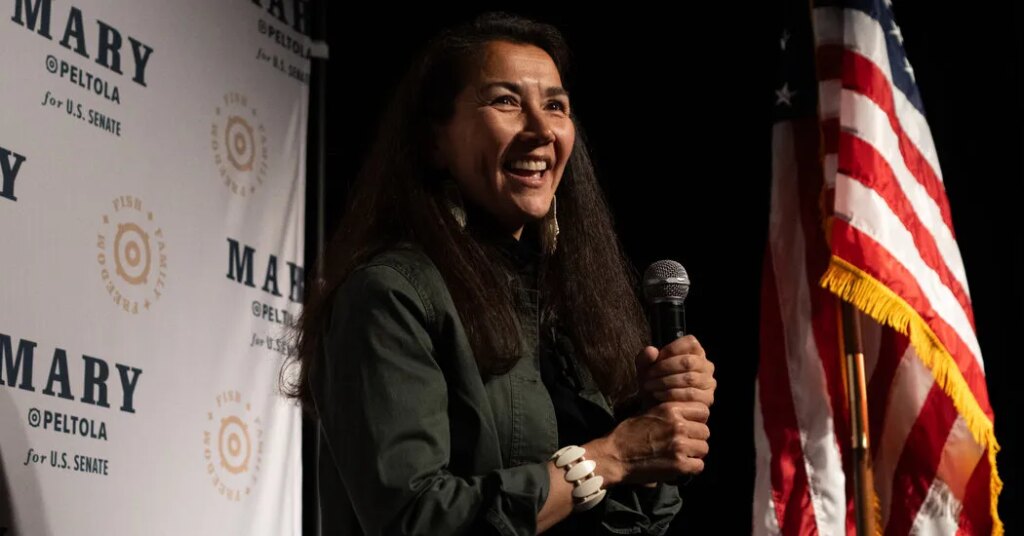
On a recent rainy, windy evening in Anchorage, at a canvassing kickoff at an Alaska Democratic Party field office, Ms. Peltola was introduced by the former president of the Alaska A.F.L.-C.I.O. Ms. Peltola was wearing black Adidas and a kuspuk. She touched her face and smiled, looked out at her supporters and began her speech.
“Where do you even start?” she said.
The post ‘She’s One of Us’: Mary Peltola’s Bumpy Rise to Political Power appeared first on New York Times.