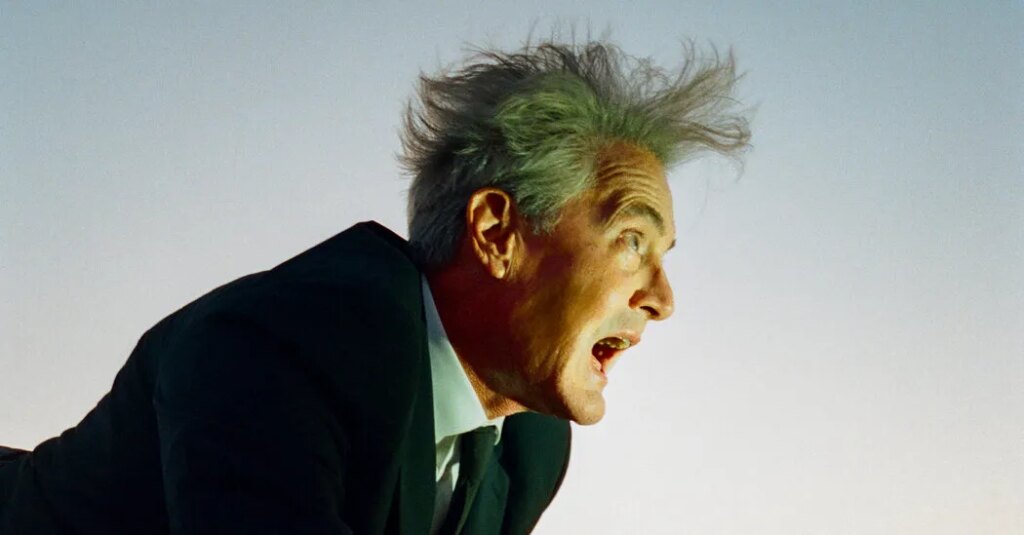
To hear him tell it, Kyle MacLachlan is not as eccentric as you might think. He plays a lot of golf. He likes to garden — or to stand, surveying his garden, with a cup of black coffee. To putter around his Manhattan apartment, where he welcomed me one recent sunny afternoon for a conversation that was notable for its genial mildness.
“I feel pretty regular — kind of boring, actually,” he told me, without actorly gloss. “Not that interesting, to be honest.”
But to know MacLachlan’s more than 40 years onscreen is to witness him as a series of weirdos — or normies in increasingly bizarre scenarios — basically from the jump. His very first role was the lead of David Lynch’s epic version of “Dune” in 1984, the beginning of a career-defining relationship with the avant-garde filmmaker that continues to disarm and enthrall fans, and MacLachlan himself.
“I put my faith in David,” MacLachlan, 67, writes in his new memoir, “Fictional Selves,” describing the audition for “Dune” and really, everything that followed. “In his simple, albeit mystical way, he gives me the confidence to get through it.”
Before the eerie oddballs of Lynch’s “Twin Peaks” and the sexually macabre “Blue Velvet,” before he portrayed a long line of what he called “doctors with issues” — including the emasculated Trey MacDougal on “Sex and the City” — MacLachlan was battle-tested by the surreal sci-fi of “Dune” when he was in his early 20s.
Constantly sprayed with smoke and sand during the seven-month shoot in Mexico, he spat up red grit at the end of each day; already lean, he lost 15 pounds during filming. The production was “insane, truly,” he said. But with no other movie experience, he thought, “This must be how it goes.”
“I can still remember the smell of the suit,” he said of his suffocating, otherworldly get-up. “It just felt like play.”
He digs into this in “Fictional Selves,” out Sept. 29 and written with Jon Sternfeld. It charts MacLachlan’s kinship with Lynch, who died last year; his roles, both earned and lost (he passed on “sex, lies and videotape”); and his romantic relationships, including with Laura Dern, his “Blue Velvet” co-star, and the actress he cheated on her with.
Going into the book project, he recalled saying: “If I’m going to do this, then it’s not all, ‘Look at me, look at all the great successes.’ You’ve got to see the other side. That was important to me.”
In the book, MacLachlan calls Hollywood “an industrial-size insecurity machine,” but he has navigated it handily, popping up in some of the most boundary-pushing TV shows and films. If it sometimes seemed as if he were being towed along in an off-kilter wake, like some dementedly gung-ho water skier — well, he knew when to keep bobbing up.
“You could call Kyle a postmodern matinee idol that was suddenly David’s to subvert,” said Graham Wagner, a creator of the dystopic Amazon hit show “Fallout,” on which MacLachlan stars as a darkly secretive father. They’ve known each other for more than a decade, having met when Wagner was a writer on the comedy series “Portlandia,” and MacLachlan played its doofy mayor.
“Kyle’s thing is to say yes,” Wagner said, whether that’s to singing the “Portland anthem” with no script or direction, or to starring in camp like “Desperate Housewives” and “Showgirls.” Wagner added, “He’s almost like a British actor — it’s full commitment with no cost to it.”
Wagner recalled when they were shooting a tricky “Fallout” scene on a specialized stage with limited takes. “It’s pressure, pressure, pressure, and then as soon as our director called ‘Cut!’ Kyle will turn to me and start doing a Popeye voice,” Wagner said. “Regardless of how heavy the work was, Kyle stayed bright and light.”
In his memoir, MacLachlan has another term for this trait; he calls himself the Great Compartmentalizer. That quality may be what intrigued Lynch, a wild visionary who also presented as an aw-shucks Boy Scout.
In “Twin Peaks,” too, as the F.B.I. agent Dale Cooper — the pinnacle role of MacLachlan’s career — he is both a Lynchian stand-in and a guide. “I feel I’m kind of walking the audience through the Lynch realm,” he said. “Like, you’re going to go to a very scary place now, you’re going to see some crazy stuff. But come with me and you’re going to be OK; we’re going to navigate this together.”
Losing the filmmaker is not something MacLachlan has come to terms with; in our conversation, he referred to Lynch in the present tense. “He is just such a big part of who I am,” MacLachlan said. They were neighbors in Los Angeles, and the actor would visit his director regularly. “He had a beautiful complex with a couple houses, these labyrinth sort of pathways,” MacLachlan recalled. “I’d see him from a distance, and he’s like” — MacLachlan dropped into an impression of Lynch’s barking voice, which in the book is represented in all caps — “‘Kale! Get out here.’” (Kale was Lynch’s nickname for him.)
Over coffee (of course) and croissants, or in Lynch’s wood shop, they reminisced or talked about film ideas — MacLachlan as an old Elvis, living in a trailer park. MacLachlan recorded some of these conversations, but Lynch asked him not to share them.
Creatively, “he was doing something every day, which was pretty inspirational,” MacLachlan said. “He was my anchor.”
Their relationship was almost legendary in artistic circles. It was symbiotic, authentic, “a staggering accomplishment,” said Ethan Hawke, a friend of MacLachlan’s. “There are a lot of other actors who would peacock around sets flaunting that, but Kyle does the opposite.”
He’s “extremely easy to be around, unpretentious, and disarming in his humility,” Hawke added.
Hawke, a co-star with MacLachlan in a cinematic “Hamlet” from 2000, said that his pal excels at playing the outer edges not because of his own quirks, “but because he’s a brilliant actor who had early exposure to great directors,” including Oliver Stone (“The Doors”) and Bruce Beresford (“Rich in Love”), in the ’90s. “And he’s carried that knowledge with him for his entire career.”
The original “Twin Peaks” discombobulated television and obsessed audiences when it aired in 1990, arguably paving the way for daring, prestige shows a generation later (in part because future creators, like Wagner, were watching). But it was in “Twin Peaks: The Return” from 2017 that MacLachlan thought he did his finest work, playing Cooper, his dastardly doppelgänger and Dougie, a blank simulacra who is primed for comedy. Lynch directed all 18 episodes himself, and when MacLachlan sees clips of it float through his social-media feed, it’s like Lynch is “alive again, and I’m feeling the energy and the joy,” he said.
His own goofy side is lately on display in his online persona. He posts skits and dances like a car lot windsock, and hosts a podcast, “What Are We Even Doing?,” on which he interviews Gen Z musicians and comedians. It’s a project he cooked up with his wife of 24 years, the producer Desiree Gruber. After dating the supermodel Linda Evangelista, he encountered Gruber at his chiropractor’s office. They have a son, Callum, a college freshman. (Callum has lent his wardrobe to his dad’s intergenerational TikToks.)
MacLachlan can still telegraph a boyish energy, though he now has a robust silver mane. In clear-framed glasses and a dark polo, slim khakis and sock sneakers, he showed me around his Manhattan space, one of two adjoining apartments in Chelsea that he and Gruber have (they mostly live in Los Angeles). The piano, the art supplies — they were all for his wife and child. He wrote his memoir in part, he said, for his son to read: One day, “he might want to take a trip down memory lane and learn a little bit more about who his dad was.”
MacLachlan grew up in Yakima, Wash., the eldest of three boys in a socially conservative family. His father was a lawyer turned stockbroker, an avid golfer who loved a routine, and his mother was a creative doer, who got her son interested in theater. His parents divorced when he was a teenager, and by doing plays and studying acting at college in Seattle, he found his niche: “I gave birth to myself,” he wrote in his book.
His mother, who died of ovarian cancer when he was in his 20s, remained a sounding board for him in his early career; he even showed her the “Blue Velvet” script (she had qualms). Gruber, a former Manhattan publicist, also helped steer him; it was at her insistence that he did “Sex and the City.”
He was nervous about being conflated with the character, whose marriage to Kristin Davis’s Charlotte implodes, in part because of his impotence. But the actors had chemistry. “I don’t think we had much time together before we were kissing all over Manhattan for the montage at the beginning of the Trey story line,” Davis recalled. After Agent Cooper, it’s the role MacLachlan is most often recognized for, he said.
Davis gets it, too. “People do still talk to me about Trey,” she said. “And online, there is often debate about whether Charlotte should have tried harder to make it work with Trey. Which is very sweet, and I really attribute that to Kyle’s talent.”
At this stage in his life, MacLachlan is a known entity. Wagner envisioned him for “Fallout” because MacLachlan once told him he wanted to do “a great big sci-fi.” But he also still sends in tapes for roles. “I think as an actor, you never are quite comfortable somehow,” MacLachlan said. “I don’t think you should ever be quite comfortable. You should just always be a little hungry.”
“I still love working,” he added. He might like to do a musical, or just showcase how he’s at ease “being me, warts and all.”
As this deceptively regular guy put it, “I like to be outside, running around, being an idiot.”
The post Kyle MacLachlan: David Lynch’s Singular Weirdo Is Secretly a Normie appeared first on New York Times.