Iran’s foreign minister said on Sunday that his country was waiting for mediators to communicate an official U.S. response to its latest cease-fire proposal before abandoning efforts to restart talks about the plan, despite President Trump’s public rejection of it.
Mr. Trump told reporters on Saturday that the proposal to reopen the Strait of Hormuz, a key shipping route in the Persian Gulf, and restart talks about Iran’s nuclear program within seven days was unacceptable, although he signaled he was open to negotiations.
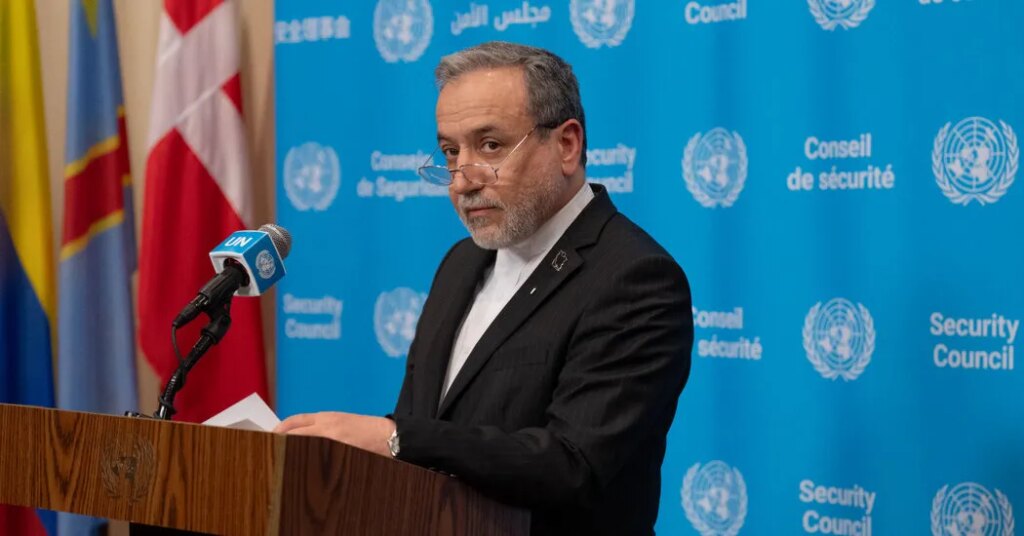
Abbas Araghchi, the foreign minister, told NBC’s “Meet the Press” that the Iranian delegation had put a “reasonable plan” forward.
“We heard from President Trump that he rejected this deal,” he added. “But we are still waiting for an official response through the mediators.”
Mr. Araghchi had earlier brushed off Mr. Trump’s comments as a “first reaction” to the proposal, which was conveyed on the sidelines of the U.N General Assembly last week. The new plan is similar to the so-called memorandum of understanding that the countries agreed to in June.
Mr. Araghchi, who is still in New York after the General Assembly session, said on Saturday that the president’s often conflicting messaging meant his comments should not be seen as the final word.
“The U.S. President has said some good things as well as many contradictory things, which unfortunately we hear from him quite often,” he wrote in a statement on social media. “We are waiting for the definitive views to be conveyed to us through the intermediaries, and we will make a decision on that basis.”
Iranian officials understand that Mr. Trump is the final decision maker on any deal, especially as the president has torpedoed previous proposals agreed to by his own negotiators, according to one mediator who spoke on the condition of anonymity because of the sensitivity of the talks. But the Iranians also suspect that the president may be taking a harsher stance in public than he is in private and are waiting for U.S. officials to provide a “translation” of Mr. Trump’s actual position, the mediator said.
Mike Waltz, the U.S. ambassador to the United Nations, criticized Iran’s proposal for asking for “everything upfront” and accused the Iranians of violating the terms of the memorandum of understanding by firing on vessels passing through the Strait of Hormuz. Iran has argued that the deal collapsed because U.S. forces were surreptitiously guiding vessels through the waterway.
“The president’s just not confident the Iranians are coming in good faith and they would truly negotiate the end of their nuclear program,” he told CNN’s “State of the Union” on Sunday.
Mr. Trump told Axios on Sunday that he expected U.S. negotiators to hold more indirect talks with Iran this week.
The Iranians likely hope that last-minute negotiations while Mr. Araghchi is in New York could prove fruitful, said Kamran Karami, a Tehran-based researcher for the Center for Middle East Strategic Studies.
“Iran may still be hoping that over the next few days, through a back-and-forth exchange of views, there may be some softening in this process,” he said.
The mediator, however, said that deep mistrust between the countries made comprehensive talks unlikely right now.
Mr. Trump has regularly oscillated dramatically between positions during the war. In his address to the General Assembly last week, he suggested that the United States could agree to a deal with Iran that would make the country “one of the greatest in the Middle East or even the world” but added that his other option was to “annihilate the Islamic Republic and do it quickly.”
Ever since the United States and Israel attacked in February to start the war, Iran has used its ability to throttle shipping through the Strait of Hormuz, a key route for oil and gas exports, to send energy prices soaring and disrupt the global economy. The country’s leaders have seen their effective blockade of the waterway as a source of leverage in negotiations with the United States, and they have repeatedly refused to make any concessions on Iran’s nuclear program ahead of negotiations.
The United States has imposed a naval blockade and tougher sanctions on Iran in retaliation, putting the country under further pressure. Iranian experts say growing economic despair among Iranians has alarmed the leadership in Tehran, wary of the kind of nationwide protests that roiled the country in January, before the war.
Treasury Secretary Scott Bessent said on Sunday that U.S. efforts to strangle Iran’s economy are working and that it is growing more desperate to make a deal. The U.S. naval blockade has prevented Iranian oil from flowing to China, the biggest buyer of Iranian oil, and estimated that there were only 15 million barrels currently at sea, he said.
“Probably within the next two weeks they are going to make their final deliveries of oil to China, and then they will have nothing,” Mr. Bessent said on Fox News. “It is an empty set, and I believe that they are feeling the pressure here. And that’s why they want a deal.”
Yet Mr. Araghchi told reporters last week that Iran would not back down on its main conditions before it reopened the Strait of Hormuz. He said that Iran’s demands included the release of roughly $12 billion in frozen assets, the lifting of sanctions on Iranian oil sales and the end of the U.S. naval blockade.
Iran secured many of those concessions in the memorandum of understanding.
Mr. Araghchi said on Sunday that Iran’s enemies had failed for months to force the country to make more concessions through military and economic pressure.
“We stand firm in the face of any new aggression,” he said.
“But at the same time, we stand ready for diplomacy,” he added. “It is up to President Trump to choose.”
Recent rounds of mediation between the United States and Iran have been led by Qatari and Pakistani officials.
Sanam Mahoozi contributed reporting.
The post Iran Still Awaits ‘Official’ U.S. Response Despite Trump’s Rebuff of Cease-Fire Offer appeared first on New York Times.