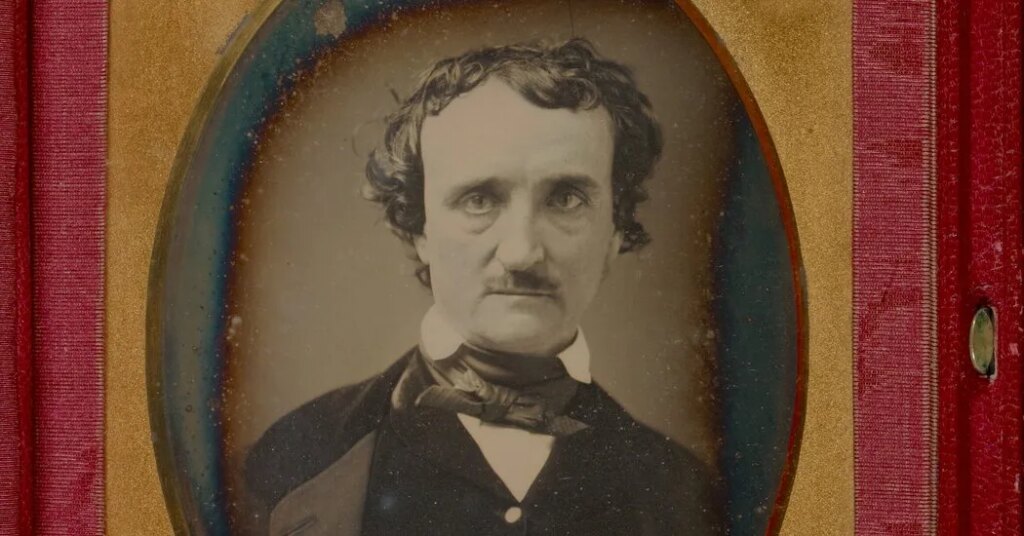
DARKNESS BECOMES BRIGHT: On the Brief Life and Immortal Art of Edgar Allan Poe, by Emily Ogden
Walt Whitman couldn’t “stomach” him. His writing gave Marie Bonaparte “night terrors.” Reading his stories for the first time, the Mexican writer Amparo Dávila found them so “terrible, terrifying” that she got diarrhea.
For Edgar Allan Poe, such responses were the very reason he wrote. Decades before authors like Oscar Wilde and Charles Baudelaire and Walter Pater — the marquee names in the aestheticism and decadence movements of the late 19th century — fought for the right to be depraved, the father of the American Gothic was not just embodying their ideal of “art for art’s sake,” he was taking it to its grisliest extremes.
As Emily Ogden writes in “Darkness Becomes Bright,” her new book about Poe and his influence, a “mysterious alchemy” occurs in his work such that “horror yields beauty. And unlike horror itself, which is intolerable, the art of horror is more than tolerable; it glows.”
A slim, engaging work of literary history and criticism by a professor of English at Poe’s alma mater, the University of Virginia, “Darkness Becomes Bright” examines his legacy through the prism of three figures he impacted directly. Baudelaire spent 17 years translating his American contemporary into French, and the result “changed the face of French literature,” Ogden says, “becoming required reading for the generations of symbolists and surrealists who followed him.”
In 1956, the Argentine novelist Julio Cortázar completed the definitive Spanish version of Poe’s stories, which he said “taught him to cross over to the ‘territory of lo otro.’” And Marie Bonaparte, Napoleon’s great-grandniece, brought his stories to her sessions with Freud; she went on to publish a 700-page psychoanalytic biography of Poe in 1933.
Into this impressionistic portrait of Poe’s “cosmic cloud” Ogden weaves elements of his depressing biography, as well as mostly gratuitous anecdotes from her own. Neither a true biography nor a comprehensive tree of his inestimable influence, this book might best be described as an impassioned defense of Poe, in aesthetic terms.
For Poe, aesthetics were personal, and his life was inextricable from his art. Orphaned as a toddler and raised in Richmond, Va., by a slave-owning foster father who would eventually disinherit him, Poe was a lifelong alcoholic who married his 13-year-old cousin when he was 27; she would die of consumption at 24, after several torturous years of illness.
He was a deeply disturbed man who, Ogden argues, made art not to teach or shape the reader, but to connect with all that was disturbing in us, too. Poe lurched toward the “darkness” and perversity the rest of us shrink from, for no other reason than to bring us within reach of the sublime.
As a critic, Ogden is both incisive and eloquent. Driving home the power of Poe’s first-person narration — the “haunted ‘I’” who is “our shared repository for the acts and drives that are hardest to confess” — she submerges her own “I” in the murk of his imagination: “In Poe’s stories, I wall a friend into a living tomb to avenge an insult. I murder someone to avoid his gaze. I mutilate my pet. I lie next to my dead wife, thinking about another dead woman. Buried alive, I scream for help; no one comes.”
She applies the same critical skill to the man himself. Without using the term “hyperesthesia” — a perceived, often pathological sharpening of the senses — Ogden rests much of her analysis on the presumption that Poe had it. In a biographical detail she returns to repeatedly, shortly before Poe’s mysterious, dramatic death in 1849, he showed up on a friend’s doorstep in Philadelphia, certain he was being chased by assassins. He claimed his hearing had become so “wonderfully acute” (Ogden’s words) that he could hear his pursuers whispering their intentions on the train.
Ogden cleverly connects this incident to “the fantasy of mastery” epitomized by Poe’s creation Auguste Dupin, the freakishly perceptive amateur sleuth who became a prototype for Sherlock Holmes, among others. She also alludes to Poe’s strange insistence that he wrote “The Raven” — a poem mourning a dead lover — not out of grief for his own dying wife, but rather to produce a carefully calculated emotional response from the reader.
“He sounds heartless and creepy,” Ogden allows, but rather than taking him at his word she offers an apology worthy of his decadent adherents. “The dream life Poe accessed in his writing and in his periods of madness was one where he had clarity and a perfect control that sometimes reassured, sometimes sickened him,” she says. Far from unfeeling, Poe felt so much that he was determined to make the reader feel something, too.
It’s worth noting how long ago this was. It would be at least 100 years before Nabokov and William S. Burroughs, let alone Bret Easton Ellis, Ottessa Moshfegh and Tony Tulathimutte, would push the provocateur into the literary mainstream. Well after Poe, the puritanical Victorians were still trying to hold the artist responsible for shaping social mores; the Marxists still thought all art had to foment revolution.
Couldn’t the pursuit of beauty be an end in itself, Poe asked, even if it was found in the gutter? Weeks before he died, he delivered his final lecture on “The Poetic Principle,” in which he denounced “the heresy of the didactic”:
Would we but permit ourselves to look into our own souls, we should immediately there discover that under the sun there neither exists nor can exist any work more thoroughly dignified, more supremely noble than … this poem written solely for the poem’s sake.
Poe didn’t just look into the human soul, he took a scalpel to it. What he found there wasn’t pretty. It was his words that made it radiant.
DARKNESS BECOMES BRIGHT: On the Brief Life and Immortal Art of Edgar Allan Poe | By Emily Ogden | Viking | 226 pp. | $30
The post For Edgar Allan Poe, Horror Was a Vehicle for the Sublime appeared first on New York Times.