On a spring day last year, Andrew Willoughby drove three and a half hours to a cheap motel in Nags Head, N.C. From the parking lot, he texted a stranger he had met online.
Julia Van Etten appeared, ushering him past a “Do Not Disturb” sign into one of the motel’s $80 rooms, which she had secretly turned into a makeshift lab. Jugs of brackish water lined the walls. Buckets overflowed with hunks of marsh grass. Bedside tables served as microscope stands.
“Oh my god, these people are legit,” Dr. Willoughby, a biologist who studies plant genomes, thought to himself as he found a spot to sit on the corner of the bed.
Over the next few days, a small group of scientists led by Dr. Van Etten, an evolutionary biologist, scoured drops of water for swamp algae. The team — brought together, in part, by disruptions and despair over the Trump administration’s freezes to federal science funding — then made an exciting discovery.
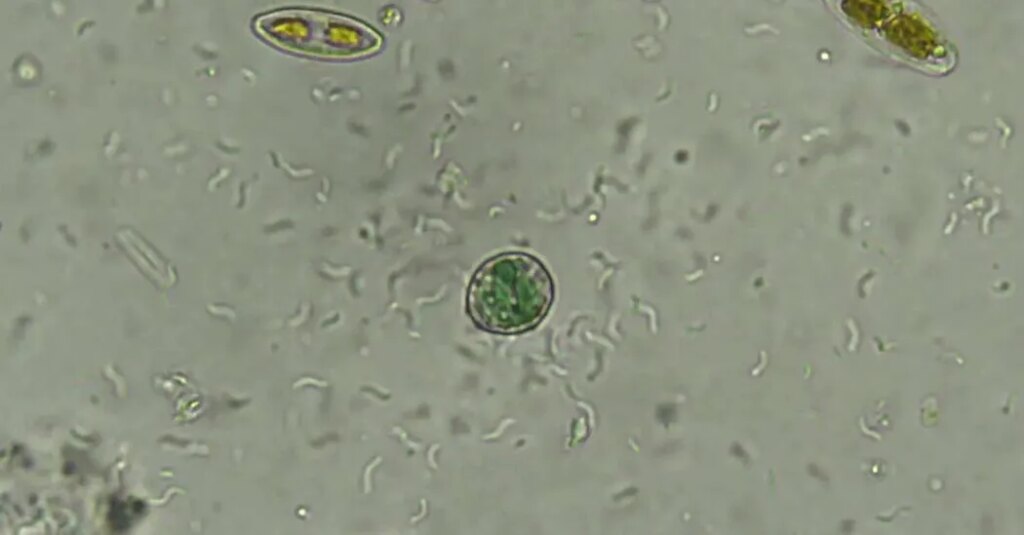
In the Journal of Phycology, Dr. Van Etten and her colleagues describe their motel-room find: two new species of a single-celled organism called Paulinella, a scaly, grenade-shaped microbe with sausage-shaped green lumps inside. Their discovery brings the world’s known total of photosynthetic Paulinella species to six.
What makes Paulinella important to biologists? Almost all complex photosynthetic life on Earth, from redwood trees to ferns to algae, traces back to an event 1.5 billion years ago. That’s when a single-celled organism engulfed a photosynthetic bacterium, turning it into a kind of energy-generating packet — what scientists call an “organelle.” But two decades ago, biologists discovered that this photosynthetic merger had happened a second time, in Paulinella, about 100 million years ago.
Because it happened so recently, evolutionarily speaking, Paulinella’s biology might offer a window into that first, improbably profound event: the moment when the planet began to bloom, becoming an oasis for life in the vast, dark emptiness of space.
The pivotal event that underlies plant life on Earth is hard to study because it’s so ancient, said Angela Oliverio, a biologist at Syracuse University who was not involved in the study. But in Paulinella, it’s not complete — like seeing a snapshot of the process midway through.
“It’s really amazing to me,” Dr. Oliverio said. This “represents the only other case right now of where this chance evolutionary event occurred.”
Studying Paulinella, scientists hope, will elucidate one of the most fundamental transitions in the history of life on our planet — and possibly give clues to how it might happen elsewhere in the universe. It could also provide practical insights on how to engineer photosynthetic organisms from scratch. At the very least, the quest illustrates the curiosity, tenacity and human relationships that advance knowledge.
A ‘couch microscopist’
The first species of Paulinella was discovered on Dec. 24, 1894, in the sediments of a backwater of the Rhine River by the German biologist Robert Lauterborn. He named the genus after his stepmother, Pauline. But it wasn’t until 2005, with the use of genetic analysis, that scientists learned that the supposedly unique event that shaped plant life on Earth wasn’t actually unique. Since then, scientists had documented only three other species.
In some ways, that’s not surprising. The planet is teeming with hidden biodiversity that has never been formally cataloged. And Paulinella doesn’t make finding it easy. It’s scarce, outnumbered by other microbes in water samples. It’s small. It grows slowly, if at all, in labs.
“No graduate student wants to work on an organism that takes four to five days to double — you’ll get that Ph.D. in 10 years,” said Arthur Grossman, a plant biologist at Carnegie Science, a research institution.
Dr. Van Etten’s own voyage of discovery began when she found herself stuck on a rainy family vacation in North Carolina. She was a graduate student at Rutgers University at the time and a self-declared “couch microscopist,” spending much of her free time hunched over a $300 microscope on her sofa looking for life in water droplets.
Her mother knew what would cheer her up: She urged her to go outside and take some samples.
Dr. Van Etten didn’t expect much from the water she had scooped from a random dock next to the highway. But among a mash of yellowish-brown plankton, she spotted a small green dot. She zoomed in, and then she shrieked.
“OMG,” she texted to her doctoral adviser at Rutgers.
It was an elusive Paulinella cell — like finding a needle in a thousand haystacks.
To be sure of what, exactly, she was looking at, Dr. Van Etten needed to find more specimens and isolate them. Over the next four years, she made a few return journeys to North Carolina to gather more samples, but it wasn’t until 2025 that she made her most fruitful trip — as the scientific career she’d long dreamed of seemed to be in jeopardy.
In January of that year, a week after President Trump was inaugurated, the White House budget office issued a memo announcing a freeze on federal funding, pending a review of whether the money supported activities that conflicted with new administration priorities, including ending diversity, equity and inclusion programs.
The National Science Foundation took its payment system offline.
Dr. Van Etten — then a research fellow at Woods Hole Oceanographic Institution on Cape Cod — was one of those locked out of her prestigious, $60,000-a-year fellowship from the National Science Foundation.
Dr. Van Etten kept working unpaid, under a cloud of uncertainty. A group chat with roughly 300 scientists, which had been used mainly for advice during tax season, turned into a career lifeline. The scientists — early in their careers and who often had little financial cushion to bridge even one missing paycheck — shared information, strategized and commiserated.
One day, Dr. Van Etten shared that she was having a particularly difficult time. A few moments later, Dr. Willoughby showed up in her DMs.
As with so many of the freezes to federal funding, this one was disruptive and confusing, but temporary. A judge stepped in, the Trump administration rescinded its memo and the science foundation turned its payment system back on a week later. Some scientists did lose funding because their grants were deemed “not aligned with program goals.” Many, like Dr. Van Etten and Dr. Willoughby, were shaken but able to resume their work.
The story could have ended there. Instead, the episode catalyzed a new scientific collaboration.
A mouth pipette and a steampunk toothbrush
Dr. Van Etten and Dr. Willoughby are both biologists, but they might as well have been working in different worlds. Dr. Van Etten’s focus was on microbes. Dr. Willoughby, a postdoctoral researcher at Duke University, spent his attention on a group of flowering plants called streptocarpus, which includes houseplants like the Cape primrose.
Thrown together by hopelessness and fear, Dr. Van Etten and Dr. Willoughby started to talk science. She told him about her next trip to hunt for Paulinella.
“You should totally come,” she said.
Which is how, in spring 2025, Dr. Willoughby found himself squeezed into an improvised lab with Dr. Van Etten and John Burns, a senior research scientist from Bigelow Laboratory for Ocean Sciences in Maine.
Within minutes of Dr. Willoughby’s arrival at the motel, Dr. Burns started deploying a steampunk scientific instrument hacked together from materials found at the local 7-Eleven. He had superglued bristles from a toothbrush onto a colored pencil and used it to poke the microbes around.
Then, he whipped out a tool that made Dr. Willoughby gasp: a mouth pipette. Dr. Burns sucked on the end of a tube, like a straw, to separate the rare Paulinella specimens from the surrounding stew of life.
“Old school,” Dr. Willoughby said. “This is like biology I don’t do.”
As Dr. Van Etten and Dr. Burns brought Dr. Willoughby up to speed on their field work so far, they described how some Paulinella were shorter and tended to be free-floating, while others were longer and stuck to plants. Dr. Willoughby made sketches as part of his scientific process and pulled out his laptop to start drawing.
He noticed that the scales were overlapping one another in different directions — in one, they overlapped on top of each other in a clockwise pattern, and the other was in reverse.
The fresh eyes of a person who hadn’t been staring at Paulinella for hours identified a curious, distinctive trait. Were they looking at two different species?
At the end of the weekend, Dr. Willoughby drove home and Dr. Van Etten and Dr. Burns road-tripped to his lab in Maine. There, they put the specimens into an electron microscope. The differences were stark under such high resolution.
Their excitement grew — this quixotic scientific side project could actually yield new scientific knowledge.
Two new species come into focus
All plants on Earth contain plastids, a basic photosynthetic engine. And plastids can be traced back to that one event some 1.5 billion years ago, when a single-celled organism merged with a photosynthetic bacterium. In Paulinella, the photosynthetic engine is called a chromatophore — a once-free living bacterium that still has its own DNA.
The team extracted that DNA and sent the samples to a lab in South Korea, led by Hwan Su Yoon, an evolutionary biologist at Sungkyunkwan University who previously discovered another species of Paulinella. He is also studying a potential new one he scooped up at a pond in his town.
Dr. Yoon performed DNA sequencing and confirmed that these were, in fact, two new species.
Studying more species of Paulinella can guide scientists like Dr. Yoon, who dreams of one day engineering a new photosynthetic organism — doing in a lab “the same trick nature has only pulled off twice,” he said. It can also shed light on the fundamental question of how complex life developed on Earth.
“It can teach us a lot,” said Sergio Muñoz-Gómez, an evolutionary biologist at Purdue University. Complex life on Earth emerged in part by stealing metabolic tricks from bacteria, exactly as Paulinella is doing, Dr. Muñoz-Gómez said. “Some people speculate that if you were to find complex life elsewhere in the universe, you would have something like” this, he continued, where two organisms merged with mutual benefits.
The problem is that those events happened so long ago that the molecular details — a complex choreography in which two independent life-forms became one in an intricate, step-by-step process of trading and losing genes — are shrouded in mystery. In Paulinella, an analogous process happened much more recently, allowing scientists to probe the details.
Dr. Van Etten and Dr. Willoughby have already teamed up for the next stage of research, partnering with citizen scientists and hobbyists to try and discover even more species of Paulinella. The funding freeze that brought them together was temporary, and both of them were able to continue their research and get paid. But it underscored that science wasn’t just a career path — but a way of life.
“We’ll always be doing this stuff; it’s part of who I am,” said Dr. Van Etten, who is setting her lab up at the University of Maryland this fall. “My little project here has big implications for evolutionary biology. Think of it: if more people were doing this, how many things we’d be learning about the planet and our health and where we came from.”
The post In an $80 Motel Room, a Discovery to Shed Light on the Origins of Life appeared first on New York Times.