El Niño threatens to dump torrential rains on California this winter. With a megadrought in the American West since 2000, that water should be welcome.
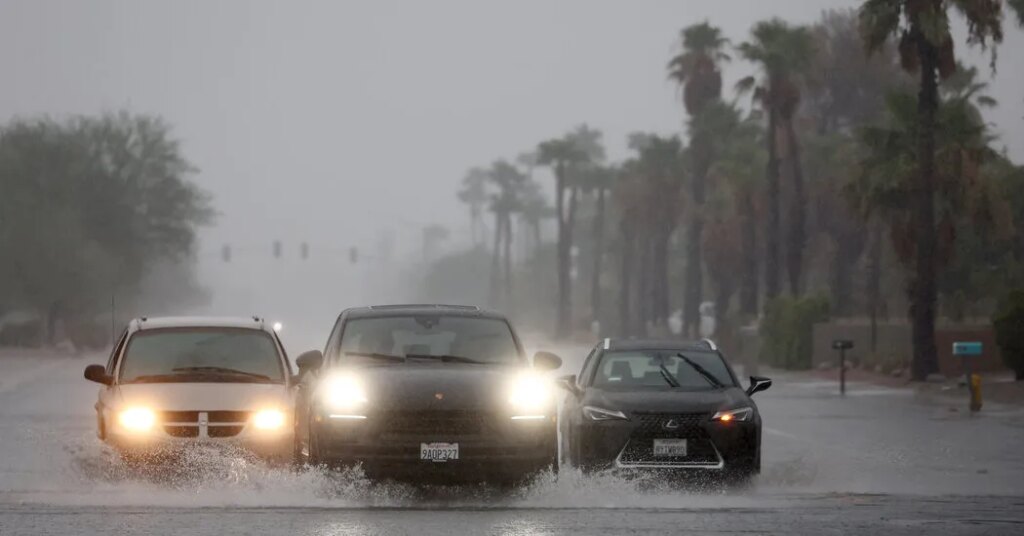
But there’s such a thing as too much water. All that rainfall can outpace the state’s ability to capture and store it for when the dry years return, gushing into the Pacific Ocean but not before causing floods and mudslides.
“We all hope that it’s wet,” said Stephanie Anagnoson, the director of water and natural resources in Madera County in the state’s agriculture-dominated Central Valley. “But maybe not too wet.”
El Niño, a phenomenon that naturally occurs every few years, tends to bring wetter-than-average weather to California and the Southwest. It can send streams of moisture known as atmospheric rivers into the West Coast, pummeling communities with days of rain and snow that can account for most of the region’s annual precipitation. The current “super” El Niño, which is still gathering strength and will continue into 2027, is expected to be one of the most powerful on record.
Gov. Gavin Newsom of California, a Democrat, declared a state of emergency this week, well before El Niño’s usual winter peak, mobilizing disaster resources and encouraging communities to prepare. State emergency officials have gathered millions of sandbags and hundreds of tons of rock around the state, ready to help divert floodwaters and shore up levees.
This El Niño will also test a decade-long effort by California officials to improve the state’s capacity to capture and store rainwater. That’s becoming increasingly important as climate change has created weather whiplash between extremes of drought and rainfall.
California receives an average of 200 million acre-feet of water in the form of rain and snow each year. (An acre-foot is enough water to cover one acre at a depth of one foot, roughly enough to supply about two to three households for a year.)
The state’s reservoirs can hold 50 million acre-feet of water while its groundwater aquifers can hold more than one billion acre-feet of water, according to the California Department of Water Resources.
“I think we’re going to learn a lot of lessons if the El Niño is what everyone is telling us it’s going to be,” Daniel Curtin, a member of the California Water Commission, said at the panel’s September meeting. “We’re going to learn a lot of lessons about how we need to prepare for the future.”
During two of the most powerful El Niños to date, in the winters of 1982-83 and 1997-98, the state received nearly twice its usual precipitation.
“It’s not a guarantee that you’re going to see something like ’83 and ’98,” said Michael Anderson, the state climatologist. “Those were so impactful it kind of sticks in everybody’s minds.”
In the winter of 2022-23, there was no El Niño but repeated atmospheric rivers dumped record-setting rainfall and mountain snow. The deluge ended a yearslong drought across California.
Water managers rushed to siphon from raging rivers and recharge depleted aquifers. Some communities were poorly equipped to capture the unexpected surplus before those trillions of gallons washed into the Pacific Ocean.
State officials have spent the years since readying basins and pumps that can channel extra water underground.
They created temporary permits to allow communities to legally capture excess water, directing it onto fallow fields and into basins, where it could resupply the groundwater. The state helped dig those basins and buy or rent temporary pumps that could pull water from flooding rivers. Since California passed a key groundwater management law in 2014, communities have spent billions on more than 1,500 projects to sustain and replenish aquifers.
Communities like Madera County created programs for farmers to earn credits for groundwater recharge by flooding basins or fields. That permits them to pump extra groundwater during dry times.
“This is their onetime to increase their water budget,” Ms. Anagnoson said.
So far, though, all that work hasn’t reversed decades of shrinking groundwater supply. The state channeled 4.6 million acre-feet of water into aquifers during the wet months of 2023 — about as much as 10 million to 15 million households use in a year — but only 1.9 million acre-feet to aquifers in 2024 and 1.1 million acre-feet in 2025.
Groundwater has declined by 8.1 million acre-feet since 2019, according to the California Department of Water Resources, so, overall, the state still lost water. A study published this month in the journal Geophysical Research Letters found that only heavy snowpack, and not rain alone, can meaningfully increase California’s groundwater.
In the drought-stricken Colorado River Basin to California’s east, El Niño could also increase precipitation. But that is less likely in mountain headwaters in Colorado, Utah and Wyoming, where spring and summer snowmelt generate most of the river’s flow.
The post California Needs Water. El Niño Might Bring Too Much. appeared first on New York Times.