The Democratic primary for Iowa’s open Senate seat presented exactly the kind of scenario that Jon Soltz, the co-founder of VoteVets, is always searching for: one where his organization could play an outsize role in shaping a race.
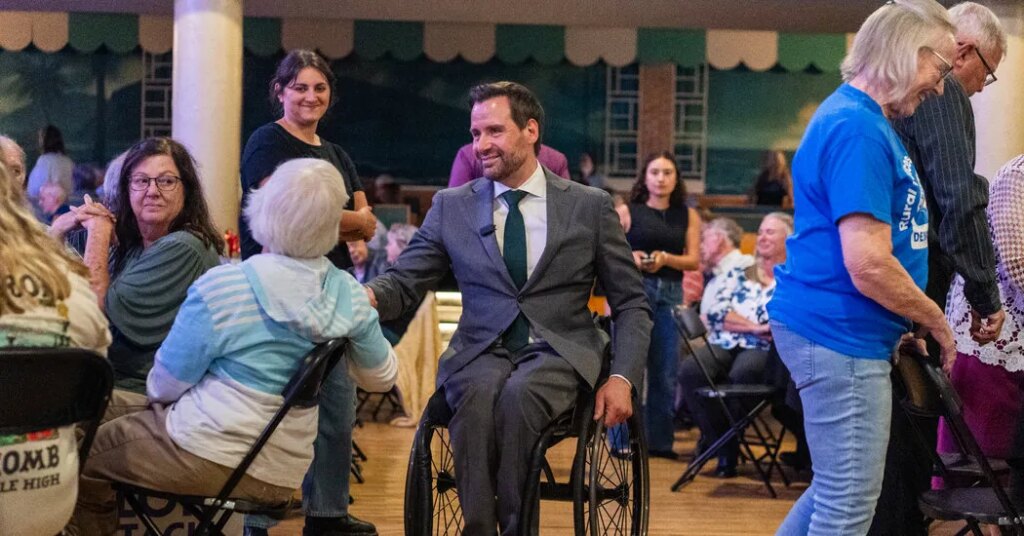
Two little-known Democrats were vying for the nomination, in a contest where no outside group was spending. So Mr. Soltz poured money into the campaign of Josh Turek, a state legislator and a former Paralympic gold medalist, who did not serve but was born with spina bifida after his father was exposed to Agent Orange in Vietnam.
The first infusion of cash from VoteVets — $825,000 in March — was more than Mr. Turek’s opponent, Zach Wahls, had on hand at the end of 2025. (VoteVets entered the race only after Nathan Sage, a veteran of the Iraq war, dropped out of the primary.)
And VoteVets kept spending, totaling an eye-popping $9.7 million on digital and television advertising, as well as direct mail, in a race that Mr. Turek won and is now viewed as within reach for Democrats.
The group is shoveling an additional $4.5 million into ads hitting his Republican rival, Representative Ashley Hinson, for her support of the war with Iran. (Ms. Hinson this week called for an “immediate end” to the war after voting a half-dozen times against directing President Trump to halt it.)
It is the starkest example of the extensive role the organization, formed in 2006 to support Democratic veterans running in opposition to the war in Iraq, is playing in shaping this year’s midterm elections as a different conflict in the Middle East has again soured voters on the party in power.
“Iowa is in play because we helped put it in play,” Mr. Soltz said in a wide-ranging interview this month. “If Democrats take back the Senate, it could be because of Iowa, and if that happens, then I can sit here and say this is the most successful cycle VoteVets has ever had.”
Overall, VoteVets plans this year to spend $60 million on 331 Democratic candidates nationwide — 20 House and Senate candidates and 311 down-ballot races — the most since it was founded. That makes it one of the most substantial single-issue advocacy groups operating in the midterm cycle, and one of the main groups spending the most to support Democratic candidates.
The only other such organization that comes close is the United Democracy Project, the super PAC associated with the American Israel Public Affairs Committee that has spent about $54 million so far this cycle and is likely to spend much more.
VoteVets operates independently, but its interests often align with those of the Democratic congressional leaders. It also coordinates with other outside groups on endorsements and then bundles money under its own umbrella. While the majority of the group’s money comes from individual donors, a substantial portion comes from big labor unions and corporate PACs, including those associated with Honeywell, General Motors, General Dynamics and Elevance Health.
“I call candidates all the time, and they can send me donors,” Mr. Soltz said. “Perhaps another organization cares about a race, but we’re the better brand.”
Over the years, the group has expanded its mission beyond supporting veterans to elevating candidates with national security backgrounds as well as people like Mr. Turek, whose lives have been shaped by a family member’s service and who understand a different facet of the human cost of war.
Mr. Soltz, who served in multiple tours in the Iraq war and other deployments overseas, is currently out to elect a new slate of Democratic veterans, including many women, at a time when opposition to the war in Iran is dragging down Mr. Trump’s approval ratings and bringing Republicans with him.
It is happening as democratic socialist candidates have received outsize attention for defeating establishment contenders in primaries across the country.
But VoteVets’ millions could be a more decisive factor in some of the critical races in which Democrats are looking to unseat Republicans to win control of the House.
In upstate New York, the group has spent $1 million on behalf of Cait Conley, who served in combat in Iraq and Afghanistan, in her race to unseat Representative Mike Lawler, a major infusion of cash for a House race. In Arizona, the group has money on hold to put behind Jo Mendoza, a former Marine drill sergeant running against Representative Juan Ciscomani. In New Jersey, the group is spending $1.2 million for Rebecca Bennett, a Navy veteran looking to unseat Representative Thomas H. Kean Jr. And in Virginia, the group is planning to spend to back Elaine Luria, a Navy veteran, against Representative Jen Kiggans.
VoteVets also played a significant role in financially boosting Luke Bronin, the former Navy intelligence officer who defeated Representative John B. Larson, the 78-year-old Democrat who was seeking a 15th term in his solidly blue district.
“We have no issue with Larson,” Mr. Soltz said. “It’s about the fact that we can get a veteran into Congress for the next 30 years, to be the chairman of the House Veterans Committee or Foreign Affairs. That’s our interest. If you only work in flippable seats, then when the wave comes in, you will lose.”
Special interest groups have long played a prominent role in elections, but some ethics experts said that an organization as powerful as VoteVets could potentially eclipse the candidates themselves.
“It’s a broader trend where outside groups are coming to just dominate the most competitive races and increasingly competitive primaries,” said Daniel Weiner, the senior director of the Brennan Center’s Elections and Government Program. “That is risky when they start to drown out candidates.”
Still, Mr. Weiner said that VoteVets was the exception in an arena increasingly dominated by outside groups that seek to hide how they are influencing elections, because it runs ads on the issue it actually stands for and has a clear agenda that voters understand.
“That is increasingly not the norm,” Mr. Weiner said. “The norm is more shadowy groups where voters don’t know what it stands for or who is behind them.”
Andrew Mayersohn, a researcher for the watchdog group OpenSecrets, said that he classifies VoteVets as “partially disclosing” its donors, meaning that more than 5 percent of its money comes from dark sources that are not disclosed. That is because it has its own nonprofit set up under the 501(c)(4) section of the tax code whose donors are not required to be publicly disclosed.
The group has had some setbacks this cycle. It heavily backed Maura Sullivan, a Marine veteran, in a New Hampshire primary she lost to Stefany Shaheen, the daughter of Senator Jeanne Shaheen, a political powerhouse in her state. And in one of Michigan’s most competitive districts, VoteVets backed Matt Maasdam, a former member of the Navy SEALs, in a heated primary he lost to William Lawrence, a progressive activist and co-founder of the Sunrise Movement.
When VoteVets was founded 20 years ago, it was still uncommon for Democrats to attack Republicans on military issues, which had long been seen as one of the G.O.P.’s strongest suits.
The organization burst onto the political scene with a searing ad that showed a mannequin dressed in the body armor given to soldiers in Iraq getting shredded by bullets, and targeted Republicans who voted against a Democratic proposal to provide $1 billion to outfit U.S. troops with more modern equipment.
Representative Pat Ryan, a New York Democrat who completed two tours in Iraq, credits VoteVets with providing the financial and political support for him to win a 2022 special election that many in his party thought was out of reach.
“This linking of military service and fighting for core American freedoms as a thing that the Democratic Party should absolutely, unabashedly own and dominate on is a huge value-add to the party,” Mr. Ryan said in an interview.
“In 2003, I desperately wish there had been leaders who could say, ‘I fought for the country; this is going to make us less safe, less prosperous’ — and to do it right out of the gate,” he said. “I’m super proud that we as vets, with VoteVets driving that, stood from Day Zero of this war in Iran and said, ‘This is bad.’”
Senator Tammy Duckworth, the Illinois Democrat and former helicopter pilot who lost both of her legs in the Iraq war when her aircraft was hit with a rocket-propelled grenade, was the first candidate VoteVets ever backed, in her first race in 2006, which she lost. She now refers to herself as “Candidate Zero” for the organization.
Ms. Duckworth said the organization has been key to her political success ever since. When opponents have tried to brand her as overly sympathetic to Syrian refugees posing a national security risk, or have raised questions about the circumstances of her injuries in the Iraq war, VoteVets has been there to defend her.
“You’re weak when you have to defend yourself,” Ms. Duckworth said in an interview. “They come in with a very strong message that just penetrates in a way that no one else knows how to do.”
Mr. Soltz is already eyeing how he can shape the 2028 field. He said he speaks regularly with Senators Mark Kelly and Ruben Gallego of Arizona and Elissa Slotkin of Michigan, as well as former Transportation Secretary Pete Buttigieg — all of them veterans or people with national security backgrounds. He is not ready to pick a favorite just yet.
“The only thing that could overtake this year,” he said, “is if we help elect a Democratic veteran president.”
The post Antiwar Veterans Group Spends Millions to Elect Democrats, Shaping Midterms appeared first on New York Times.