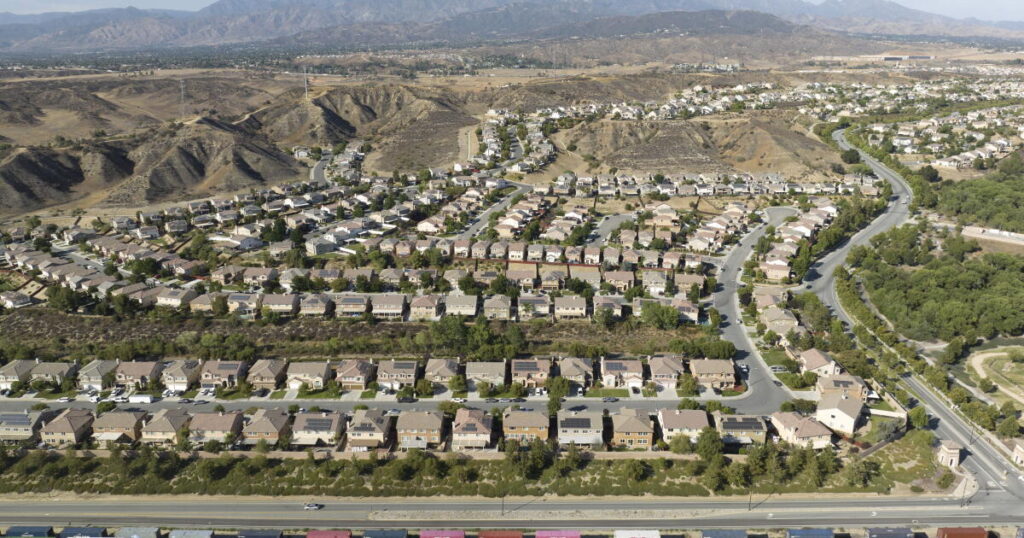
For generations, the Inland Empire was considered one of Southern California’s best real estate deals.
As development slowed in coastal regions, Riverside and San Bernardino counties continued to see booming new housing tracts that cost significantly less than coastal communities — as long as you could handle longer commute times and higher temperatures. But now, housing anxiety is gripping the region.
A new report from the Public Policy Institute of California found that affordability is becoming a bigger problem across the Inland Empire.
The think tank studies California’s political geography every few years, gauging which issues residents care about the most. In its 2020 report, coastal communities such as L.A. and the Bay Area were the most concerned with housing affordability. But now, San Bernardino, Riverside and Kern counties — once considered bastions of affordability — are all right there with them.
In all three counties, more than 60% of people called housing affordability a big problem. East San Bernardino County saw a 17% jump compared to the 2020 survey. West Riverside County saw a 12% jump. Kern County saw a 22% jump.
Eric McGhee, the researcher who authored the report, said migration patterns account for growing stress in the Inland Empire. During the pandemic, tens of thousands of people left L.A., Orange and San Diego County for San Bernardino and Riverside counties.
“People who can’t afford to live in the Bay Area or L.A. can move somewhere else, like the Inland Empire, where housing is generally cheaper,” McGhee said. “But that leads to people with higher incomes moving to areas with lower incomes and bidding up housing prices.”
Inland Empire residents have fewer choices than coastal migrants, he added. It’s not as simple as moving somewhere cheaper because they’re already in a relatively cheap area. So they either move out of state, get a roommate, become homeless, or, most commonly, simply swallow the increased housing costs.
The stress seems warranted; Inland Empire price increases are outpacing L.A.
Since the start of 2020, the median home value in L.A. County has risen 35%. Over the same stretch, median home values rose 48% in San Bernardino County and 50% in Riverside County, according to Zillow.
In 2022, the median rent for a one-bedroom apartment in the Riverside-San Bernardino metro area was $1,306. This year, it’s $1,959 — a 50% increase in four years.
“Back in the day, if it was cheaper to buy than rent, people bought,” said Joseph Huelskamp, a real estate agent in Riverside. “But right now, both mortgages and rents are going up, and people don’t know what to do. That’s when the anxiety comes in.”
Huelskamp said coastal buyers are moving farther out into the Inland Empire. Earlier this year, he sold a home in Hemet to a family with jobs in San Diego. That’s a two-hour drive on a good day.
“Most sellers are at retirement age, and they’re relocating out of state,” Huelskamp said, adding that elderly people with fixed incomes are the ones most affected by rising rents.
Huelskamp said many renters are hanging onto cheaper, rent-controlled apartments for years because if they move, they won’t be able to afford the rates of the current market. He knew one tenant who was paying $1,700 per month. When they left, their landlord rented the same unit for $3,500.
The frustration is pouring over online. In a Reddit post discussing expensive rent in the Inland Empire, one user wrote that they’re spending $2,800 on rent and blamed it on people moving there from Orange County and L.A.
“It’s insane, most places have more than doubled in the past ten years,” wrote someone paying $1,350 for a studio in Redlands.
“IE rent prices never made any sense to me,” wrote another. “Barely … cheaper than OC/LA but you get absolutely zero of the benefits of those cities.”
Meanwhile, the percentages of people who called housing affordability a big problem in the PPIC study actually went down in some L.A. areas: 2% less in the coastal L.A. region and 6% less in the central L.A. region compared to 2020.
It’s not a big surprise given that L.A.’s rents have largely remained flat in recent years. Earlier this year, the median rent in the L.A. metro area dropped to a four-year low.
Traditionally, the Inland Empire has had significant lower housing prices and rent compared to coastal areas like L.A., Orange County and San Diego; that’s in part because of longer commutes and greater distance to major city centers. The region has seen more job growth thanks to the boom in the logistics economy, but studies have found those jobs often don’t pay enough to afford homes.
The pandemic prompted some people to leave coastal cities like Los Angeles and San Francisco, with some citing a lack of affordability. During this period, the population boomed in San Bernardino and Riverside counties, thanks in part to new housing tracts and lower prices.
This PPIC survey is just the latest to raise alarms about Inland Empire affordability. A 2022 UC Riverside study found only 31% of Inland Empire households could afford to purchase a median-priced home.
Census data tracks burdened households, or households that spend more than 30% of their income on housing; nationally, the median homeowner spends 21.4% of their income on housing, while the median renter spends 31%. In 2024, the most recent year with available data, more than 41% of households were burdened in both San Bernardino and Riverside County.
In the aforementioned Reddit post, a Corona resident wrote that they’re spending roughly 50% of their paycheck to rent a duplex.
“It sucks, but I like where I live,” they posted.
The post The Inland Empire was once a bargain. Now, rising home prices, coastal invasion bring anxiety appeared first on Los Angeles Times.