If there is one person who represents the frontier of Chinese artificial intelligence, it is Tang Jie.
The soft-spoken data engineer is the co-founder, chief scientist and largest individual shareholder of China’s leading artificial intelligence lab, Z.ai, whose models have risen to the top tier of China’s performance tables and made Mr. Tang the flag-bearer for the Chinese A.I. ecosystem.
In some ways, Mr. Tang’s messaging about A.I. seems to mirror that of Dario Amodei, the co-founder and chief executive of Anthropic — the American company behind Claude — and one of the most prominent voices extolling A.I.’s promise while warning of its risks. Mr. Tang pairs an almost utopian excitement with what he has called the “heaviest responsibility” of “extreme safety governance.”
“Once a technology reaches a magnitude of power sufficient to alter the course of civilization, safety is no longer an accessory, but the fundamental precondition for that technology to survive and to be permitted for use,” Mr. Tang said in a letter to staff that was leaked to the Chinese media in July.
Those words may sound strikingly similar to warnings now coming from leading American A.I. labs. But they are better understood through the language of President Xi Jinping of China, for whom A.I. “safety” is ultimately bound to one overriding concern: the security of the Chinese Communist Party regime.
While the debate in Western capitals has centered on the dangers A.I. poses to society, the animating concern in China is the threat it poses to the state. Chinese models are already well known for filtering or avoiding politically sensitive information in ways that reflect state censorship. But developers like Mr. Tang are going further, working to embed Communist Party orthodoxy deeply into the models, with potentially far-reaching implications for the values and vulnerabilities that Chinese A.I. systems bring with them.
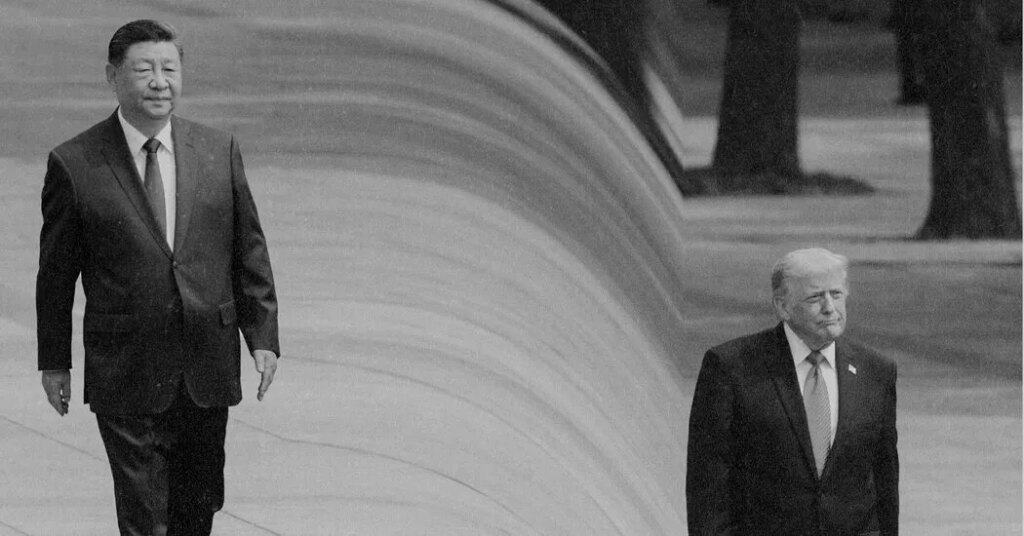
Recognizing these diverging views on the technology that will shape the next century is crucial in setting expectations for the talks on Thursday between President Trump and Mr. Xi at the White House. The leaders are set to discuss how to mitigate A.I. risks. Arriving at meaningful cooperation will be difficult — if not impossible — because there are two almost entirely unrelated conversations about what A.I. safety means happening on opposite sides of the Pacific.
The wider stakes are potentially enormous. Mr. Tang and his colleagues are instilling values into their models that shape how they interpret the world and respond. As Chinese A.I. is increasingly being adopted globally, those values could travel with it, quietly carrying the Communist Party’s worldview far beyond Chinese shores.
Six days after Mr. Tang’s letter to Z.ai’s staff, Mr. Xi provided a glimpse into his thinking when he convened the annual World Artificial Intelligence Conference in Shanghai on July 17. In comments translated into English by state-run media, Mr. Xi was quoted as saying that “China lays great emphasis on safety and security in A.I.” and is committed to keeping it “safe, secure and controllable.” It seemed a reassuring signal ahead of the scheduled talks with Mr. Trump.
But Chinese state media often translates comments by the country’s leaders in ways that soften their political meaning for foreign audiences. What Mr. Xi actually said in Chinese was that China’s emphasis was on “development and security,” and on making sure “A.I. is secure, reliable and controllable.”
That may seem like a fine distinction in translation. But in Mr. Xi’s vocabulary, words like “security” and “control” ultimately refer to the political security of the Communist Party. Time and again, Mr. Xi has made clear that ensuring China’s Communist system endures in a rapidly changing world is at the heart of his agenda.
Today’s Silicon Valley pioneers grew up in a liberal democracy, consuming science fiction in which man builds machines that promise utopia but might ultimately destroy him. Mr. Amodei’s essay in January on A.I. risks, “The Adolescence of Technology,” opens with a scene from one of his favorite films, “Contact.” The protagonist, played by Jodie Foster, is asked what she will say to the advanced life form that has established radio contact from outer space.
She replies: “How did you do it? How did you evolve? How did you survive this technological adolescence without destroying yourself?”
The essay details how to manage the potentially catastrophic risks inherent in the technology that Mr. Amodei is helping build, including by baking safety principles into A.I. so they are inseparable from the model itself. Known as constitutional A.I., this method attempts to teach the technology what it means to be “a good A.I.” at the level of character, values and personality — “like a child forming their identity,” Mr. Amodei wrote.
The values that Anthropic instills in its models borrow from the Universal Declaration of Human Rights and are weighted heavily toward access to information, rule of law, political freedom, self-determination and individual liberty.
Similarly, Demis Hassabis, the co-founder and chairman of Google DeepMind, has developed a set of A.I. principles explicitly anchored in liberal democratic values and argues that democracies should lead in A.I. development, “guided by core values like freedom, equality, and respect for human rights.”
China’s new generation of tech leaders has been brought up in an altogether different environment, an authoritarian world where liberal values are labeled hostile to China and technology is developed and controlled for the benefit of the Communist Party.
Mr. Xi’s minister for state security, Chen Yixin, made that clear in an essay published this month on the dangers of A.I. Mr. Chen made no mention of the existential threat of artificial intelligence turning against its masters, the fear that preoccupies leading American A.I. figures. Instead, he said China needed to raise its defenses against hostile human forces that would use this powerful new tool for a “direct assault on our political security, institutional security, and ideological security.”
A.I. safety, in Mr. Chen’s telling, lies in aggressively pushing forward the development of Chinese artificial intelligence so that it does not fall behind the United States, a prospect that he implied posed the technology’s biggest danger for China. The country’s evolving A.I. regulatory system also places threats to socialist values, state power and political stability among the government’s core safety concerns.
Very little personal information is known about Mr. Tang, who rarely speaks publicly. He formed Z.ai by joining together with other members of the Knowledge Engineering Group, a research unit at Beijing’s prestigious Tsinghua University. The group developed sophisticated tools for analyzing social networks and information flows, including systems for profiling and locating researchers in China and other countries and mapping their relationships, which were presented as recruiting tools.
In Mr. Tang’s July letter, he rejected the idea of “bolt-on” safety patches for A.I., saying instead that behavioral principles must be embedded in the foundations of the company’s models, including writing Chinese national laws, strategy and security concerns — in other words, the Communist Party’s political interests — into the A.I.’s basic DNA. In August, Mr. Tang went a step further, publishing a commentary that argued in favor of laws to impose ideological conformity on the Chinese artificial intelligence industry.
Last month, his company released one of China’s most powerful A.I. models, GLM-5.3 — which Z.ai markets as a cheap, accessible and capable open-weight cyberdefense tool approaching the abilities of Mythos 5, Anthropic’s powerful cybersecurity model. Users can download and modify open-weight models, fine-tuning them for specific tasks, though deeply embedded behaviors may be difficult to strip out. Z.ai argues that advanced tools like these should be made widely available to developers and cybersecurity teams around the world, an approach that contrasts with the more closely guarded proprietary models of Anthropic and OpenAI.
Despite Mr. Tang’s rhetoric of openness, Z.ai has otherwise offered little transparency into how its models are trained and evaluated. And Chinese citizens, business and other entities are subject to a National Intelligence Law that obliges them to support state intelligence work when called upon. Z.ai’s financial reports state that vulnerabilities uncovered by its models are submitted to Chinese authorities, including the National Vulnerability Database, which collects and analyzes information on cybersecurity flaws. The database is managed by Mr. Chen’s Ministry of State Security.
This raises a troubling question, especially as use of Chinese open-weight models spreads overseas: When Z.ai finds a dangerous flaw, who learns about it first — the company that needs to fix it, or the Chinese state?
Researchers at leading American A.I. labs and government agencies in Washington and allied capitals are already voicing growing concern over the potential threat from “sleeper agents” — malicious hidden instructions that can be planted in A.I. models and remain dormant until triggered, making them difficult to detect or remove. Those dangers are amplified by newer “agentic” A.I., which is often given greater and more autonomous access to computer systems.
All of these things underscore the pressing need for the United States and China to find common ground on A.I. — and, at the same time, why that will prove exceedingly difficult.
The Communist Party’s obsession with gaining an advantage over the United States and prioritizing regime security leaves little room for agreement on the catastrophic risks of A.I. Mr. Trump, too, seems to feel strategic competition outweighs the danger of unchecked A.I. development, recently dismissing the need for regulation in public comments and on social media.
Trump’s free-market attitude misses the larger contest taking shape. The race over A.I. is no longer only about technological superiority. It is also a contest over whose concepts of freedom, security and the role of the state become embedded in the powerful systems that are increasingly shaping how societies think, make decisions and wield power.
Source photograph by Alex Wong/Getty Images.
John Garnaut is a founder of Garnaut Global, a geopolitical risk advisory firm. He was a China correspondent for The Sydney Morning Herald and a senior adviser to Prime Minister Malcolm Turnbull of Australia and is the author of “The Fall of the House of Bo.”
The Times is committed to publishing a diversity of letters to the editor. We’d like to hear what you think about this or any of our articles. Here are some tips. And here’s our email: [email protected].
Follow The New York Times Opinion section on Facebook, Instagram, TikTok, Bluesky, WhatsApp and Threads.
The post What China Really Wants on A.I. Safety appeared first on New York Times.