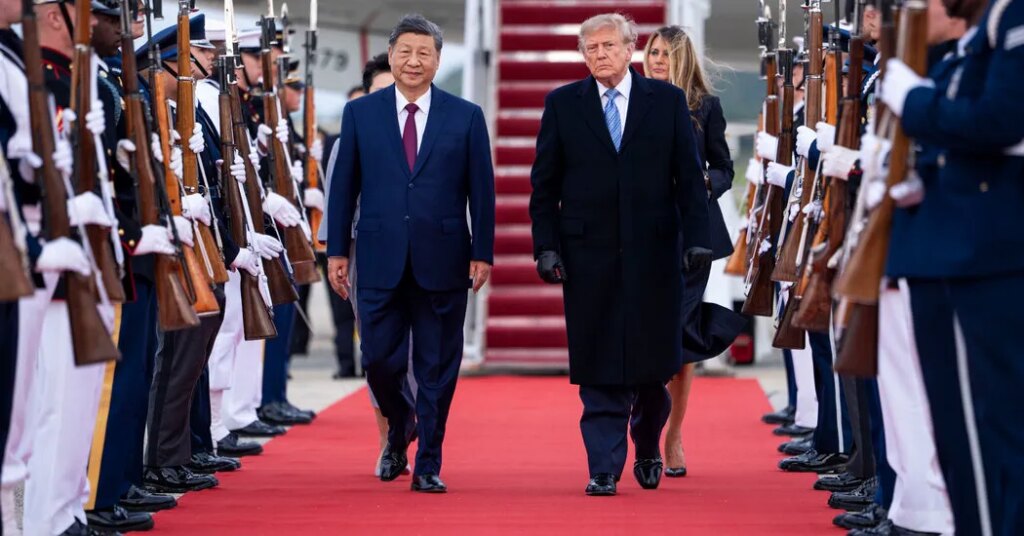
President Trump and President Xi Jinping of China are meeting at a moment when China continues to export a flood of inexpensive goods to the world, despite the Trump administration’s efforts to overhaul the global trading system with tariffs.
But it remains unclear how much, if any, pressure Mr. Trump will put on Mr. Xi during his state visit to Washington to curtail China’s strategy of using government subsidies to rev up exports and fuel the country’s growth.
China’s strategy of flooding global markets with cheap cars, solar panels, minerals and other goods has long frustrated Western economies, including the United States, which have struggled to develop their own domestic industries in the face of Chinese competition.
The issue has dogged both Democratic and Republican administrations for years and was one of the main driving factors behind the sweeping tariffs Mr. Trump has imposed on Beijing. In his first term, Mr. Trump’s advisers pressed China for promises to restructure its economy, though they ultimately settled on a far more modest trade deal involving purchases of agricultural and other products, along with more open markets.
China’s exports to the United States have slowed significantly because of Mr. Trump’s tariffs. Trade in goods and services between the countries fell 25 percent last year compared with the year before. But China’s exports to the world have continued to surge, and many economists believe Chinese parts and products are still flowing into the United States through other countries.
Mr. Trump now faces the test of whether he will have any influence on Mr. Xi’s economic approach, something his administration has so far failed to alter despite tariffs and trying to marshal a public pressure campaign.
“The problem is that there isn’t that much that can be done about it,” said Jonas Nahm, a professor at the Johns Hopkins School of Advanced International Studies who was an industrial strategy economist in the Biden administration. “The tariffs are treating the symptom but they’re not treating the underlying problem that imbalances are sort of baked into the Chinese economy.”
Despite global backlash over the flood of Chinese goods, its exports have continued to surge unabated. This year the country is on pace to surpass last year’s record $1.19 trillion trade surplus as it continues to sell vast quantities of goods across the world.
The Biden administration was worried about China saturating global markets with inexpensive green energy products such as solar panels. Former Treasury Secretary Janet L. Yellen warned that a second “China shock” threatened to hollow out what is left of America’s industrial base.
For the Trump administration, the concern has been more focused on exports of Chinese steel, minerals and cars. Treasury Secretary Scott Bessent, who has been leading economic talks with Chinese officials, has argued that Americans should not allow themselves to be seduced by affordable Chinese products.
“Access to cheap goods is not the essence of the American dream,” Mr. Bessent said in a speech to the Economic Club of New York last year. In an interview with NBC, he followed up by making the case that prosperity is not about buying “cheap baubles” from China.
The Trump administration appears to believe that more tariffs are the solution but is looking to punish countries beyond China. The White House trade adviser Peter Navarro published a report in August that accused Chinese exporters of routing goods into the United States through more than 40 countries.
The Trump administration has threatened to impose global tariffs on China, the European Union, India and other countries that run trade surpluses with the United States, citing “excess capacity and production” in foreign factories.
The tariffs could apply to more than 40 countries, and would add to other levies the administration has already issued, including tariffs of between 10 percent to 12.5 percent that took effect in July. The excess-capacity tariffs target foreign countries over a wide range of practices, from subsidies and currency manipulation to a lack of labor laws.
The Trump administration argues that other countries have used those practices to build more factory capacity than their own consumers need. Those countries often export the difference, chilling production and new investments in the United States and resulting in trade deficits, Trump officials say. Many trade experts believe this critique applies to China, which heavily subsidizes its industries.
China produces far more cars, solar panels, batteries, steel and minerals than its own consumers need. But the administration’s tariffs appear poised to apply to many other countries, including Switzerland, Norway, Cambodia and Mexico, some of which have argued they are unfairly targeted. In a filing to the U.S. government, Norway argued that its abundant production of seafood is a result of its long coastline, technical innovation and environmental protection of its fisheries.
The tariffs that the Trump administration actually imposes on China may not even be that high.
The Trump administration announced a 12.5 percent tariff on Chinese exports last month. People familiar with the plans say the U.S. may officially announce a higher tariff level and then suspend some of it to maintain the level of tariffs they agreed to in their truce. On Wednesday, Mr. Bessent said that the United States and China would extend their trade truce for two additional months, until January.
Mr. Trump has held off imposing any more tariffs on China until after his meetings with Mr. Xi.
“I think the administration decided not to do anything in advance of the summit because they wanted to preserve leverage to possibly increase tariffs if the Chinese don’t give them what they want,” said Evan S. Medeiros, a professor at Georgetown University.
Critics say the Trump administration should be working with allies to pressure China to adjust its trade practices, rather than targeting Europe and Canada.
U.S. tariffs on Chinese products have pushed Beijing’s exports into other markets, exacerbating pressures for Europe, which is experiencing an “alarmingly quick deindustrialization,” said Mira Rapp-Hooper, a visiting fellow at the Brookings Institution.
The E.U. had set a deadline in October for trade negotiations with the Chinese over the issue, but they did not appear to be making much progress, she said.
China’s export strategy has exacerbated the country’s debt burden and strained its banking system, but the Chinese government continues to believe that those challenges are worth the investment in a robust industrial base that has strengthened China’s global influence. Chinese officials also push back against the idea that its manufacturing prowess is a problem for the world.
However, China is mindful of its strategy’s political ramifications and has turned to investment promises to help mollify concerns that its exports are eroding manufacturing jobs in other countries. China has stepped up purchases of American soybeans, and Mr. Trump has suggested that he would consider allowing Chinese car companies to build automobiles in the United States.
“They understand jobs are a big issue, and the way they can work through that is through investment,” said Mary Lovely, a senior fellow at the Peterson Institute who specializes in global supply chains and the economic relationship between China and the United States. “China’s preferred way to solve it is with investment into these countries.”
The post Trump Struggles to Find Leverage With Xi Over Chinese Exports appeared first on New York Times.