The kayak launch at Freshkills Park on Staten Island, along a deserted lane that winds past rotting warehouses, municipal road-salt piles and a strip for driving tests, looks like a good place to dump a body.
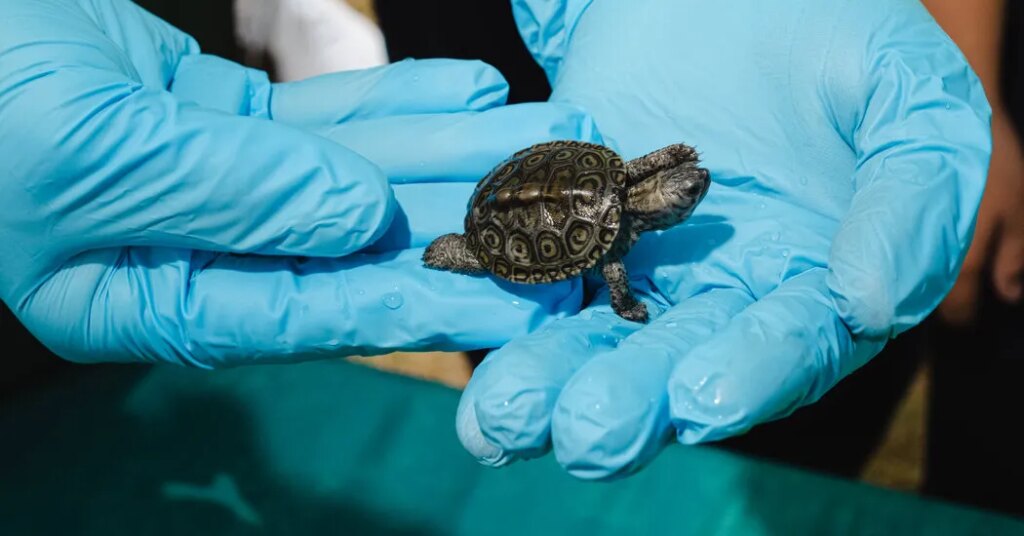
But the 47 pewter-colored, Oreo-size creatures that were tipped out of plastic tubs and into the murky marsh there on Tuesday afternoon were very much alive. They were diamondback terrapin hatchlings, some only a few weeks old. Their voyage to their ancestral estuary was part of a conservation effort aimed at giving the turtles, whose numbers have been declining for decades, a fighting chance.
For diamondback terrapins — the only North American turtles that live in brackish water (part salty, part fresh) — the last couple of centuries have brought one challenge after another. They were hunted nearly to extinction for turtle soup. Their numbers gradually rebounded, but then habitat loss, fishing and pollution took a toll.
And then there are the predators. Every June and July, along marshy parts of the New York City coastline, female terrapins clamber ashore, dig holes in the sandy soil and lay clutches of 10 eggs. But within a day or so the nests are raided by raccoons and other mammals.
Researchers studying the turtles in nearby Jamaica Bay have reported a 70 percent drop in population over the last 30 years, but little research has been done on terrapins on Staten Island. A few years ago, a zoologist at the Staten Island Zoo, Elle Fenton-Hulett, took an interest in them.
“I knew that they were kind of around, and wanted to understand where they were on the island and how their population was doing and if there was anything we could do to help it,” she said.
The result is the Staten Island Terrapin Project, a joint effort by the zoo and Freshkills Park, the 2,200-acre preserve of wetland and native grasses that is gradually taking shape on the site of what was once the planet’s biggest garbage dump.
During nesting season this summer, field assistants from the zoo kept watch all day long over a stretch of shoreline in the park around a bend from the kayak launch. After a female laid eggs, the turtle team would dig up the nests and take some of the eggs to an incubator at the zoo and some to a “turtle garden” — a box with a chicken-wire lid installed near the kayak launch to keep out foxes, the terrapin’s main predator at Freshkills.
The eggs started hatching in late August. On Tuesday, as the last minutes of summer ticked away, staff members from the zoo and the park and a group of environmentally minded students from St. Clare School, a nearby Catholic school, gathered to see them off. Wearing waders, the students tramped down a little hill and stood in the shallows. On the way they passed a raided nest lined with off-white shreds of turtle eggshell.
Ms. Fenton-Hulett tilted a plastic box and the first hatchling crept out, took a couple of steps, fell into a hole, pulled itself out and stood for a second at the waterline. A wavelet swept it up and it started paddling. The children cheered. “Here he goes!” someone yelled. “He’s swimming away!”
The turtle immediately took on the brown cast of the water and the creek bottom, dipped beneath the surface and disappeared.
Ms. Fenton-Hulett pointed to a stand of cordgrass sprouting from the water. “These guys will probably find a nice little spot in the spartina grass over here in the mud,” she told the children, “and they’ll dig themselves in so that they’re nice and safe and protected.”
The reality is a little harsher, said Russell Burke, a Hofstra University researcher who studies the declining diamondback terrapin population in Jamaica Bay.
“You put those hatchlings on the water and it’s a great thing, but almost all of those are going to be hit by predators,” he said — herons, sea gulls, osprey, toadfish, sharks.
“What the folks in Staten Island are doing is great, but it needs to be ramped up,” he added. “We need to protect terrapin nests on a much larger scale. It’s not that expensive, but it takes people, and some money.”
Within minutes, the last turtle had vanished into the marsh grass.
Across the creek, a line of gulls and egrets stood on an old wooden barrier, gazing over toward the kayak launch and waiting.
The post This Zoo Helps Protect Baby Turtles, Then Sends Them on Their Way appeared first on New York Times.