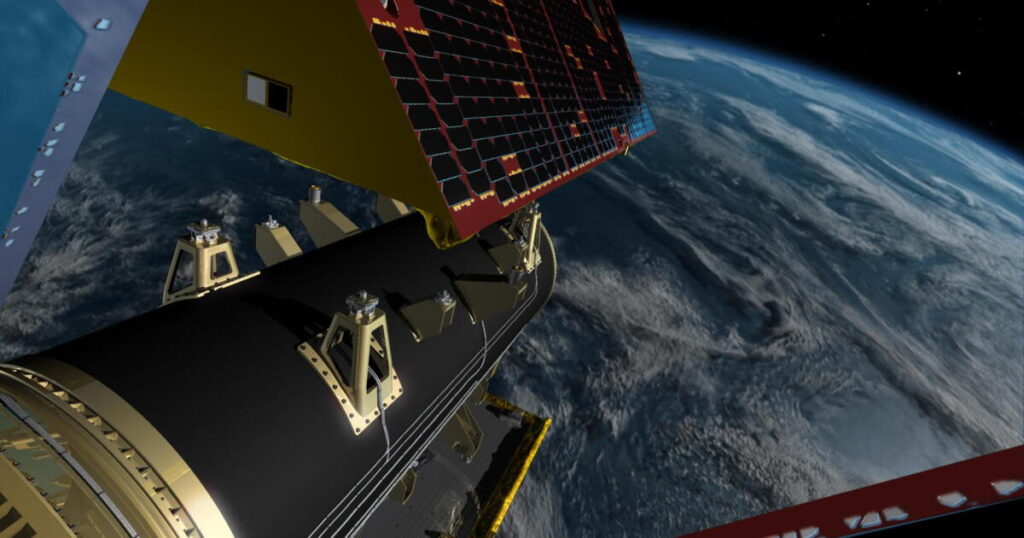
The next phase of a highly successful satellite mission led by NASA’s Jet Propulsion Laboratory has burned through its rainy day fund and now risks cost and schedule overruns, according to a new report.
One of the culprits: the 2025 Eaton fire, which came within a mile of the La Cañada Flintridge research facility.
The mission is the newest generation of the Gravity Recovery and Climate Experiment — or GRACE — which tracks the movement and storage of Earth’s life-sustaining water, and has documented declining aquifers, melting ice sheets and rising sea levels.
The report by NASA’s independent Office of Inspector General found that the $658-million mission still remains on schedule to launch from Vandenberg Air Force Base by July 2029. However, it argued that with more than 60% of the rainy day fund spent, the mission’s financial situation is “less than desirable.”
The fund, called “unallocated future expenses” in NASA speak, is money budgeted to cover unexpected costs.
JPL, when faced with potential schedule delays, has so far decided to speed up progress by paying more staff to work on the mission instead of accepting the schedule slip.
During the Eaton fire, the laboratory shut down for two weeks — which is not insignificant for a lab that tracks hold-ups in days. The blaze had forced about 20% of JPL’s staff to evacuate. It destroyed the homes of more than 200 employees and displaced 100 more employees long-term.
Representatives for JPL, which Caltech runs for NASA, did not immediately respond to a request for comment.
The lab initially predicted in February that the mission would run $9.3 million over budget, but it downgraded that figure in June to just $300,000 after new components were completed — an overrun of less than a tenth of a percent.
Launch is currently slated for December 2028, ahead of schedule.
Since the first pair of twin GRACE satellites launched in 2002, the instruments have led to new scientific discoveries about the world’s ice and water.
The satellites chase each other in orbit to measure gravitational shifts in water mass, both on land and underground. When the lead satellite passes over something big — for example, a glacier — the object’s gravity pulls the lead satellite faster, creating a larger, measurable gap between it and the follower satellite. (The follower satellite eventually catches back up after it passes the same large object.)
The satellites are nicknamed Tom and Jerry, due to this subtle cat-and-mouse chase high above the planet. Separated by more than 100 miles, the original satellites used microwaves to detect a change in distance of just one micron — 70 times smaller than the width of a human hair.
GRACE Follow-On launched in 2018 to replace the original GRACE satellites. Alongside the primary sensor, these satellites carried a laser-based sensor that demonstrated 20 to 30 times better precision than the original satellites. JPL is working on the third installment of satellites, called GRACE-Continuity, that will use the laser technology for its primary sensor.
The GRACE spacecraft have enabled scientists for the first time to map the widespread depletion of groundwater around the world. Last year, research based on the satellite data revealed that large areas of the world are getting drier and losing fresh water, and that farming areas of California are among the regions where groundwater is being depleted the fastest.
In a study published this month, researchers using the data found that California needs years of heavy snowfall in the mountains to recharge groundwater.
“The information that it has provided, I think it’s been unprecedented,” said Jay Famiglietti, a professor at Arizona State University and former NASA water scientist who has done extensive research using the data.
“It’s been transformational for understanding how fresh water availability is changing around the world,” he said, and it’s also shown that the human fingerprint, through climate change as well as groundwater depletion, is very strong.
But GRACE-Continuity has hit a few bumps in the road.
Project managers proposed a rainy day fund of roughly $83 million. This was a relatively low figure as far as NASA missions go. They argued development would be relatively smooth since it would rely on components it had already designed for previous missions instead of engineering everything from scratch.
However, multiple lab-wide reorganizations after NASA yanked its flagship Mars project increased the overhead for other projects like GRACE-Continuity. Additionally, JPL agreed to pay its German partners in euros. The exchange rate rose from $1.08 per Euro during the planning phase to $1.20 per Euro in early 2026, meaning JPL has to pay more in U.S. dollars for the same euro-based contracts.
The lab also ended up spending more than $35 million of the fund to handle manufacturing problems with the new laser technology.
The post This JPL satellite mission is burning through its funding. One reason: the Eaton fire appeared first on Los Angeles Times.