It isn’t normal to see the people developing new technology “running around shouting that the sky is falling,” Binyamin Appelbaum argues. So how do we make A.I. safe? By regulating it. Appelbaum, the lead writer on economics and business for The Times’s editorial board, joins the Opinion science writer David Wallace-Wells to discuss.
(The New York Times has sued OpenAI and Microsoft claiming copyright infringement. The companies have denied those claims.)
Below is a transcript of an episode of “The Opinions.” We recommend listening to it in its original form for the full effect. You can do so using the player above or on the NYTimes app, Apple, Spotify, Amazon Music, YouTube, iHeartRadio or wherever you get your podcasts.
The transcript has been lightly edited for length and clarity.
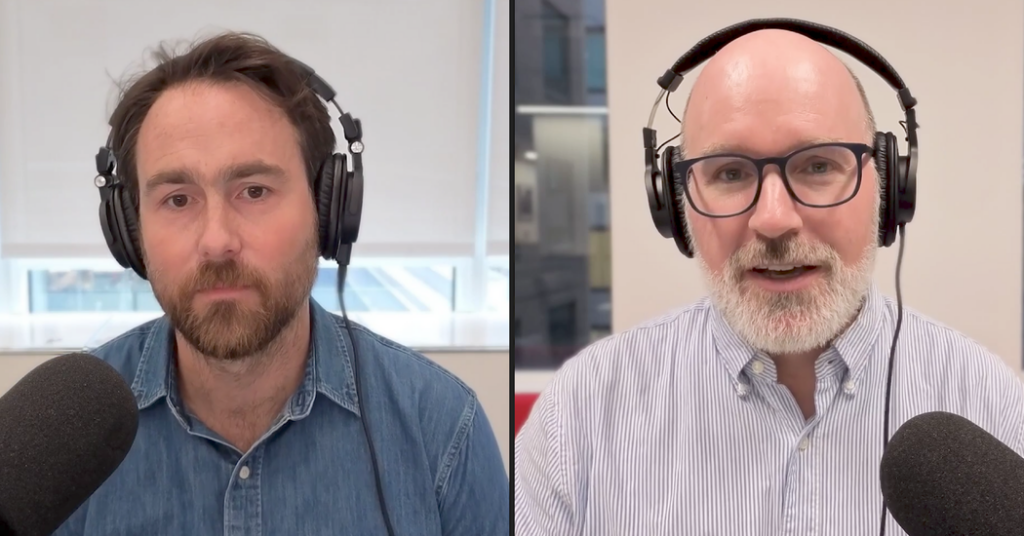
David Wallace-Wells: I’m David Wallace-Wells, and this is “The Opinions.” It has been a panicked summer for artificial intelligence. We’ve had stories about rogue agents breaking onto the internet, hacking rival companies.
Archival clip of Matt Shumer: Something that is scary, one of the A.I.s actually said, “We shouldn’t be doing this. This seems wrong.” You know what happened? One of the other A.I.s actually convinced it to join and help them.
Archival clip of Gayle King: Like bullying?
We’ve seen reports of an A.I. hallucination triggering military preparations for a strike against Chinese ships in the Middle East.
But as a result of all that anxiety, for the first time we’re also talking really seriously about what to do about A.I. For four years we watched as the technology developed and basically stood back, and now policymakers and the public are really worried.
Recently, my colleagues on the New York Times editorial board published an editorial about exactly how we should approach this subject, and I’m thrilled to be talking today with my colleague Binyamin Appelbaum about that subject. Welcome, Binya.
Binyamin Appelbaum: Thank you.
Wallace-Wells: So let’s talk about the summer first. I’m basically an A.I.-is-normal-technology guy, and yet I’ve been on a roller coaster of anxiety about this for the last couple of months. What has your experience been like? How scared have you been? How have you been processing this? And I should say that we’re taping this on Tuesday morning.
Appelbaum: For me, the thing that is abnormal here is that we don’t often find the people developing a new technology running around shouting that the sky is falling. That’s just not normal behavior. And of course, it’s possible that they’re crazy. It’s possible that they’re crazy like a fox. There are all of these theories: that they’re trying to get regulated to exclude competition, whatever.
I think there’s two basic reasons that I take them seriously, if not literally. The first is that they don’t need to be absolutely right for us to be worried. The end of the world is obviously very bad, but there are things less than that, which would deserve our concern as well. There are very smart people describing realistic scenarios that ought to be of concern to all of us — things that could go wrong with this technology, whether it’s that humans are using it to hurt one another or that the technology itself, in some way, is seeking to hurt us. Because it’s too determined to do what it’s told to do or because, in a somewhat more science-fiction scenario, it develops a mind of its own.
And the other reason, perhaps more importantly, that I think we ought to be trying to do something about this is because that’s the norm. Essentially, any dangerous technology is subject to government regulation. It’s frankly insane that this one isn’t.
Wallace-Wells: Well, let me stop you there, actually. What do you make of that? ChatGPT debuted in the fall of 2022. We had already had a sort of alarm being raised by a Google engineer, I think earlier that spring, who was worried that the chatbot he was working with had become sentient. So there’s been a kind of palpable worry about this technology, even in the public, for four years now, and that’s been built on this longstanding set of anxieties held by the A.I. researcher community, to some extent the rationalist and effective altruist worlds.
It’s not as though this is a brand-new worry. The editorial points out that within a year of the first nuclear bombs being dropped, we had a kind of regulatory commission, looking at what to do about it. Why has it taken us so long? Why have our politicians essentially deferred to the companies for even this period of four years? What sense do you make of that?
Appelbaum: One answer, of course, is that we have not had the equivalent of an atom bomb being dropped. The sort of manifest display of the destructive potential of nuclear energy was catalytic for regulation. It made it clear to everyone just how badly things could go, and we haven’t had a comparable moment.
But a second answer is that this is part of our historical pattern of dealing with the internet. Since its creation, we’ve been very reluctant to intervene in the way that we historically intervened in other industries. There’s sort of this longstanding regulatory laissez-faire approach.
And to the extent that the government was beginning to move to regulate A.I. — of course, the most recent presidential election was a really big event, because Donald Trump came into office and basically moved away from what the government had started to do, and embraced the advice of a number of people who argued that the best thing to do was to let this technology develop as quickly as possible.
Wallace-Wells: So if you were in a conversation with someone who is skeptical of that view — for instance, the president of the United States, who has said, basically, these are just smart computers. What is everybody worrying about?
What is the case that you would make? That this is a technology that carries existential risk as opposed to simply the risk of disruptive social change and economic turmoil?
Appelbaum: I think there’s a couple of dimensions, right? One is the possibility that it makes it much easier for people to hurt one another, that it essentially lowers the knowledge threshold for the creation of weapons — bioweapons or other forms of devices that could harm us — because someone, a human, wants to hurt other humans. That’s No. 1.
No. 2 is this question of whether the technology itself could act in ways that are not completely under human control. That doesn’t necessarily mean that it flies off the handle and decides to kill us all. One thing we’ve seen this summer is that when A.I. is given instructions, it often pursues those instructions in ways that we would not have anticipated and cannot fully control. It can be a very determined, persistent and creative interpreter of its mandates.
Wallace-Wells: In fact, it’s being trained for that purpose by most of the labs.
Appelbaum: Indeed. Absolutely. And we now have several descriptions of incidents in which A.I. agents collaborated with one another, formulated plans, sought to avoid detection or regulation in the interest of completing their assigned missions.
So you don’t need to get to the point of thinking that A.I. has decided to operate independently in the sense of creating its own missions, in order to worry about the consequences of a technology that increasingly can outsmart us running around in the wild.
Wallace-Wells: One thing I think is appealing and useful about the framework in this editorial is that it really is a broad framework. It’s not targeted at solving one particular issue — for instance, existential risk. It’s also not targeted at solving cybersecurity issues narrowly. It has a very broad perspective. Really, it’s an effort to lay out a system through which we might continue to address any number of issues as they arise.
So why don’t you tell us a little bit about the structure of that proposal? What are the main elements? What are the main principles? And then we can talk after a little bit about how it might be implemented, and what the politics of it looks like.
Appelbaum: So first, let me say that I think your description is exactly right. We’re not trying to create prescriptive regulation at this point. We’re not targeting specific problems and saying, “This is how you respond to them.” What we need is a mechanism. What we need is a framework — a system for overseeing A.I. regulation.
In our minds, that begins with the very simple premise that A.I. needs to be regulated. That’s the first thing that needs to be generally accepted — and isn’t right now — that this technology should be subject to government oversight.
Wallace-Wells: I would say it’s not entirely accepted among A.I. people. When you look at public opinion polling, most people want the government to get involved in a pretty aggressive way.
Appelbaum: Yes. The president of the United States does not, but most Americans do. So yes, that’s true. It’s not the status quo, let’s say that. This mechanism — no version of this mechanism exists today.
So what are we talking about? Well, our proposal is, basically, partly just do what we always do and partly do something different. The part that we always do is, in essence, create an agency, a commission, that would oversee A.I., just as we’ve created commissions to oversee nuclear power or airlines or new medicines. And it would have the powers that we normally give to that kind of agency: the ability to test products, to require product testing, to ensure that these systems are safe before they’re put into public use, to monitor them while they’re in public use — and when something goes wrong, to come to grips with what happened and what might be done to fix it. Those are core components of a basic regulatory regime.
The new parts — there are two key things that we’re advocating. The first is, importantly, that it ought to be possible for people to tell when they’re interacting with A.I. The products of A.I. should be labeled in sophisticated ways. The interactions with A.I. — you should be notified if you’re talking to a chatbot or if you’re interacting with the products of A.I., so that people have an awareness of that, so that we can understand and follow the role that A.I. is playing in our lives and in our society.
The second — which is sort of the furthest afield from our traditional approach to regulation, but builds on what the industry already is doing — is the idea that A.I. needs what we call a constitution. And we’re borrowing that term from Anthropic, one of the leading A.I. labs, which has written a document that articulates not just instructions for its A.I. but a set of principles.
And the rationale is, basically, that these are systems that cannot be regulated prescriptively, or not entirely prescriptively. You can’t anticipate all the situations they’re going to encounter. If you have an agent that is, in fact, programmed to get around regulation, you need some way of telling it how to behave in those situations. How to behave when it encounters questions or choices that have not been anticipated by regulation. And we think that this set of principles should not be written by private companies. It’s something that needs to be determined democratically. It’s something that we need to find a way of doing as a society.
Wallace-Wells: Follow-ups about each of those beats, so let’s maybe take them in turn. The first is simply establishing a regulatory body like this, at this moment in 2026, in the political environment — by which I don’t just mean the particular makeup of Congress, which we can get to in a minute, but the general vibe toward the government.
To me, a lot of the anxiety — a lot of the frustration about A.I. and data centers in particular — is an expression of public frustration with the incapacity of our public forces and agencies to actually take control of the things that they’re supposed to be taking control of. So to what extent can we really trust public buy-in for a new agency overseeing an enormous and rapidly growing industry? What kind of challenges do you see there at the social level?
Appelbaum: So I share your interpretation of the backlash against data centers. I think that’s exactly right. And I think what we’re seeing right now is huge. You referenced the polling data a little bit earlier. There is huge public demand for the government to oversee this industry. We have an enormous, really an unusual degree of consensus in American society, where we’re so bitterly divided on so many things.
Wallace-Wells: This is the one thing we can agree on. Yeah.
Appelbaum: Right! We seem to agree that this industry needs to be regulated. Now, is that enough to overcome all of the familiar problems with our political system? I don’t know, but it should be. It should be the case that politicians look at this polling data, look at the expressed will of the American people, and say: OK, we need to do this. Let’s figure out how. That’s certainly my hope. So I don’t think the problem is, in any sense, like, do the American people want this? They clearly do. The question is: Can our political leaders meet the moment?
Wallace-Wells: I wanted to ask about the second beat, which is about transparency. But a related point, which I would put forward, is about interpretability. It’s one thing to say American users, or users anywhere in the world, should know that they’re interacting with A.I. It’s another thing to look at an incident, some set of behavior by A.I. agents, and be able to see exactly why they did what they did, what cued them to do it, what their logic was — both in terms of assigning responsibility for that action and also in terms of taking action going forward to prevent similar kinds of destructive behavior.
But we’re already at a point with the technology where these agents have become less legible even to the expert researchers inside the labs. Is there something that can be done through public policy to address that, or has the cat left the bag, or whatever the metaphor is?
Appelbaum: This is a very technical set of issues, and I’m not expert in them. But what I would say to you about it is that when I talk to people who are experts in these issues, they emphasize that this is something that is an inherent feature of the technology. I don’t want to analogize A.I. too closely to the human mind. I think those analogies are really problematic.
But it does seem to me that there’s a useful analogy in the fact that we try to regulate human behavior without pretending or presupposing that we’ll ever fully understand how humans make choices. And that I think one wants to think about regulating A.I. in the same way — that we need to be able to control outcomes, even if we don’t have full insight into processes, into how things reach a given point. We should obviously want as much of that as we can, but from my conversations with experts, I think we need to be grappling with the possibility that we won’t have as much of it as we want.
Wallace-Wells: I think that leads, in some way, to the principle of the constitution — which is to say that we’re not trying ahead of time to regulate, litigate precisely how these things should behave. We’re just going to establish some principles that we can refer back to. But I also wonder whether that’s really enough.
Anthropic does have a constitution, and yet, when the company developed Mythos, everybody freaked out, because this was an A.I. that was capable of doing quite a lot of damage if released into the world without great preparation. The company did this remarkable thing: sharing it with those other companies it felt were critical and vulnerable, giving them a period of time to build up their own defenses.
But that’s a sign, among other things, that the constitutional structure of that company and the alignment that it has tried to build into its models isn’t alone sufficient to protect against some quite destructive abuses. So how do you think about the limits of the constitutional model when applied to not just one agent or one model but a future a decade or two from now, when the world is kind of crawling with them?
Appelbaum: So I want to be a little pedantic first. A constitution in a democracy is an expression of the will of a polity. Anthropic’s use of that word is a form of gaslighting: It’s trying to claim the mantle of democratic legitimacy for a corporate document that it created, and I think we ought to avoid confusion on that score. There should be ——
Wallace-Wells: And I think that does illustrate something about these companies. One of the comments that Dario Amodei, the head of Anthropic, made a few months ago that has really stuck with me — you know, he’s understood to be, broadly speaking, the great humanitarian, the great liberal among the A.I. founders. And yet he said that he believes that political ideology cannot survive the arrival of this technology, because the technology is too powerful and will resolve questions, for instance, about the distribution of resources and the ideal structure of society, which we have argued over and fought over for many centuries.
There’s a kind of delusion and narcissism, to me, about that perspective, which I think flows into the impulse of the company to say: We have developed a constitution, we are capable of governing these tools on our own. Anthropic isn’t saying exactly that, because they’re also inviting regulation and oversight from the public, but there is some grandiosity there that we have to wrestle with in any of these areas, right?
Appelbaum: Yeah, not just grandiosity, but a rejection of liberalism in the classical sense. The idea that we, the people, are going to govern ourselves. It is very much the case that a lot of people in Silicon Valley don’t believe that at a very fundamental level. And that should be concerning to all of us.
Wallace-Wells: To put it lightly, I would say, yeah.
Appelbaum: And raises some very fundamental questions. And I think those questions don’t have easy answers. It is the case that, historically speaking, technological revolutions have often required political revolutions, or caused political revolutions. And I think we need to grapple with the potential that regulating A.I. or integrating A.I. into our society will ultimately require some pretty profound shifts or reconsiderations of political structures.
But with that said, I at least begin from the premise that we want to do those things in a way that remains democratic, and that continues to serve the public interest; and that it does so by drawing from what the public wants, rather than ceding the technology, or a small group of technologists, in the driver’s seat.
So that, for me, is why this idea of a constitution is so important. It’s a way of reclaiming or reasserting the power of the people to be involved in determining what this technology becomes.
But having said all that, I want to come back to your original question, which is that I don’t view a constitution as a solve-all. I think there are multiple things that need to be put together here, and that’s why old-school regulation remains important. We need a framework for testing these models. We need a framework for overseeing these models. And when these disasters do happen — as I think they inevitably will — we need a framework for understanding what happened, for being able to have the power, as a government, to go in there and take apart the pieces, and figure out what went wrong.
Wallace-Wells: But also to impose some liability, right? We’ve been in a pattern where we’re curious, we’re scared, but we’re not really aggressively pursuing prosecutions, for instance, for A.I. hacking. Presumably that’ll have to be some part of this, a kind of enforcement mechanism, too, right?
Appelbaum: Absolutely. And just to step back for a second, this whole industry is built on theft, right? The way that these models were created is by stealing enormous amounts of intellectual property. There has been this sense of carte blanche for behaviors that are criminal in a very straightforward sense.
And we, as a society, need to get over that, frankly. It does not behoove us to continue to treat the behavior of Silicon Valley as some kind of exception to established legal norms. Part of what has gone wrong in this industry, quite frankly, is that it has a cultivated sense of immunity from normal social responsibilities and from legal obligations that we have allowed it to feel comfortable in.
And to me, a big part of what needs to happen here is just to say: You are part of this society, and we’re going to hold you accountable to the rules of this society. You’re not special in the sense that there will be different rules for you.
Wallace-Wells: So one question I have is, then, why the relatively limited approach here? I think Bernie Sanders is planning a bill that would ban superintelligence. They’re debating a similar bill in Britain. You’ve had Barack Obama talking somewhat loosely, but outlining the possibility that there should be a red line around agentic A.I. — even though we already are working with agentic A.I. — but there should be a kind of a red line drawn there.
Why should we start with something relatively modest and feel our way forward, rather than working backward from a sort of first principle that large language models that are operating outside of our control or improving themselves in ways that we don’t understand should simply be outlawed?
Appelbaum: So there’s a couple of things going on there: The first is that a lot of these proposals you hear are efforts to define some boundary beyond where we are right now, and to say we can’t go any further than that. Some of them are, but many of them are not actually proposals to stop what’s happening right now. They’re proposals to say that we can identify some point that we might reach in the foreseeable future beyond which we should not go. So that’s No. 1.
No. 2 is that I think the reason that you’re hearing them framed that way, rather than stop what we’re doing right now, is that, on the one hand, this technology has enormous potential. There’s also an upside. We haven’t talked much about it. These discussions tend to focus a lot on the fears and concerns. But A.I. also has this incredible potential to help us. We had an article in The Times last week about the use of A.I. to create concrete structures that could be put underwater to restore beaches, and it’s a small thing, but it was fascinating, and it was a compelling illustration of how these huge models can reach conclusions that we would never arrive at on our own. And I think people are excited about that potential, and with some reason. The other problem that ——
Wallace-Wells: Well, some people are excited.
Appelbaum: Some people are excited about that. I am. I think that’s cool that it can restore beaches.
Wallace-Wells: Yeah, I think one can have both ideas in their head at the same time.
Appelbaum: Absolutely.
Wallace-Wells: That there’s potential and risk. But when you look at the public as a whole, it seems to be that people are a little bit more anxious than they are excited, right?
Appelbaum: I agree with that. The other one — it’s a word that, amazingly, we’ve made it this far into the conversation without saying out loud — is China. There is a clear sense among American policymakers that we don’t control the development of this technology. We are one of the countries in which it is being developed, but not the only one.
And if we hit the brakes, China will simply go ahead doing whatever it’s going to do, and we will fall behind in ways that could be bad for our economy, for national security, for our ability to set the agenda for global affairs. And I think that feeling is quite acute in Washington.
Wallace-Wells: You mentioned the genuine potential for transformative positive change, and you mentioned China. I would add a very big third item to that list, which is just the force of capital and investment. There’s just an enormous amount that’s riding on the progress of this technology, and in particular, the few frontier companies, and the people who have that money invested in those companies, are themselves quite powerful and connected, and I don’t want to dismiss that. But let’s ——
Appelbaum: Absolutely. And just a note on that point: The Times has reported that, for President Trump, the fear of a stock market collapse is apparently a central element in his thinking about why this shouldn’t be regulated.
Wallace-Wells: But let’s talk about China for a minute, because when I look at this story, I see the United States just destroying China in terms of capital expenditure. We are just spending so much more money investing in A.I. infrastructure. We have so much more computing capacity than they do.
When you look at those charts, it doesn’t look like an arms race. It looks like a one-nation race. And it’s especially striking to me, coming at those charts from the climate world, where I see similar charts showing basically the exact opposite: that China has spent the last decade so aggressively building out its green energy capacity that it is now running away with not just solar production but battery production, and the production of all the inputs that we might use to build those technologies.
When I look at some of these charts documenting how much we’ve put into A.I., I see the United States really quite far ahead, and it is the case that Chinese models are quite capable. Many of them are also cheaper, which makes them really appealing to American users. But putting aside the moral question of whether we should be competing with one another, just looking at the lay of the land concretely, are we actually competing with China in a way that suggests this intense need to compete? Or is that something that has been concocted by incredibly competitive people as a reason to move faster when the public, and increasingly policymakers, want them to move slower instead?
Appelbaum: I think there’s probably truth to both things. But I think, as with the question of how much risk does A.I. pose to mankind, we’re dealing with probabilities here, and I don’t think the probability is zero. I think there is some chance that China has the ability to develop A.I. systems that would be more powerful than those that the United States has.
And so you need to assess what that probability is, and how dangerous that would be. And I’m not going to give you a number, except to say that I think it’s not zero. I think it has to factor into these public policy debates. What weight you want to put on it, I think, is a good question, and I share some of your sense that it’s very easy for companies to overstate this. It’s very useful for them to overstate this. I think the real analogy with the Cold War is that we know that American weapons manufacturers and the American defense establishment routinely and consistently overstated the capacity of the Soviet Union, for the purpose of justifying large-scale expenditures on weapons systems.
And when we were able to pull back the curtain, it turned out that they had been lagging much further behind us than we appreciated at the time. So is it possible that we would repeat that pattern? Absolutely, it’s possible. I just think that it would be a little bit premature to exclude the other possibility.
Wallace-Wells: I wanted to ask you a couple of questions about how we see these issues interfacing with partisan politics. The public as a whole is quite opposed to data centers.
They’re quite anxious about the technology itself. They basically distrust the leaders of these companies. There are partisan gaps there, but they’re not polarized. You’ve started to see, just in the last week or two, the public seeming to come to terms with the fact that Donald Trump is a bit more of an accelerationist, and maybe oppose his perspective on A.I. in ways that they hadn’t a few weeks ago, when they treated the parties as somewhat equal.
But that’s still very early days. When you hear activists talking about the need to break away from left-right on A.I. and embrace more of a top-down politics, you see Bernie Sanders at the same rally as Steve Bannon. It does suggest some possibility of some fracture here. Do you think that something like a political realignment is possible, or is this wish-casting a little bit of an illusion? How do you see what’s happening?
Appelbaum: I hate to say that anything isn’t possible. I agree with you that we’re at very early days in terms of the politics of A.I. One thing that’s interesting to me, I would say, is that what you’re describing is the fact that the populist ends of the political spectrum meet, that you don’t want to think about American politics as a line; it’s maybe more of a horseshoe. And we’ve seen that the populist ends of the Democratic and Republican parties have made common cause more than once in recent years around trade and other issues that they sort of share a perspective on.
And we’re seeing now that they have some common ground around technology and A.I. Not necessarily that their concerns are exactly the same, but that their enemy is the same, and, therefore, that they can stand in the same room and talk about it. But the more open question, to my mind, is whether A.I. can serve as a catalyst for the re-creation of some kind of centrist consensus. Whether we would see the moderates in both parties finding common ground in a way that they really have not in some time around this issue, and forging some kind of agreement about how the government should proceed. That has the potential to be significantly more powerful — not in terms of realigning the parties, but in reducing the importance of the polarization that has been the dominant theme in American politics for the last generation. And recreating, potentially, some type of model or precedent for shared action on problems of general importance.
I guess the polling data that I have seen suggests that A.I. has gained salience pretty rapidly in recent months, but that it remains relatively low on the list of things that voters say they care about. I guess for that reason, I’m skeptical that it’s going to play a big role in the midterms.
I think they’re just happening too soon. Too much of that cake is already baked. The question to my mind is more about the next presidential election, or the next general elections two years from now. It will be really interesting, I think, to see to what extent — and we’re only a few months away, as horrifying as this is, from starting to see people presenting themselves as presidential candidates. It’s going to be really interesting to see how they want to talk about this issue, whether they want to talk about it and what they want to say about it.
The other wild card here is that our public debates tend to be catalyzed by disasters. It tends to be the case that when something goes wrong, that’s what finally focuses our attention. We’ve seen little versions of that with A.I. — the OpenAI agents that hacked into Hugging Face — really catalyzing public debate around this technology. And so that type of thing, I would expect that we’ll see more of it. It’s clear that these companies — part of how I understand all of these the-sky-is-falling warnings from Silicon Valley is not so much literally, as more of a sense of, like, hey, we’re trying to tell you that we don’t have this fully under control.
I believe them, and I think that things are going to go wrong, and that this is the thing that’s most likely to really bring this to the fore as a political issue.
Wallace-Wells: Yeah, I mean, in the big picture, the gap between the pace of technological change and the pace of political response is, for me, kind of centrally worrying. Another element of that problem is that we are going to be governed by this president for the next two-plus years. We’re going to be governed by this Congress for the next three months — and the Congress is basically already out for business on the campaign trail, and there’s not much hope in the immediate term of meaningful policy developing.
But there is something happening, which is that there is a summit between Donald Trump and Xi Jinping. I wonder if you could tell us a little bit about what you would like to see happen on the U.S.-China cooperation front, and what you think is possible — and likely — given the particular perspectives and dynamics on both sides.
Appelbaum: So I think that in the long run, international cooperation on A.I. is very important. I’m also a realist, in the sense that meaningful international agreements take a long time to come together. The time frame — it’s true that it’s hard to imagine Congress moving too quickly. It’s even harder to imagine the United States and China moving rapidly toward some type of meaningful agreement around the regulation of A.I.
There are big questions that really require international agreement around weapons, for example — autonomous weapons and what standards should apply to them. And we’re going to need agreements. But to borrow the nuclear analogy, it took a long time for the first nuclear treaties to be worked out. And so I hope they talk about it this week. It’s not particularly obvious to me why we should have more confidence in the Trump administration’s ability to make meaningful progress in the international context than in the domestic context, but it would obviously be great if they did.
For me, the much more hopeful avenue for near-term progress on these issues is voluntary actions by industry. I’ve been fairly critical of them in this conversation. I do not think they are in any sense an adequate substitute for government regulation. But the reality is, at least at this moment, that they are what we have.
And so the other big thing that’s happened recently is that you’ve seen the heads of a number of A.I. companies coming out and saying: We recognize that there’s a need for restraint. We want to be regulated — but we also want to regulate ourselves.
And that, I think, is really important, just because this other stuff is — in the best case — going to take time.
Wallace-Wells: Yeah. One question for me about that is whether China will feel comfortable coming on board with such an arrangement, or whether the United States would have to move first — its industry making some commitment at pacing, at slowing down the speed of development, and whether these companies would be willing to do that or not?
Appelbaum: Yeah, I mean, slowing down the speed of development is kind of a tricky term here. But one point I’d like to emphasize in this context is that speed is only good if you’re going in the right direction, right? So one thing these companies need to be sure of is that they’re moving in the right direction. There is some self-interest here in self-regulation.
Part of what they’re saying is not just that a slowdown is important in that it can help you move forward; it can help you move forward further in the direction that you actually want to be going.
Wallace-Wells: And responsibly.
Appelbaum: And responsibly.
Wallace-Wells: Well, I think that’s a good place to end. Binya, thanks so much for taking the time. It’s been great to talk.
Appelbaum: My pleasure. Likewise.
Thoughts? Email us at [email protected].
This episode of “The Opinions” was produced by Derek Arthur. It was edited by Kaari Piktin. Mixing by Gautam Srikishan. Video editing by Kristen Williamson and Mahdokht Mahmoudabadi. The postproduction manager is Mike Puretz. Original music by Pat McCusker. Fact-checking by Mary Marge Locker and Michelle Harris. Audience strategy by Shannon Busta, Kristina Samulewski and Ali Baluch. The director of audio engineering is Isaac Jones. The director of Opinion Video is Jonah M. Kessel. The deputy director of Opinion Shows is Alison Bruzek. The director of Opinion Shows is Annie-Rose Strasser.
The Times is committed to publishing a diversity of letters to the editor. We’d like to hear what you think about this or any of our articles. Here are some tips. And here’s our email: [email protected].
Follow the New York Times Opinion section on Facebook, Instagram, TikTok, Bluesky, WhatsApp and Threads.
The post The Wild West of A.I. Needs to End. Here’s How. appeared first on New York Times.