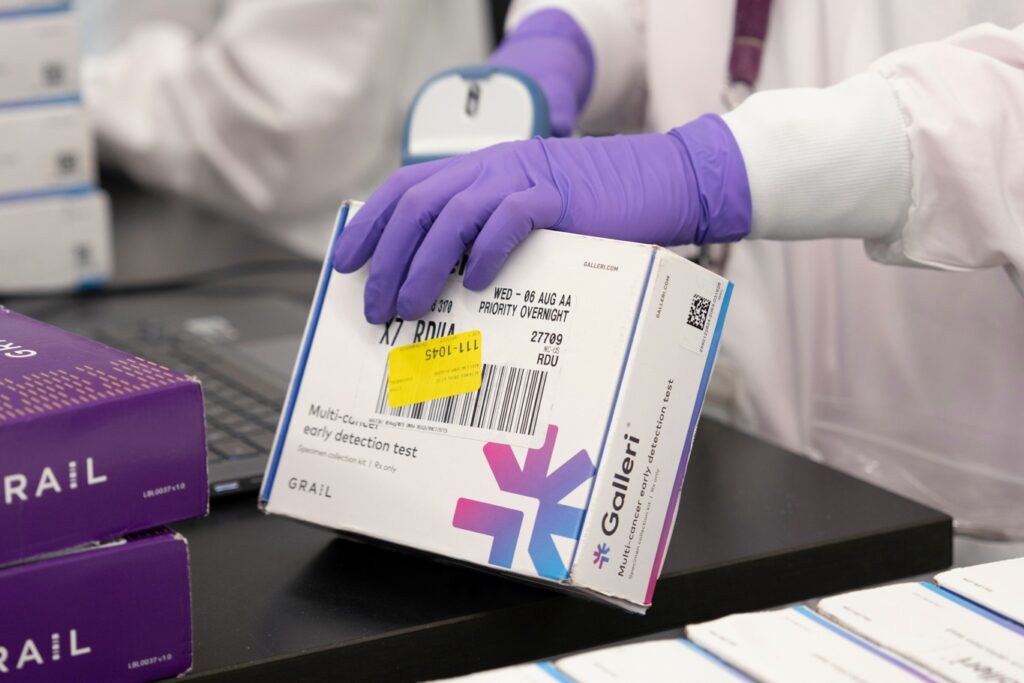
A divided Food and Drug Administration panel narrowly backed a controversial blood-based cancer test Wednesday, a step forward for an emerging field of cancer screenings that could offer less invasive methods of detecting a range of cancers before symptoms appear.
The test, Galleri, has been sold in the United States since 2021 but has not been approved by the FDA. It tests for fragments of DNA in a blood sample that could indicate the presence of cancer. Grail, the test’s manufacturer, says it can detect more than 50 types of cancer, including stomach, bladder, colorectal, skin and breast cancer.
Advocates say the test has saved lives through early detection of cancers, many of which are not currently screened for, and that it would make cancer screening more accessible.
Others have questioned its efficacy. A major trial conducted with England’s National Health Service did not show a significant reduction in late-stage cancer diagnoses for patients who took the Galleri test, Grail announced earlier this year.
Here’s what to know about the test and what’s next.
How was the panel divided in its support?
The 10-person Medical Devices Advisory Committee voted 6-4 to affirm that Galleri is effective, and 7-2 (with one abstention) that the test’s benefits outweigh its risks. All 10 members voted in favor of Galleri’s safety.
“Today’s vote reinforces the strength of Galleri’s clinical evidence,” Grail CEO Josh Ofman said in a statement.
Some committee members said Galleri’s potential to detect cancers that cannot currently be screened for is promising enough to support the test. Others were remarkably candid about their hesitancy, even as they voted in favor of Galleri, and said there is not yet enough data to firmly establish the test’s effectiveness.
“If we can find more Stage 1 or more early-stage cancers in a population that we can’t screen for currently, then that will end up having benefit,” said Victor van Berkel, division chief of thoracic surgery at the University of Louisville and one of the committee members. “But I don’t know that that’s been proven yet. So perhaps my ‘yes’ is a hopeful [vote] rather than an accurate one.”
The decision by the FDA’s Medical Devices Advisory Committee is not final, and the FDA will make its own decision on whether to approve the test, though it often follows the guidance of its committees.
When could Galleri be approved and how much does it cost?
Grail has proposed that Galleri be used for adults ages 50 and older, and said it should not replace existing cancer screenings. It applied for premarket approval of Galleri in February, and the FDA is expected to make a final decision in coming months, according to the company.
FDA approval would pave the way for the test — which costs nearly $1,000 — to be covered by private insurance and Medicaid.
In seeking the FDA’s endorsement, the company has proposed the test’s label indicate that:
- A test showing no cancer signal detected “does not rule out the presence of cancer.”
- A result detecting a possible cancer signal requires more testing and the test does not diagnose cancer.
- The test doesn’t detect signals for all cancers.
- The test may produce false positives and false negatives.
Why are ‘liquid biopsies’ are promising, and controversial?
A liquid biopsy — a test of bodily fluids, most often blood, to detect small signs of cancer such as cancer cells or fragments of DNA — is a newer procedure for cancer detection.
Some proven liquid biopsies focus on detecting specific types of cancer or determining a prognosis once cancer has been diagnosed.
Galleri is an example of a more ambitious class of multi-cancer early-detection tests, which seek to detect a wide range of cancers before they present symptoms. Several patients and physicians at Wednesday’s committee meeting shared testimonies of uncovering hidden cancers after a Galleri test.
William Dahut, the chief scientific officer of the American Cancer Society, said at Wednesday’s committee meeting that multi-cancer early-detection tests offer a more efficient way to improve cancer screening than developing more dedicated tests for specific cancers.
“No screening test is perfect,” Dahut said. “… but if we sit in a room for the next 20 years trying to find the perfect test, we have a large possibility we’re going to lead to more cancer deaths.”
Emil Lou, an oncologist and associate professor of medicine at the University of Minnesota, said the tests hold promise, and that research has improved our understanding of cancer signals and how to find them in blood.
But he cautioned that at present there remains a risk of false-positive results and false-negative results. False positives could cause patients undue stress and lead to unnecessary additional tests and procedures, while false negatives risk creating a false sense of security, he said.
“People might see this [and think]: ‘Well, I can just go do a one-time test. If it comes back negative, I have no cancers, and I don’t have to do a colonoscopy,’” Lou said.
The NHS trial of Galleri, a first-of-its-kind trial of a multi-cancer early-detection test that involved more than 140,000 participants, found that testing did not decrease the rate of Stage 3 and 4 diagnoses of 12 cancers, which was the trial’s main goal.
Scott Ramsey, a physician and researcher at the Fred Hutchinson Cancer Center and a principal investigator in a separate multi-cancer early-detection trial funded by the National Cancer Institute, said the Galleri trial’s failure to reduce late-stage diagnoses called the test’s effectiveness at early detection into question. He also raised the risk of false-negative results.
“There’s no proof that this is going to reduce your risk of dying from cancer,” Ramsey said. “If you have a negative test, you should not feel reassured [and] continue with [cancer screenings] that have been proven.”
Eric Topol, a physician scientist at Scripps Research, agreed that the trial’s failure should have given the FDA’s committee pause.
“I think these tests are great, but they just didn’t prove what was needed,” Topol said.
The post One blood test could screen you for 50 cancers. Here’s why it’s controversial. appeared first on Washington Post.