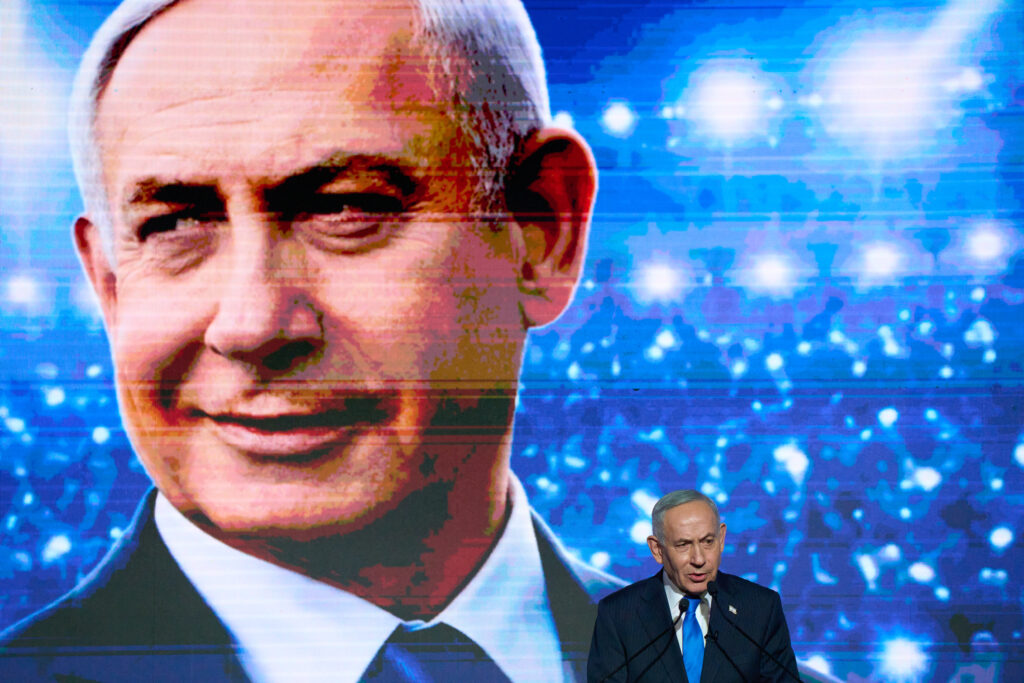
NEW YORK — Weeks ahead of high-stakes elections, Israeli Prime Minister Benjamin Netanyahu arrives in New York to address the United Nations on Thursday at a critical moment for his country and political future, with Israel under intensifying isolation and Netanyahu’s relationship with President Donald Trump under strain.
The isolation, especially at the U.N., is no surprise: At last year’s General Assembly, more than 100 diplomats from more than 50 countries walked out of the assembly hall in an unusually strong rebuke as Netanyahu entered, although he drew some cheers as well. Netanyahu often thrives under such pressure, messaging to voters at home and allies abroad a stalwartness in the face of an increasingly unsympathetic world.
But in recent months, Israel’s international standing — which took a downturn amid criticism of its conduct in the war in Gaza in response to the Hamas-led Oct. 7 attack on Israel — has continued to erode. International outrage has grown over the expansion of illegal settlements in the West Bank and violence committed by Israeli settlers there.
This month, a dozen countries including Britain, Canada and France announced sanctions on Israeli settlements. When announcing the measures, British foreign secretary Edward Miliband said he felt “a deep sense of shame about what has unfolded in Palestine under the eyes of the international community” in both Gaza and the West Bank.
“Israel finds itself in a dire situation,” said Jesse Weinberg, a researcher focused on U.S.-Middle East relations at the Institute for National Security Studies, an independent Israeli think tank.
Although the two countries and their militaries remain close, “American support for Israel is at an all-time nadir, and he can’t get away from that,” Weinberg said. “There is this growing consensus amongst Israel’s friends in the U.S. that if things continue as they are now, Israel will be in significant trouble,” he said.
As the election nears, Netanyahu’s critics at home blame him and hard-liners in his government for tarnishing Israel’s international reputation. But many supporters see him as a hardened leader capable of handling multiple conflicts even under international pressure.
Trump and Netanyahu have clashed over the direction of the war in Gaza since Trump’s election in 2024, and more recently the two have been at odds over the war in Iran as the conflict has dragged on, plunging global energy markets into crisis.
As of Wednesday, Netanyahu was not planning to meet Trump during his New York visit. The Israeli prime minister is set to arrive in New York on Thursday and return to Israel without spending the night. Weinberg said Netanyahu generally spends longer in the United States when he comes for the U.N. General Assembly.
“The fact that it’s just a single-day trip, and the fact that Trump is not going to meet with him, underscores the problematic situation that Israel and Israel’s leadership find themselves in at this moment,” he said.
New York Mayor Zohran Mamdani, a sharp critic of Israel, repeatedly pledged on the campaign trail to honor a warrant for Netanyahu’s arrest issued by the International Criminal Court, over charges that the Israeli leader has dismissed as antisemitic lies. But since assuming office, Mamdani has said he lacks the authority to make the arrest.
“Shame on you,” Netanyahu said in a video statement posted to X before he departed Israel on Tuesday. “I’m coming to the U.N., I’m going to tell the truth about our heroic soldiers, and I’m going to tell the truth about you.”
Such exchanges can bolster Netanyahu’s image in Israel. “Netanyahu always tries to time his speech at the U.N. so it hits prime-time Israeli television. It’s a big issue for him,” said Michael Oren, former Israeli ambassador to the U.S.
Netanyahu has spoken before the General Assembly as prime minister more than a dozen times, and over the years he has leveraged the appearance for political and strategic messaging.
Last year, Netanyahu’s address was broadcast live into the Gaza Strip via loudspeakers at his instruction, while Israeli hostages were still being held in the enclave. “He’ll put the spotlight on Iran. He’ll always come back to Iran, the mega source of Middle East instability and violence,” Oren said. “He’ll point out the hypocrisy of the world, which condemns Israel rather than Iran.”
In the U.S., Israel is facing declining favorability. According to a Pew poll published in April, 60 percent of American adults have an unfavorable view of Israel, up from 53 percent the year before. And among U.S. lawmakers there are growing calls for dramatic changes to U.S. military aid to Israel.
In Europe, Spain and Italy began calls for restricting arms sales to Israel in the days and weeks following the Oct. 7, 2023, attacks. Last year, a wave of nations including France and the United Kingdom recognized the state of Palestine.
Tensions are also playing out in cultural spaces. Ireland announced it will boycott the Eurovision Song Contest next year for a second year in a row over Israel’s participation. The Netherlands, Iceland, Slovenia and Spain also skipped the 2026 competition.
So far, measures intended to isolate Israel on the global stage have not only failed to have much impact, but in the immediate term, they appear to be boosting Netanyahu, said Aaron David Miller, who worked as a Middle East negotiator through several Democratic and Republican administrations before joining the Washington-based Carnegie Endowment for International Peace.
“For Netanyahu, the more isolation the better,” Miller said. Measures like the sanctions targeting settlements, he said, are used by Israel’s extreme right to justify the country’s adversarial policies.
“The fact is, the isolation plays into the narrative Netanyahu is trying to create, which is: It’s us versus them,” he said.
Soroka reported from Tel Aviv.
The post Netanyahu faces new depths of isolation ahead of address to U.N. — and Israeli voters appeared first on Washington Post.