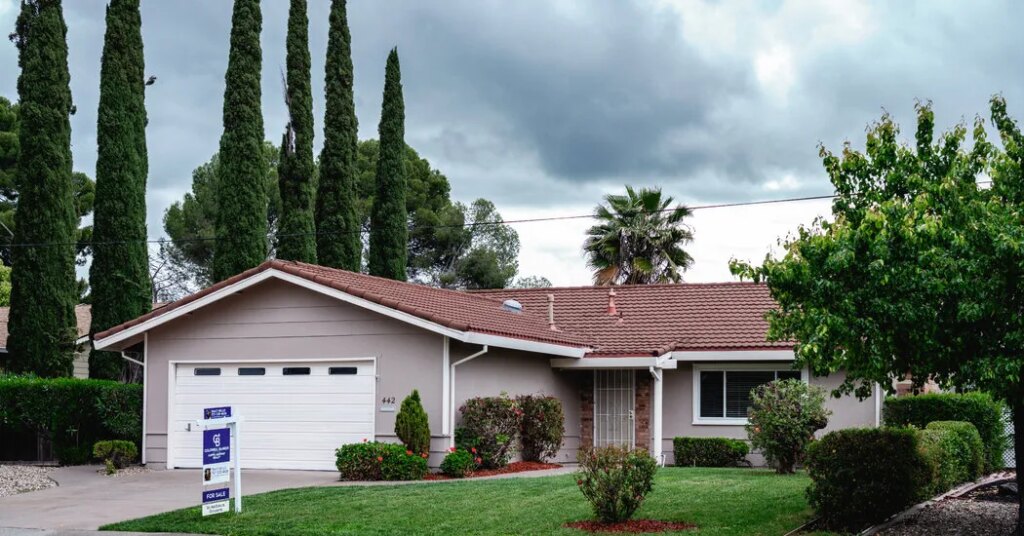
Mortgage rates jumped to 7 percent this week for the first time since January 2025, squeezing housing affordability when many Americans are grappling with higher energy costs and economic uncertainty brought on by the war with Iran.
The average 30-year, fixed-rate mortgage rate, the most common home loan in the United States, rose to 7.03 percent, up from 6.3 percent a year ago, the mortgage giant Freddie Mac said Thursday.
Mortgage rates fell below 6 percent in late February, offering a glimmer of hope that the housing market was recovering from a yearslong slog. But they began steadily rising again after the United States and Israel launched attacks on Iran on Feb. 28.
“A move from 6 to 7 is a big change,” said Stijn Van Nieuwerburgh, a finance professor at Columbia University’s Graduate School of Business, “and it will further dampen an already weak housing market.”
Since war broke out in the Middle East, oil shipments from the Persian Gulf have dwindled, pushing up prices for energy products like gasoline, diesel fuel and heating oil. Economists worry that higher energy prices caused by the war will spread to other parts of the U.S. economy.
Those concerns have materialized in the government bond market, which underpins mortgage rates. The yield on the 10-year Treasury bond — a benchmark for a range of consumer borrowing costs — has climbed above 5 percent, a level not seen since before the global financial crisis two decades ago.
Overall inflation has remained stubbornly elevated, at an annual pace of 3.4 percent in August, prompting the Federal Reserve to raise interest rates this month.
Higher mortgage rates in turn are weighing on a moribund housing market. Sales of existing homes fell 2 percent in August from July and are at their lowest level since June last year, the National Association of Realtors reported. Home prices rose 1.5 percent annually in June, up from a 1.2 percent annual gain the previous month, according to Cotality, a housing market data provider.
“Nobody can afford to buy a house anymore at these high prices and at these higher mortgage rates,” said Professor Van Nieuwerburgh, who added that the cost increases had locked up the housing market.
Mortgage rates had dipped as low as 2.65 percent in January 2021, setting off a stampede of home buying that ignited bidding wars and drove up prices. But as rates began to rise again about a year later, the housing market settled into a malaise as homeowners became reluctant to move and give up their ultralow rates.
With the housing market stagnating, developers are delaying building homes. “Higher mortgage rates, rising construction financing costs and affordability challenges continue to weigh on the market and limit momentum for new-home construction,” Bill Owens, chairman of the National Association of Home Builders, said in a statement.
Eric Orenstein, a senior director at Fitch Ratings, said that he expected home sales and mortgage refinancing to slow for the rest of the year, but that the market would eventually begin to thaw as homeowners were forced to move because of major life events, like a job change.
“There’s a psychological aspect: At what point do consumers just accept that rates are not going back to 3 percent?” Mr. Orenstein said.
And as owners build more equity in their homes, losing a low rate will have less impact, he added. Americans have amassed a record $35 trillion in home equity, according to the Federal Reserve Bank of St. Louis.
Professor Van Nieuwerburgh said he was hopeful that the 21st Century ROAD to Housing Act, which Congress passed in June, would add to the supply of homes to local markets by easing regulations for builders.
The post Mortgage Rates Hit 7% as Iran War Crushes a Weak Housing Market appeared first on New York Times.