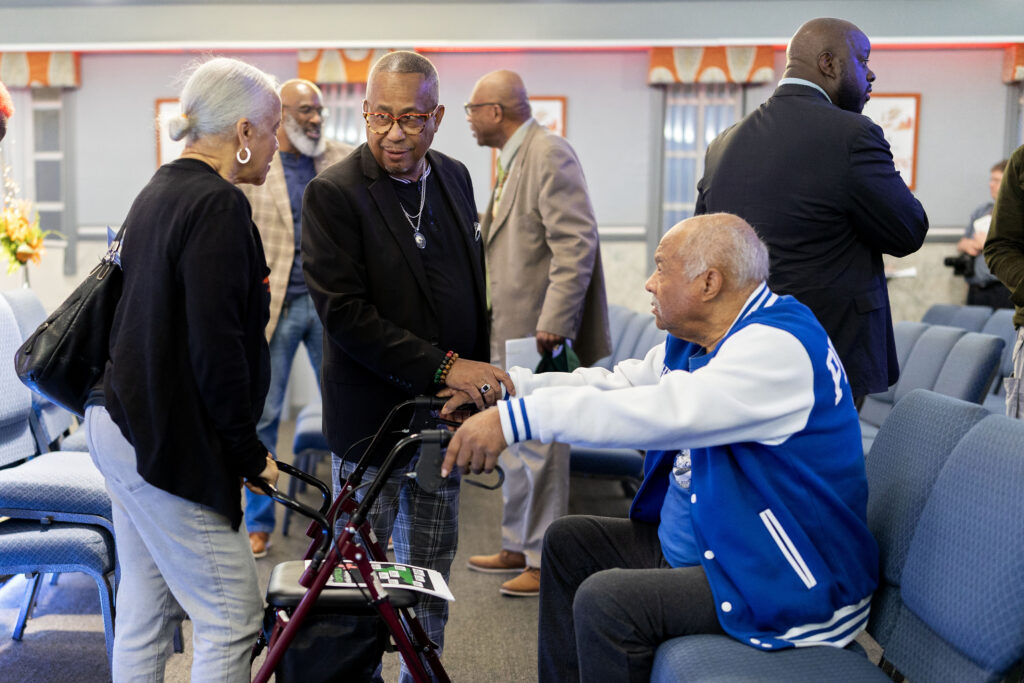
FRANKLIN, Va. — Pastor Eric Majette was so worried that his congregation is losing access to health care that he had a blood pressure machine installed outside the church sanctuary and set up heart-health counseling once a month.
It’s not much, but anything helps as the community barrels toward the potential closure of its struggling local hospital. Here in one of the most competitive House districts in the country, health care is an urgent part of the affordability topic driving political campaigns everywhere ahead of this fall’s midterm elections.
Shutting the Bon Secours Southampton Medical Center would be a serious economic blow to this former paper mill town whose main employer closed years ago. Democrat Elaine Luria is trying to win back the House seat she once held by reminding residents that President Donald Trump’s “One Big Beautiful Bill” will enact Medicaid cuts that could force the hospital out.
“What’s even more scary is people might not actually recognize what’s coming,” Luria said in an interview, promising to work to reverse Medicaid changes that Virginia officials have said could cost some $2 billion a year.
Cook Political Report rates the race against Rep. Jen Kiggans (R) in Virginia’s 2nd Congressional District a toss-up, and both parties have highlighted it as critical in the battle for control of the House.
Across competitive races nationally, Democrats have focused heavily on the rising costs of health care, spending two times more than Republicans on advertisements that frame it as an out-of-reach household expense, a Washington Post analysis of data from the ad tracking firm AdImpact found.
The analysis showed that Republicans have spent nearly four times more than Democrats on ads about funding hospitals. Democrats have spent $60 million on ads mentioning Medicare or Medicaid, against $3 million from Republicans — a 20-to-1 gap.
It’s put Republicans on the defensive in districts like this. Kiggans, who won the seat from Luria four years ago, is trying to make the case that a rural health provision in the spending bill will protect the state.
But the $189 million the fund provides Virginia this year for rural hospitals is significantly less than the cuts that state officials say create problems for the industry, including about $2 billion a year in Medicaid reductions beginning in 2028 and the loss of subsidies for health insurance through the Affordable Care Act that caused as many as 90,000 Virginians to drop insurance this year.
“We need to rid ourselves of this leadership that’s taking us backwards,” Alvin Harris, a retired physician, told Luria at a health care roundtable last month in Franklin, urging her to go to Washington and make changes.
A spokesman for Kiggans insisted that the Medicaid changes are not cuts. They impose work requirements on recipients that are expected to significantly reduce the number of people who qualify and will cut waste and fraud to save taxpayers money, Kiggans spokesman Calvin Moore said.
That has led some voters to throw up their hands in confusion.
“We’re all very concerned” about the prospect of the hospital shutting down after serving the community for generations, said Susan Jones, 57, whose family has owned a downtown office supply shop more than 50 years. “Most of us here in town have no idea why, or what the problem is.”
She and her sister, Mary Christy Saunders, 59, said they don’t know enough about Luria and Kiggans to choose between them but feel a general sense of dissatisfaction with all politicians. “I always leaned Republican,” Saunders said. “I have not been impressed with any of them lately.”
Over the summer, a report from Virginia’s bipartisan Joint Commission on Health Care identified five rural hospitals across the state at imminent risk of closure, including Franklin’s Bon Secours Southampton Medical Center. It said looming Medicaid cuts — which would both reduce the number of patients seeking care and slash payments to hospitals — could push them over the edge.
Bon Secours, the nonprofit that bought the Franklin hospital in 2020, said that the challenges facing such facilities are not new. “In recent years, however, those headwinds have intensified,” the nonprofit said in a statement.
The state report documented years of declining services at the hospital, which stopped delivering babies in 2017 and has eliminated almost all inpatient surgeries. About 70 percent of the hospital’s patients are on Medicare or Medicaid, the study found.
For many services, residents have to travel about 40 minutes farther to a hospital in the city of Suffolk.
Franklin and the surrounding Southampton County are at the far western edge of both the 2nd Congressional District and the region known as Hampton Roads, which is heavily military and suburban. This end of the area is largely rural — flat, swampy land marked by fields of peanuts, corn and soybeans and stands of pines that have been logged for generations.
The Union Camp paper mill that employed thousands in Franklin is closed, taking with it the white-collar jobs that once supported grand old houses and a bustling little downtown. The small city’s population is more heavily Black than the rest of the region, though the electorate of the 2nd District as a whole is nearly one-quarter Black — one of the highest concentrations of minority voters in a swing district this year.
The looming Medicaid cuts that could pull the rug out from the local hospital will disproportionately affect Black residents, according to Rodrigo Soto of the Commonwealth Institute for Fiscal Analysis, a left-leaning think tank in Richmond. About 34 percent of Virginia’s Medicaid enrollees are Black, nearly double the proportion of African Americans in the state’s overall population, at 18 percent.
Because of the scope of federal cuts to Medicaid, the ACA and low-income food assistance, the roughly $189 million coming to Virginia this year from the Big Beautiful Bill is not enough to close the gap in aid to vulnerable populations, said Lauryn Walker, the state’s deputy secretary of Health and Human Resources.
“To be clear, we are thrilled to have that investment for the rural communities in our commonwealth,” Walker said. “It will help us mitigate some of the harm.”
Republicans view the Rural Health Transformation Program as a political asset and will tout it in campaigns around the country, said Reilly Richardson of the National Republican Campaign Committee.
“Democrats have desperately tried to spin healthcare, but the truth is, voters aren’t buying it,” Richardson said in a written statement. “Republicans have a record they can go on offense with, from delivering the rural healthcare transformation fund to protecting Medicaid for the most vulnerable from fraudsters.”
Kiggans made that point at the end of August when she hosted a roundtable in Virginia Beach with Mehmet Oz, appointed by Trump to run the Medicare and Medicaid systems.
Kiggans said in a video posted to social media that her job as a geriatric care nurse practitioner makes health care affordability especially personal. One of the keys to that, she said, is “saving Medicaid.” The Big Beautiful Bill, which she supported, helps do that by eliminating “waste, fraud and abuse,” she said.
Franklin resident Liz Carman, who holds a clerical job at the hospital in Suffolk, said she is an ardent supporter of both Kiggans and Trump. “He’s done great things for our country,” she said, mentioning “chasing the illegals out of the country” and keeping men out of women’s sports. “And I like how he brings God into things,” she added.
Sitting on a bench after lunch at a Franklin restaurant on a hot day at the end of August, Carman and her friend Bonnie Langer, 77, agreed that the survival of the Franklin hospital is an important issue. But they also favored cuts to Medicaid, which Langer said should not be used for undocumented immigrants.
Undocumented immigrants are not eligible for federal Medicaid benefits.
But Yvonne Rose, 76, an elder at Majette’s New Life church, said the looming cuts will be a serious blow to low-income families. “And we’re pretty much a population of poor people out here,” she said.
Harris, the retired physician, said the hospital might have to fail before enough people see the need for change. “People don’t feel it,” he said, “until it’s happening to them.”
Lydia Sidhom and Luke Connors contributed to this report.
The post How the fate of a rural hospital could help flip the House appeared first on Washington Post.