The Empire State Building was so shrouded in fog on the morning of Saturday, July 28, 1945, that its upper floors had vanished from view. Lost in the dense clouds that smothered the city, the pilot of a B-25 Army bomber, flying across Manhattan at skyscraper-height, saw the landmark too late.
The plane smashed into the 78th and 79th floors, shearing off its wings. The twin engines ricocheted like pinballs, one into the elevator shaft, the other onto the roof of a neighboring building. “Brilliant orange flames shot as high as the observatory on the 86th floor,” The New York Times reported, “as the gasoline tanks of the plane exploded.”
Thirteen people perished instantly, including the pilot, 27-year-old Lt. Col. William F. Smith Jr., who had recently returned from service in Europe, where the war had just ended. Smith’s flight had been a training exercise before an expected redeployment to the Pacific.
When news of the crash broke, Ernie Sisto, a Times staff photographer, was in the paper’s city room on 43rd Street, discussing the day’s assignments. He rushed to 34th Street, emerging from the subway into a melee of fire trucks, police officers, ambulances and stunned bystanders.
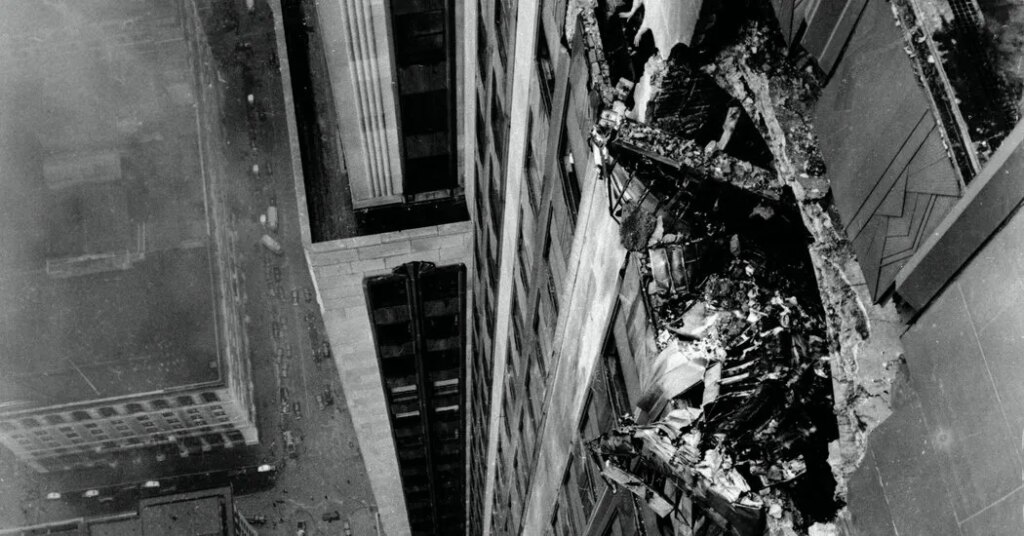
The crash had torn a hole some 20 feet high and 18 feet wide into the Empire State Building’s north side. Roughly 900 feet below, Sisto, his camera in his hand, his press pass tucked into his hat, knew that to get a good shot he would need to get closer.
Sisto was carrying his 4-by-5 Speed Graphic, the standard for newspaper photographers since the late 1920s. It produced large, detailed negatives but it was also cumbersome — nowhere near as unobtrusive as the smaller 35-millimeter cameras made famous by Leica. As Sisto’s colleague Eddie Hausner recalled, “Using the Speed Graphic, you had to get the picture and you had to get it right the first time around, if possible. If you didn’t, you had to pull out the film holder and reset the next sheet.”
Sisto was renowned for getting his shot, particularly at sporting events. During one football game, he was so close to the sidelines that he was tackled. Covering a hockey contest, he was hit in the head with a puck; after getting stitched up, he resumed shooting. Even when he was far from the action, he found a way to get close by expertly wielding an enormous long-lens camera known as Big Bertha.
Entering the Empire State Building, Sisto took the elevator to the 67th floor — as high as an elevator could go that morning, but still not high enough. Along with some other photographers, he climbed 14 flights of stairs, past the crash site and higher still, to the 81st floor. He located a ledge that looked down onto the wreckage. The perspective was right, but he needed to get out far enough to capture the scene. Sisto changed the lens on his Speed Graphic to a wide-angle. To his colleagues, he said, “Hold my legs while I lean way out.”
Climbing onto the ledge, Sisto wedged one arm against the side of the building and stretched over the side as far as he dared to take his shot. He later recalled that he did this four or five times, crawling back to safety to change the sheet of film before leaning out again some 1,000 feet above street level, to take a shot for every other photographer as well. The Times editor Arthur Gelb, who also reported on the crash, later declared, “To all newspapermen on the scene, the hero of the day was Ernie Sisto.”
The next day, Sisto’s photograph ran across three columns on the front page of The Times. (The photos he took for the colleagues who held his legs ended up in newspapers around the country.) In it, the twisted metal and shattered stone of the crash site appear as a violent puncture in the building, disrupting the skyscraper’s sheer vertical lines. Even at that height, Sisto managed to frame the shot to include an advertisement for war bonds painted on a building below.
Sisto never lost his sense of derring-do. In 1954, he took Big Bertha onto a DC-4 to photograph a total eclipse. Flying with three open windows at 13,000 feet, and wearing an oxygen mask, he relied on intuition and exposed his film at much faster speeds than recommended. His photographs were the expedition’s only successful ones.
Ernie Sisto retired in 1972, after a 49-year career, and died in 1989. His epitaph — at least according to the card catalog in The Times’s clippings archive — reads “Ace Photographer.”
The post ‘Hold My Legs’: How Ernie Sisto Shot a Sky-High Disaster appeared first on New York Times.