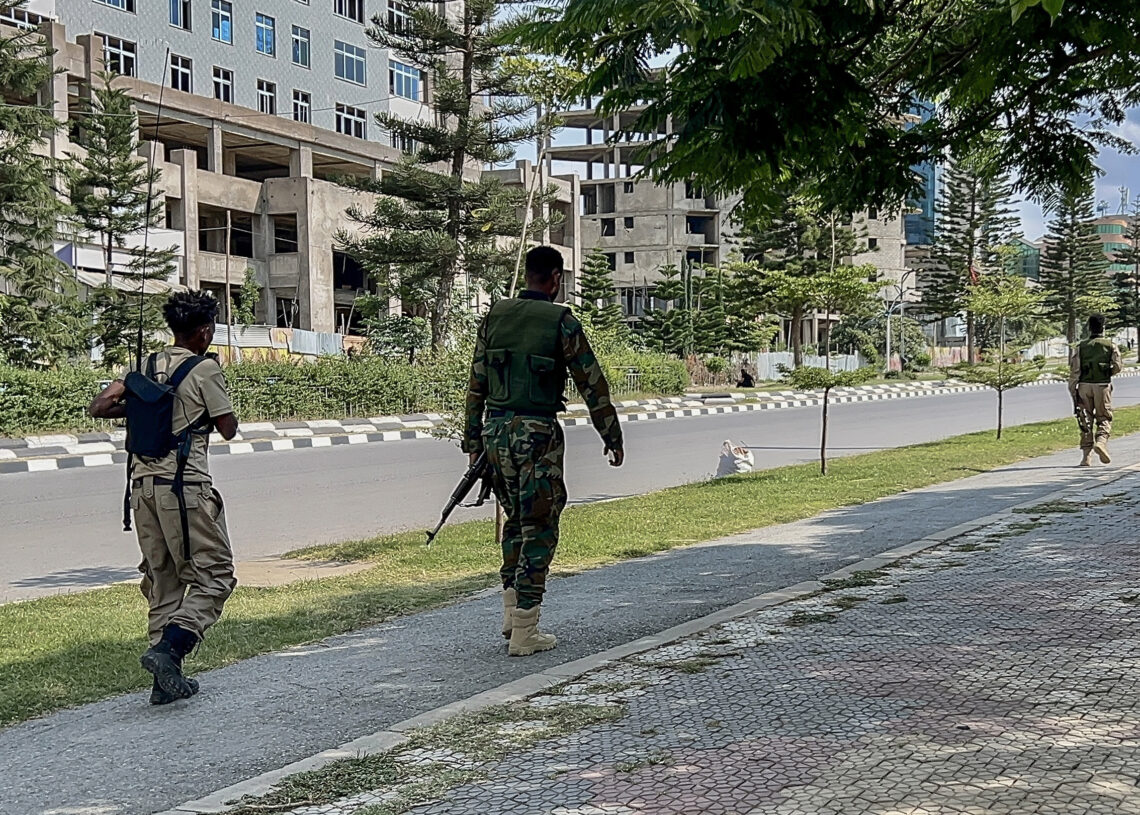
Tigray fighters have attacked government positions and taken control of three airports in northern Ethiopia days after pledging to overthrow the government, stoking fears that the African nation has slid back into civil war.
The Ethiopian National Defense Force said Thursday that it had killed 272 “enemy troops” and captured 260, and seized weapons and other equipment in the fighting. “Currently, the army is assessing the enemy’s situation and launching well-planned counter-attacks from key military positions it holds,” the ENDF said in a statement.
The government didn’t report any losses. The African Union, however, expressed concern at the “detention of federal personnel.”
More than half a million people were killed in Ethiopia’s viciously fought civil war from 2020 until 2022. The sides signed a peace accord in Pretoria, South Africa, but have since renewed fighting. Now, analysts warned, the deal appears to have collapsed.
“We are pretty much back into post-Pretoria war mode,” said Hassan Khannenje, director of the HORN International Institute for Strategic Studies in Nairobi.
The action followed several government drone strikes on Tigray state, according to Ethiopian media, including on a Catholic Relief Services convoy carrying U.S. aid.
The Tigray Army said Wednesday that it was responding to a “full-scale offensive along multiple fronts” by the government of Prime Minister Abiy Ahmed involving “infantry, mechanized units, drones and air force assets.” The government, meanwhile, said it was the Tigray People’s Liberation Front that had launched an “all out offensive” against government positions in the northern states of Afar and Amhara.
“The TPLF politico-military leadership has obviously taken irresponsibility to new heights,” said Getachew Reda, Ethiopia’s minister adviser on East African affairs.
The TPLF enjoys some support in Tigray but little internationally. The State Department said the U.S. government was “deeply concerned by this escalation” and called on the sides “to immediately engage in constructive dialogue to prevent further violence.” The U.S. ambassador to Ethiopia said he was “disappointed to see the leadership of the TPLF, that the United States sanctioned earlier this year, make the poor decision to launch a large-scale offensive today.”
“Rejecting dialogue … and engaging in an unwinnable fight does nothing for the people,” Ambassador Ervin J. Massinga said.
African Union Commission Chairman Mahmoud Ali Youssouf called for the “immediate cessation of all actions that could further escalate tensions.” He said the Pretoria agreement, which was brokered by the A.U., “remains the cornerstone of sustainable peace, stability and reconciliation in Ethiopia.”
Tesfaye Hailay fled Ethiopia in 2022 for Kenya. He returned two years ago but now worries that he must leave again.
“The situation is very difficult,” he told The Washington Post on Wednesday from Tigray. “They have suspended the flights, and we are afraid … that internet and telecom services will also be suspended.”
Some people were storing food, Tesfaye said, but many can’t afford to. “We experienced a war a few years ago, and many people’s economic capacity were exhausted at that time,” he said. “There is no capacity to survive another.”
The conflict began as a political struggle the TPLF, which ruled Ethiopia for three decades until 2018, and Abiy, who came to power that year through the Ethiopian People’s Revolutionary Democratic Front. But it has since devolved along ethnic lines.
Abiy, who was awarded the 2019 Nobel Peace Prize for his leadership in resolving the Ethiopian-Eritrean border conflict, has been accused by international monitors since then of violating human and civil rights and backsliding on democracy.
Tigray leaders accused the government Wednesday of “invasion and genocide.”
“Our army will continue its fight to ensure that the rights, security, sovereignty and survival of our people are protected,” the Tigray regional government said in a statement. “Our people who are found inside and outside will be asked to stand with the brave army.” It concluded by urging “all our people to take necessary precautions.”
Tesfaye said Tigray fighters were calling on young people to join them, but at least some were resisting. “Some of the youth are not interested in the war,” he said. They “believe differences can be solved by political dialogue. They have seen the damage from previous war. They are not willing to participate in the war.”
On Sunday, seven groups, including the TPLF, announced that they had formed the Ethiopian People’s Forces Alliance for Survival. They called Abiy’s government “an existential threat to the peoples of Ethiopia” and said they bore “the historic responsibility” of overthrowing it.
Since 2022, Khannenje said, Abiy’s government has strengthened its position by securing drones and other support from new friends in the Middle East and Persian Gulf. But the new alliance, which includes former TPLF adversaries the Oromo Liberation Army and the Amhara Fano National Movement, is “significant.” The militants could be taking advantage of the war in the Middle East, he said, “which means sometimes reduced support and engagement in Ethiopia, to try and pile pressure against the current government.”
“And so at a time when there is no serious framework to intervene,” Khannenje said, “there is a calculation I think on the side of the rebels that they may be able to make progress.”
“There is the calculation that they can put a lot more pressure on the government either to make concessions or to follow through with some of the arrangements from Pretoria, or in the hope that it becomes so weakened that it’s no longer able to survive.”
Ethiopia is involved in other regional conflicts. The Sudanese Armed Forces accuse Abiy’s government of hosting a camp for the rebel Rapid Support Forces, currently fighting for control of that country. Ethiopia accuses Eritrea of supporting Tigray rebels and preparing for war. A conflict between Ethiopia and Eritrea could draw in Egypt. And tensions over access to the Red Sea have raised the regional temperature.
“This is extremely dangerous,” Khannenje said. “If the conflict expands we’re likely to start seeing another refugee crisis, but also a final death nail in the regional and continental mechanisms of conflict resolution.
“Remember, the region and the continent has been unable to solve the conflict in Sudan, and to add a new layer of conflict in Ethiopia is going to be extremely catastrophic. … You may have another extremely serious humanitarian situation in Ethiopia that may even be larger than the one in Sudan, because Ethiopia is a country with 130 million people.”
The post Ethiopia’s last civil war killed over half a million. Another could be starting. appeared first on Washington Post.