On Dec. 4, 1982, a man used sodium cyanide to kill himself in Sacred Heart Catholic Church in Boise, Idaho. For the next four decades, he was known only as the “Unknown Wanderer” until investigators announced on Wednesday that they had identified him as Dr. Mathew Betkouski, an organic chemist.
When the Ada County Sheriff’s Office said its investigators had solved the cold case, it also announced the discovery of a possible link to another mystery, one that had gripped the nation that year when Extra-Strength Tylenol capsules were lethally tainted with potassium cyanide.
Seven people in the Chicago area died after ingesting the tainted pills, and the case prompted makers of over-the-counter drugs to introduce new safety features.
“Identifying the Unknown Wanderer opened an unexpected door,” the sheriff’s office said in a statement.
Tim Cooper, a detective with the Ada County Sheriff’s Office, added, “We’re hoping that getting his story out generates new leads, not just for this case, but for others we may not even know about yet.”
The sheriff’s office said it was withholding some of what it called supporting evidence for a possible connection between Dr. Betkouski and the Tylenol killings, saying a full account would be revealed in the Oct. 9 release of “Unmasking the Tylenol Killer,” a documentary it had worked on with the television series “Unsolved Mysteries.”
While the authorities in Idaho are not calling Dr. Betkouski a suspect in the Tylenol case, they said they had shared their findings with the Chicago Police Department, which confirmed it has been in contact to determine whether there is a connection.
The Chicago police said in a statement on Thursday that the Tylenol investigation “remains an open cold case” and that it was inviting tips from the public.
The Arlington Heights Police Department in Illinois said in a statement on Thursday that it had also received information about the findings from the Idaho investigators. It said it was working with the F.B.I. and other agencies “to identify the individual or individuals responsible for the 1982 Tylenol murders.”
The Tylenol poisonings date to September 1982, when a 12-year-old girl, Mary Kellerman, died after swallowing a capsule to fend off a cold. Six more people in the Chicago area died after taking Tylenol.
The Food and Drug Administration warned consumers nationwide to stop using Extra-Strength Tylenol. The manufacturer, the McNeil Consumer Products division of Johnson & Johnson, recalled specific lots of the capsules, and offered a $100,000 reward for information leading to the arrest and conviction of the “person or persons responsible for the murders.”
Some states banned sales. Stores removed the capsules from their shelves.
“You’re dealing here with an absolutely monstrous crime,” Bob Fletcher, a spokesman for the Illinois Department of Law Enforcement, told The New York Times in 1982. “Whether it’s a psychotic individual, whether it’s targeted at one particular person, whether it’s a perverted juvenile prank — there’s simply a universe of possibilities in the case.”
Several men were questioned, but the leads went nowhere. One man, James W. Lewis, a tax consultant, sent a letter to the manufacturer saying he would “stop the killing” in exchange for a million dollars. He was arrested and spent 12 years in federal prison for extortion.
As the killings remained unsolved, investigators continued to scrutinize Mr. Lewis. In 2009, F.B.I. agents executed a search warrant at his residence in Cambridge, Mass. In 2022, investigators traveled from Illinois to speak with him, the CBS affiliate in Chicago reported at the time.
Mr. Lewis was never charged in the murders, and he denied any involvement. He died in 2023.
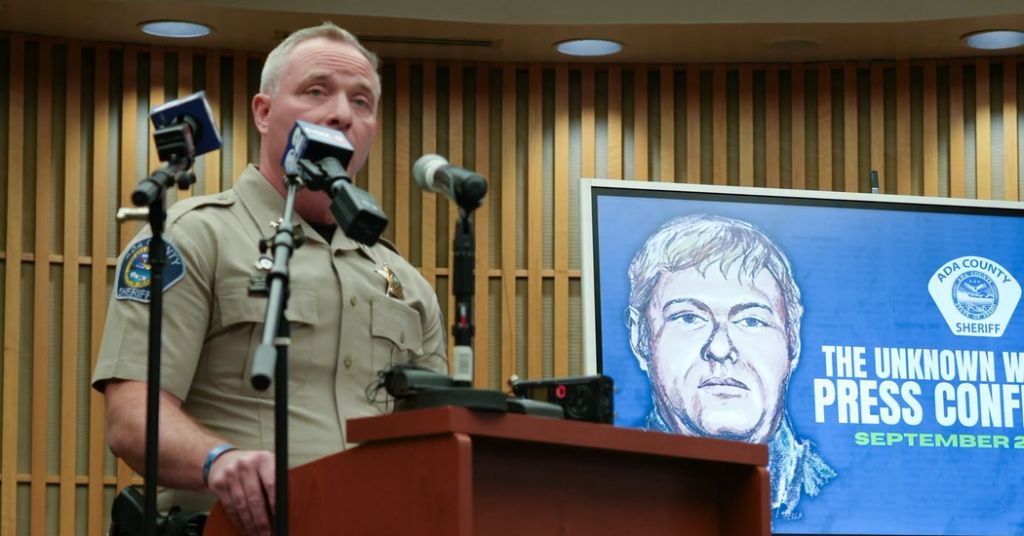
Meanwhile, Detective Cooper reopened the “Unknown Wanderer” cold case in 2019. The body found in the church in Boise had in his possession 19 $100 bills, about 30 keys and a typed note signed William L Toomey, a name that proved fake, Sheriff Matt Clifford said at a news conference on Wednesday. The county coroner determined that the man had died of cyanide poisoning, the sheriff’s statement said.
An engraving on a key led investigators to a street, Mills Court, in Jacksonville, Fla., where records showed a property owner who had disappeared in 1982 and was declared dead in 1989 in absentia. A DNA sample from a family member yielded his name, Detective Cooper said.
His story slowly emerged in the investigation. He grew up in Los Angeles, and in 1974 he had a traumatic brain injury after a fall, Detective Cooper said, adding that “his mental illness throughout his life was complicated.”
Investigators spoke to people who knew him, leading to what the sheriff’s office described as his “possible connection” to the Tylenol murders. He had worked in drugstores in Florida, had a volatile nature and a fascination with explosives, the investigation showed. Colleagues said he had discussed the idea of a “perfect crime” with cyanide as an undetected killer.
During the investigation, Detective Cooper discovered that Dr. Betkouski was hired by Lockheed in 1979 and worked on a NASA project at the White Sands Test Facility in New Mexico, where a former colleague said he had spoken about how “poison could be introduced into over-the-counter capsules if a person wished to do so.”
His employment there ended in March 1982, after he created a “disturbance” while trying to obtain capsules from a pharmacy in the Las Cruces area for what he called an “experiment,” Detective Cooper said at the news conference.
A map of Chicago and a small bottle of sodium cyanide were found among his belongings, Detective Cooper said, noting that a different type, potassium cyanide, was used in the Tylenol poisonings. Photographs showed he had visited Chicago, but investigators “cannot place him” there at the time of the murders in 1982, he said.
“Our goal today is to generate new leads,” he said. “We’re especially interested in Dr. Betkouski’s movements between Oct. 15 and Dec. 4, 1982.”
The post An Idaho Cold Case Revisits the Unsolved Tylenol Killings in 1982 appeared first on New York Times.