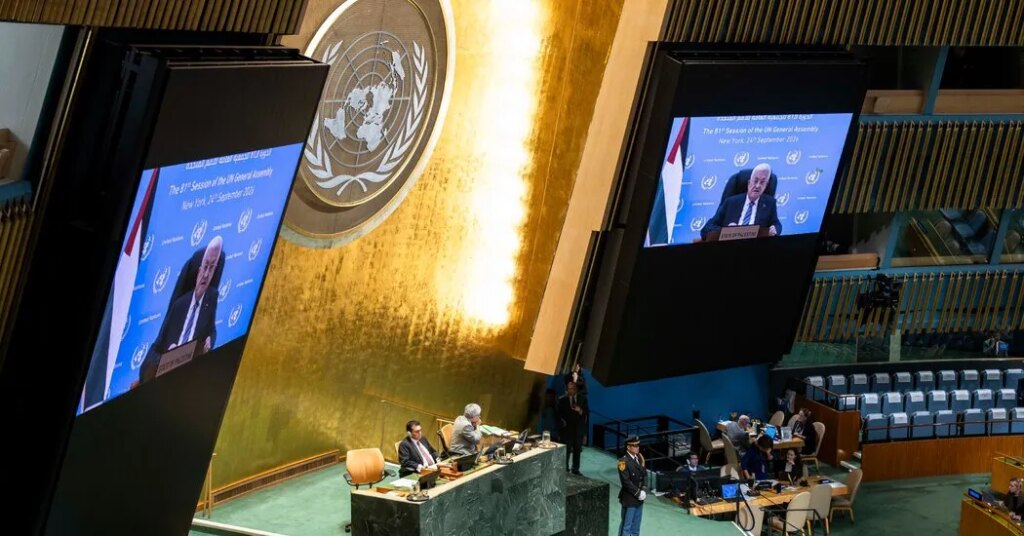
The Palestinian leader Mahmoud Abbas renewed his call for a two-state solution in a videotaped address to the General Assembly on Thursday, as he accused Israel of prosecuting “a genocidal war” against Palestinians “that has created an unprecedented humanitarian catastrophe.”
For the second year in a row, Mr. Abbas, 90, did not appear in person at the annual gathering because the Trump administration denied him a visa to travel to New York. The General Assembly requires all world leaders who give speeches to the body to show up at United Nations headquarters in New York for the event. But it can make an exception under extreme circumstances, and the U.N.’s 193 members voted last week, as they did last year, to allow Mr. Abbas to send a videotaped speech.
Mr. Abbas, who the president of the Palestinian Authority, forcefully renewed calls for the creation of an independent Palestinian state, one that he said would exist peacefully alongside the state of Israel.
“We seek a democratic Palestinian state that respects the rule of law and human rights, a non-militarized state that lives in security and peace alongside the state of Israel,” Mr. Abbas said. “It is possible.”
Palestinian statehood has widespread support at the U.N., with 157 out of 193 member states recognizing Palestine as an independent state. In 2025, some major Western countries, including France, Britain, Canada, Australia and Portugal, formally recognized a Palestinian state at a conference on the sidelines of the General Assembly.
Mr. Abbas condemned the persistent Israeli violence toward Palestinian civilians in Gaza and the occupied West Bank. Israel’s annexations of land in the West Bank for Jewish settlements have been heavily criticized as an impediment to the creation of a Palestinian state.
He characterized the continued Israeli attacks in Gaza and settler violence in the West Bank as “a malicious colonial scheme aimed at making the lives of Palestinians more difficult in their homeland and forcing them to leave it.”
Israel has rejected those accusations, justifying its conduct in Gaza as an attempt to root out terrorism by Hamas that it says threatens its national security. The Israeli prime minister, Benjamin Netanyahu, 76, is expected to address the General Assembly on Thursday afternoon.
The conflict in Gaza is in its fourth year. Israeli attacks have continued despite a cease-fire brokered by the United States, and Hamas, the militant group that once controlled the enclave, has not been disarmed. Much of the enclave lies in ruins, and reconstruction efforts are suspended.
In the West Bank, extremist Israeli settlers are still attacking Palestinians and have in some instances taken over their land by force. The Israeli government also has expanded the building of new settlements even though they have been deemed illegal under international law.
Mr. Abbas welcomed President Trump’s Board of Peace plan for Gaza, which U.N. Security Council adopted in a resolution, as a blueprint for ending the war, disarming Hamas and rebuilding the enclave its shattered infrastructure. That plan has since stalled.
“Regretfully, we have not seen any of this materialize on the ground,” Mr. Abbas said.
The Palestinian leader rejected the notion that Palestinians would ever voluntarily leave their land. Israel has been accused of pursuing policies in Gaza that make life for Palestinians impossible by destroying their homes, schools, universities, hospitals and infrastructure.
“We will not leave our homeland,” Mr. Abbas said. “We will not accept resettlement. We will not allow anyone to decide for us.”
The post Abbas Presses Case for Palestinian State in Taped General Assembly Address appeared first on New York Times.