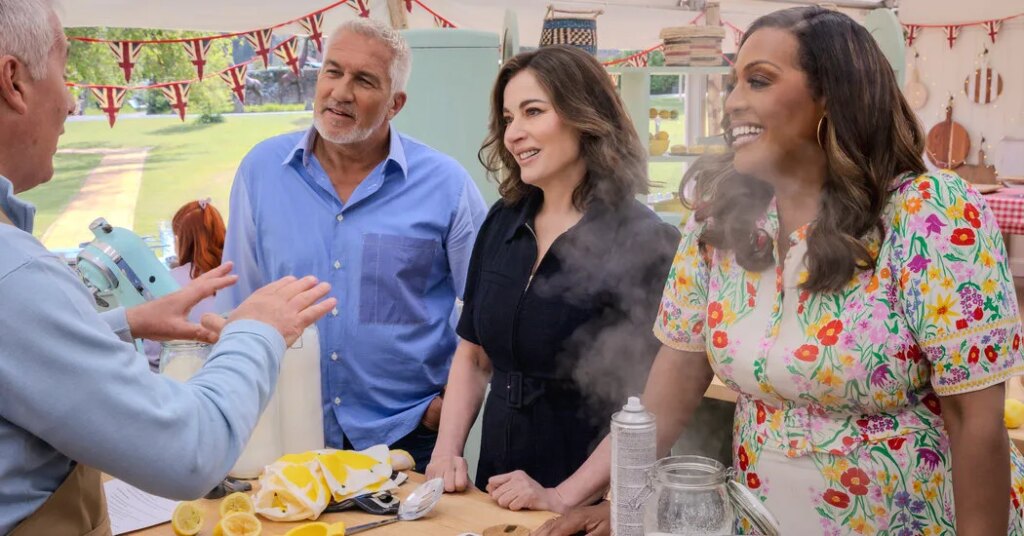
“Bake Off” is back and buzzing over a new treat: Nigella Lawson.
The British phenomenon — a description that could apply to either Ms. Lawson, a 66-year-old titan of British food media, or “The Great British Bake Off,” the beloved reality television show hosted in a tent — set the country afire on Tuesday night with the debut of the 17th series.
In the first episode, which is coming to the United States on Friday under its Americanized name, “The Great British Baking Show,” Ms. Lawson brings the poise. And her signature sensual love of food is already spicing up the show’s traditional coziness.
She reigned supreme over the first challenge: A “sumptuous” chocolate stout cake, in honor of her famous Chocolate Guinness cake.
“Could there be a more Nigella word than ‘sumptuous’?” quipped Alison Hammond, one of the presenters, explaining the task to the amateur bakers in the clip below.
Ms. Lawson, ever ready, took the bait.
“OK,” she said, flashing her eyes around the room. “I want it really sumptuous.”
The horde of amateur bakers taking part in episode one — who range in age from 21 to 67 and speak with a bouquet of accents from across Britain — raced to impress.
And Ms. Lawson, ever regal, dished out advice through the often-chaotic episode. There were a few tears, and even a few tumbles, and that’s all we’ll be forking over in the way of spoilers.
“If you’ve got the cherries, you can hide a multitude of sins,” she advised generously, as a baker fretted that her cake could stick to the pan.
Then it was time for the judging.
With tempered criticism, Ms. Lawson staked her claim as good cop to her co-judge Paul Hollywood’s bad cop, who has become something of a Simon Cowell of the pastry world with his reliably gruff smackdowns.
Mr. Hollywood may bluntly call a cake overcooked or flavorless. Ms. Lawson seems to prefer a compliment sandwich: This is lovely, it could improve, but good effort overall.
She took a stand over a peanut and caramel concoction. Mr. Hollywood, she said, might have preferred a neater bake. (The frosting had smeared over the stacked crumb.) But not Ms. Lawson, a former columnist for The New York Times and a food star for decades.
“I like a bit of goo,” she purred, leaning against the counter. “It looks irresistible, doesn’t it?”
She took a big bite. “Sensational,” she rasped, her eyes wide.
She took another bite. “I’m in heaven.”
Mostly, so are the British papers.
“‘Bake Off’ and Nigella are a match made in heaven,” drooled The Telegraph.
“The Domestic Goddess is easily the best thing that could ever have happened to ‘Bake Off’,” raved Metro.
“Can Nigella buck the trend for modern enshittification of all things and give us the sanctuary we crave?” asked The Guardian, breathless. “Yes, my friends. Yes, she can.”
Ms. Lawson, who studied medieval and modern languages at Oxford, began her career as a writer and editor before rebranding as a powerhouse of cooking and food, publishing the best-selling “How to Eat” in 1998 and “How to Be a Domestic Goddess” in 2000. Along with many other viral moments in her cookery show career, she famously brought the world the most creative possible pronunciation of the word “microwave” in 2020. (For the avoidance of doubt, it was playful, as she later explained: “I do say it like that, but not because I think that’s how it’s actually pronounced.”)
In her new role, she is following in the steps of Mary Berry, now 91, who was the face of the show from 2010 to 2016, and Prue Leith, now 86, who passed the torch to Ms. Lawson with a “Doctor Who” nod in the clip below.
“The Great British Bake Off” has changed over the years since it was first broadcast on the BBC in 2010 — and changed British baking along with it. The so-called “Bake Off Effect” set off a wave of home baking, a boost in the ambition of baked goods in British cafes and more room for diverse flavors in the pastry mainstream.
It is too early to know how Ms. Lawson will settle into a rhythm with the other stars, Mr. Hollywood, Ms. Hammond and Noel Fielding.
It seems clear, however, that she will be quietly nurturing of the amateur bakers, even those who really botch it.
“What Nigella has been able to do is combine rigor and intelligence and discipline with kindness and warmth,” said Ruth Rogers, the owner of the River Café in London.
Ms. Rogers, who has been friends with Ms. Lawson for a long time, said that cooking is often a performance. Restaurants can be judgmental. Reality television is usually even more so.
But “Bake Off” has always been supportive of young cooks. And so has Ms. Lawson, she said.
Sure, the contestants are whittled down, week by week, as they bake and bake and bake. Ultimately, though, everyone’s a winner.
Or maybe under Ms. Lawson, everyone is a subject in her new reign of sumptuous delight.
The post A Sweet, Salty, ‘Sumptuous’ Recipe for ‘Bake Off’: Just Add Nigella Lawson appeared first on New York Times.