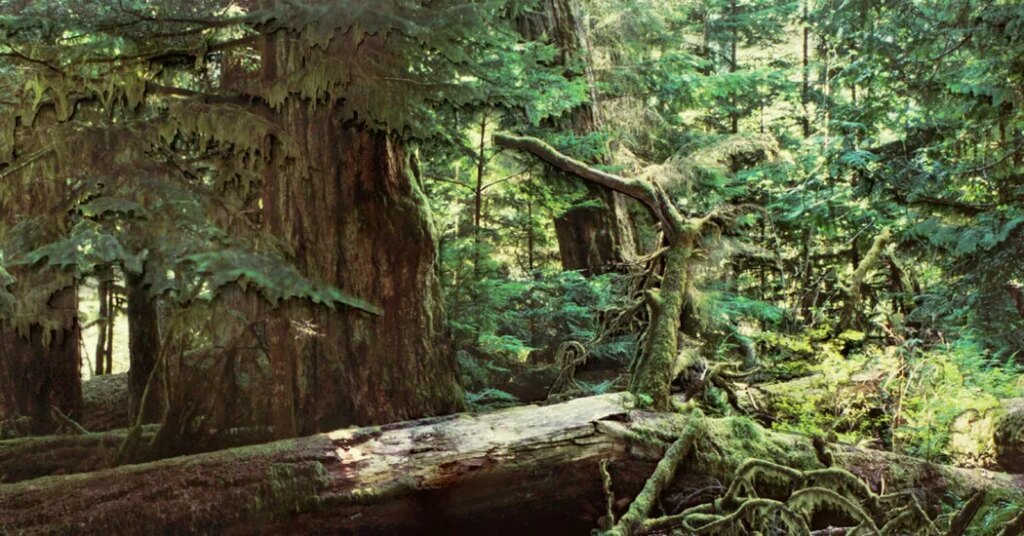
Thirteen years ago, I traded a shoe-box apartment on the east side of Manhattan for a cabin in the woods on the west coast of Canada. Like so many would-be Thoreauvians before me, I moved here in part because I craved an escape from the city’s pollution and noise. In that time, however, I have begun to feel the city — which is to say, the whole tangled system of advanced technology, industrial agriculture and hypercapitalism — crowding in on this little forest from afar.
Each wildfire season, the sky outside my cabin now turns a shade of nicotine yellow I associate with Los Angeles in the 1970s. On the smokiest days, news headlines declare that our air quality is “worse than New Delhi’s,” which is to say, worse than in one of the most polluted cities on earth.
The inverse is true, as well. One hot day this July, as clouds of smoke oozed south from Ontario, I drove through New York City and saw the buildings washed in the same sallow light I’m used to seeing during wildfire season back home.
As the climate continues warming, this spooky entanglement between the urban and the sylvan will only deepen. In doing so, it has revealed to me what is normally hidden from view: We all live under the same vengeful sky.
A lifelong, bone-deep atheist, I didn’t used to view the earth’s climate as some kind of god to be feared and placated. In fact, I tended to look askance at people who used religious language to make sense of the essential chaos of natural disasters. Often, the places hardest hit by catastrophic droughts, floods and storms are rural communities in nations where the average person’s carbon footprint is minuscule, like Nepal and the Philippines. Here in Canada, Indigenous people make up just 5 percent of the overall population, but in 2025 they made up more than 50 percent of wildfire evacuees. Such is the nature of what the climatologist Friederike Otto calls “climate injustice.”
So when the smoke descends upon us each summer, I can’t find much wisdom in talk of “ecological sin” or “climate karma,” which presumes a tidy logic of personal comeuppance. In a time of climate chaos, the religious language I find myself drawn to is far older, wilder and more mysterious.
Every year, I undergo a kind of baptism by wildfire. This religious conversion always follows the same arc. First the smell of burned wood — sauna-scented, not altogether unpleasant — floats in on the breeze. Then the sky begins to mutate. In the warm, Egglestonian light cast down by an alien red sun, everything takes on an old-timey quality. Before long, the vibes are decidedly acrid: Smoke seeps into the house, leaving me headachy and short of breath. By Day 3, my husband and I find ourselves squabbling over nothing. By Day 5, my thoughts vacillate between apoplectic rage and apocalyptic despair.
After a week of yellow skies, I reach my breaking point. In these moments, I often fantasize about agreeing to give up one of my guilty pleasures — drinking expensive coffee, say — if only it would clear the air. I suspect this desperate pleading is similar to what my ancestors, living in the dark greenwoods and damp peatlands of Iron Age Britain, experienced in times of woe. The ancient Celts were known to discard precious objects into rivers and lakes to appease the gods. I don’t own a sword, but when the smoke gets really bad, I would gladly relinquish my espresso machine to be able to breathe freely again.
In these moments, I stop seeing the sky as a blank backdrop. I see it as a living thing, and an angry one. I see the spirit of the forest rising up, rageful and trickstery, to hurl down thunderbolts and sicken us while we sleep. Put differently, I feel myself drawn away from scientific atheism, and toward a creed that philosophers call “scientific animism.”
Animism, put very simply, is the belief that the natural world is inhabited by spirits who can either punish us or bestow favors. Scientific animism applies this ancient lens to modern science, showing how forces in the natural world (plants, rivers, entire planets) are self-organized, self-perpetuating and self-willed. In this view, nature is not an inert, passive backdrop to human progress. It actively responds to our actions — though not always in the way we would predict.
Take trees. Until fairly recently, I tended to view trees as ecologically angelic beings that purified our air, shaded our homes and helped stabilize our climate. But today, the halo around trees is rapidly dimming. One wide-ranging study found that Canada’s forests, thanks in large part to wildfires, officially became a net source of carbon emissions rather than a carbon sink around 2021. (Canada’s heavily logged “managed” forests” passed a similar tipping point all the way back in 2001.) This means that, in one of the largest and most forested nations on earth, trees are now releasing more carbon dioxide into the atmosphere than they absorb.
A similar metamorphosis seems to be taking place in the Amazon and Congo rainforests. Moreover, the soot produced by wildfires can float up into the atmosphere and settle back down on snowy regions elsewhere, darkening them, which further contributes to global heating. It appears that a terrible feedback loop could be forming: Trees burn, warming the world; the world warms, and more trees burn.
Put another way, I worry our forests are now acting as amplifiers of our ecological actions; that if we continue to heat the climate, trees will only accelerate the warming.
This phenomenon jibes with the teachings of many Indigenous cultures, which hold that certain trees are inhabited by spirits who, if the tree is unceremoniously killed, will exact their revenge on you or your relatives. The kodama of Japan, the aos si of Ireland, the radande of Sweden, the yaksha of India, the jumbies of the Caribbean, the Iroko-Man of Nigeria, the kumaka akiri of the Amazon — all are variations on this theme.
The ancient Greeks and Romans held a similar belief regarding nymphs and dryads. In one of history’s most haunting ecological fables, Ovid recounts how the arrogant king Erysichthon, having felled a sacred oak inhabited by a dryad, is cursed by the gods with an eternal and all-consuming hunger. Trying to fill his bottomless belly, he eventually sells his daughter into slavery and then gnaws off his own limbs.
The Nuu-chah-nulth philosopher Umeek, rather than referring to nature “spirits,” sometimes substitutes the word “powers,” which is easier for us in urbanized cultures — who are raised with scant ecological knowledge, but a rich understanding of power relations — to grasp. For me, this tiny semantic shift is transformative. Looking at the natural world as a mosh pit of powers, I find it violently, gloriously reanimated. I understand that I am just one small frail human body, pushed around by larger powers, in a crowded universe.
The world’s forests are one such divine power — a god so vast it can be seen from outer space, a god so powerful it can scorch the planet, a god so wily that, even when it dies, it can turn to smoke and sneak into our homes, our lungs, up into the very vessels of our brains. Like all gods, the forest demands respect. It demands care. And, from time to time, it demands sacrifice.
Talk of “sacrifice” has fallen almost entirely out of the environmental discourse of late. After all, what good is personal sacrifice when A.I. data centers and crypto mining outfits are busy polluting the atmosphere at the same rate as entire nations? Many people have come to feel helpless before the demigods of the tech industry, and understandably so. But wildfires — and heat waves and hurricanes and droughts — remind us that there are powers much higher than any corporation.
The prophets of scientific animism — ecologists and climate researchers — are in near-unanimous agreement that, to save ourselves from ecological collapse, what is needed are not just small everyday acts of sacrifice, like forgoing a morning latte. We need to sacrifice something big. We need to replace the fossil fuels of coal and oil with wind and sun, and we need to transform a system based on maximizing profit into one aimed at balancing ecological, communal and personal well-being. In other words, we need to sacrifice carbon capitalism itself.
Otherwise, the forests, and the other awesome powers that inhabit this wild planet, will continue to punish us. This is no mere metaphor. It is a literal, bodily truth. The choice is clear: Either we give up carbon capitalism to appease our earthly gods, or our world will continue to burn.
Robert Moor is the author of “In Trees: An Exploration” and “On Trails: An Exploration.”
The Times is committed to publishing a diversity of letters to the editor. We’d like to hear what you think about this or any of our articles. Here are some tips. And here’s our email: [email protected].
Follow the New York Times Opinion section on Facebook, Instagram, TikTok, Bluesky, WhatsApp and Threads.
The post Wildfire Converted Me From Tree-Hugger to Tree-Worshipper appeared first on New York Times.