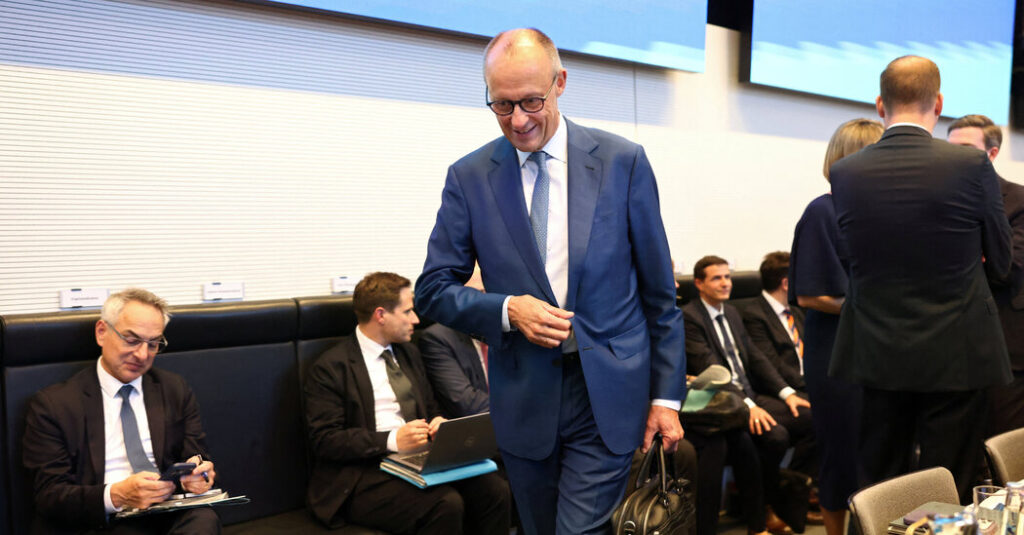
There are two big reasons Chancellor Friedrich Merz of Germany, whose mainstream conservative party has been trounced by the far right in recent state elections, is fighting for his political career.
Both are versions of the greater ailments plaguing centrist politicians across Europe and the rest of the wealthy world.
First, Mr. Merz is trying to enact difficult economic policies, including painful pension cuts, at a time when voters want simple and painless solutions.
Second, and perhaps more important, he is finding it difficult to explain those policies to voters, especially younger ones.
For Germans under 25, social media has replaced church, civic and even political groups as the primary source of political information, researchers say. The internet provides a steady diet of simple, bold promises from populists on the political extremes.
Mainstream leaders like Mr. Merz “no longer have any way to reach the hearts and minds of young people,” said Steffen Mau, a sociologist at Humboldt University of Berlin.
It is a story that mirrors the surge of populist movements around the world, including in the United States.
In Germany, in elections in the small eastern states of Saxony-Anhalt and Mecklenburg-West Pomerania this month, young people broke heavily toward the far-right Alternative for Germany, or AfD, which says it will solve the country’s problems in part by deporting millions of migrants. In Berlin, young people embraced the far-left Die Linke, which promised to reduce housing costs in part by seizing hundreds of thousands of private apartments.
Mr. Merz’s Christian Democratic party was a clear loser in all three elections. In Mecklenburg-West Pomerania, the party failed for the first time in postwar Germany to clear the 5 percent threshold needed to win seats in a state Parliament. The Christian Democrats now trail the AfD handily in national polls.
Mr. Merz accepted some blame his week. He vowed to stay in office and to right the ship even as Christian Democrats panic about how to stop the party’s tumble.
“We know that we face major problems with public support, that we are no longer reaching significant segments of the population and that there is a widespread feeling among the public that things are no longer fair in our country,” Mr. Merz said.
He also acknowledged, “We no longer have satisfying answers to far too many questions, and we will and must change that.”
Part of the problem lies in the economic compromises that Mr. Merz wants Germans to make to sustain the federal budget and welfare system after years of sluggish growth. Many voters have recoiled at plans to cut pension benefits and to require workers to obtain a doctor’s note on the first day they call in sick.
Mr. Merz’s popularity was low even when he entered the chancellery. Conservatives chafed at how quickly he reversed a campaign promise on fiscal restraint. Liberals were upset he tried to vote with the far right during efforts to toughen immigration laws.
His ratings have since plunged toward single digits. That is partly because of factors beyond his control, including anger at fuel prices that spiked this year largely because of war in the Middle East.
Yet some of Mr. Merz’s struggle, analysts say, is particular to him.
Voters have soured on his gruff personal communication style and his charmless responses to their concerns.
In May, Mr. Merz, 70, took questions from a gathering of Roman Catholic youth in the city of Würzburg. One audience member asked whether Mr. Merz could understand the frustration of young people “when they feel repeatedly portrayed — among others, by you or your party — as somewhat lazy.”
“No one in my party has ever said that people in Germany are lazy,” Mr. Merz said. “Neither have I. No, no, no, no, no, no, no, no, no, no.”
Mr. Merz then explained, in detail, a view that many economists endorse: that Germans, who log fewer working hours than many of their European neighbors, need to work more if they want to rev up the economy.
A heckler interrupted his response.
Still, analysts say that much of Mr. Merz’s predicament comes from forces bigger than any one chancellor — and unlikely to change even if he steps down.
The Christian Democrats trail the AfD and Die Linke in digital outreach. When speaking to voters, centrists often struggle to articulate how they will solve voters’ problems, said Julia Friedlander, chief executive of Atlantik-Brücke, a nonprofit that promotes cooperation between Germany and the United States.
“The style of political communication that the political center in this country has pursued just doesn’t work anymore,” Ms. Friedlander said in an interview.
Mr. Merz suggested something even more fundamental in remarks after the state elections this month. Centrist parties, he said, have yet to convince voters that their time-honored focus on compromise and incremental change is more effective than the “radical” plans of the AfD or Die Linke.
“Anyone who has ever governed,” Mr. Merz said, “knows that there are no simple solutions.”
The post Why Germany’s Leader Is Struggling: Painful Cuts and a Wooden Style appeared first on New York Times.