To the Editor:
Re “Trump Tells U.N. Iran Faces a Risk of Annihilation” (front page, Sept. 23):
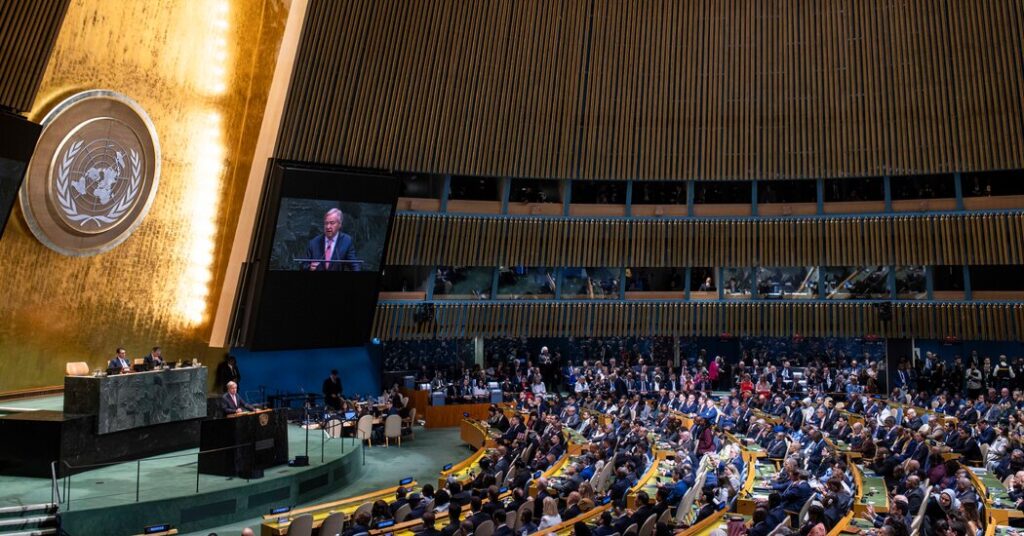
The idea that President Trump would tell the United Nations General Assembly that he has two options for ending the war with Iran — make a deal or “annihilate the Islamic republic and do it quickly, never giving them a chance to kill and destroy people and countries again” — is a bridge too far for any civilized nation, let alone the United States.
Presenting the destruction of an entire country as the alternative to a negotiated settlement, before the world’s assembled leaders, raises profound questions about the president’s judgment and the limits of executive power.
If there were ever a moment for the members of the Trump cabinet to seriously consider Section 4 of the 25th Amendment, this is it. The amendment provides a mechanism for the vice president and a majority of the cabinet to declare that a president is unable to discharge the powers and duties of the office.
The question is no longer merely what Mr. Trump says about Iran. It is whether the people closest to the president are willing to exercise their constitutional responsibilities when the stakes are so high.
Denny Freidenrich Laguna Beach, Calif.
To the Editor:
Rather than presenting himself as a visionary statesman at the United Nations, President Trump once again embarrassed himself and, by extension, the nation at yet another global forum.
He offered up a meandering, incendiary and uninformed speech, highlighted by his cavalier threat to “annihilate the Islamic republic” of Iran, his characterization of climate change as a “hoax” and an unabashed willingness to deploy U.S. military might for strictly mercenary, profit-seeking purposes, as he did in Venezuela.
Mr. Trump’s predominantly incoherent rantings were more befitting of one his raucous, outlandish MAGA rallies than of an annual gathering of top United Nations delegates to discuss in person the most pressing global and diplomatic matters.
In addition to wearing out his welcome with the American people, Mr. Trump is proving a deeply exasperating and tiresome presence on the world stage as well.
Mark Godes Chelsea, Mass.
For Immigrants, ‘Fear Itself Changes Behavior’
To the Editor:
In “Immigration Policy Is Becoming Even Crueler” (Opinion guest essay, Sept. 17), Stephen Yale-Loehr warns about the new public charge rule and highlights a consequence of immigration policy that deserves greater attention: Fear itself changes behavior.
If immigrant families avoid health care, nutrition assistance and other services because they fear jeopardizing their immigration status, the effects will extend far beyond those directly subject to the rule.
They will reach children, including U.S. citizens, and ripple through schools, workplaces, health systems and communities. The Department of Homeland Security itself anticipates impacts on hospitals, nonprofits and businesses as families withdraw from public programs.
As a demographer, I worry that public debate focuses narrowly on arrests, deportations and legal status while overlooking how fear and uncertainty reshape the behavior of entire communities.
When families avoid clinics, disengage from institutions or hesitate to interact with public systems, those individual decisions accumulate. What begins as immigration policy can ultimately affect population health, community trust and the strength of social institutions.
We can disagree about immigration policy. But we should not ignore the lasting effects of policies that make people afraid to be seen.
Camerino I. Salazar San Antonio
Better Eating Habits
To the Editor:
Re “Rise of GLP-1s Leaves Food Industry Holding the Party-Size Bag” (front page, Sept. 19):
As you explain in your article, people on these drugs are changing their diets and lifestyles. That gives this retired pediatrician the most hope I have had that eventually we will be able to overcome the tsunami of advertising for foods that, if not truly addictive, certainly engender a craving for more of the same.
As people on these drugs change their eating and buying patterns, they will start to feed their children better, and maybe we can break this destructive, expensive cycle.
Barbara Gold Philadelphia
The post Trump’s Threat to ‘Annihilate’ Iran appeared first on New York Times.