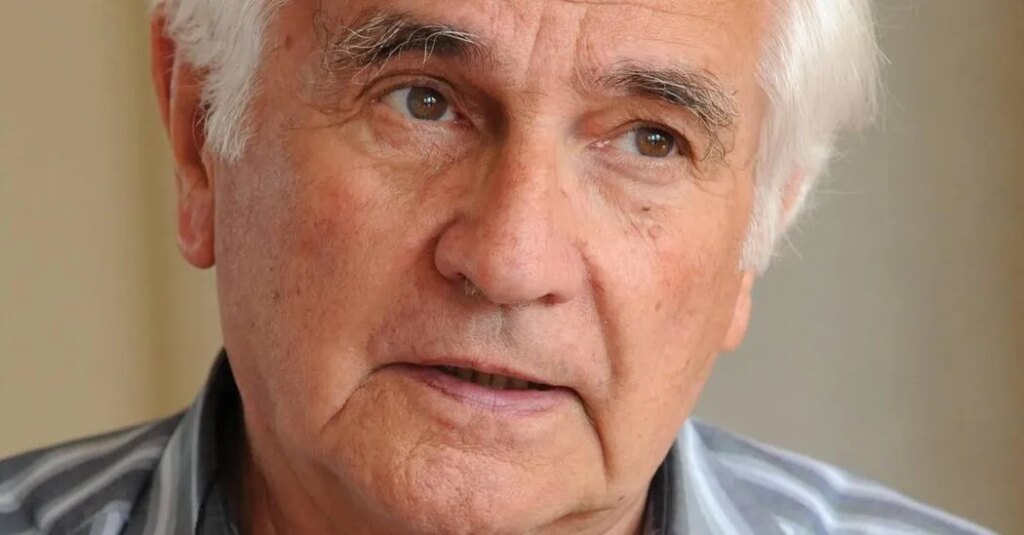
Stanislas Hutin, whose firsthand account of witnessing torture by French troops in the Algerian war of independence helped incite a wave of revulsion against that losing conflict, died on Sept. 2 in Arradon, in Brittany, France. He was 95.
His death was announced by Ouest-France, a large-circulation daily newspaper that Mr. Hutin’s father founded after World War II.
Mr. Hutin’s testimony — published anonymously in June 1956 and soon republished by well-known French antiwar writers — was among the earliest to chronicle the systematic torture practiced by French forces against Algerians attempting to free themselves from colonial rule, and it was among the most influential.
Mr. Hutin was a 24-year-old Jesuit seminarian when he was conscripted in 1955. His army unit, the 21st Colonial Infantry regiment, was sent as part of a “pacification” effort — he used the phrase derisively in a 2019 interview — deep into the Algerian countryside.
He was a most reluctant recruit, as he made clear in the interview, conducted by the historian Tramor Quemeneur for the national audiovisual archive. Mr. Hutin, a machine-gunner, said, “I wrote a text before I left” France, “pleading with the Lord that this machine wouldn’t spit death because of me.”
After disembarking from his troop transport, he was shocked by the poverty of the Algerians and the brutality that his officers displayed toward them. Beatings of suspects were the order of the day, but much worse was to come.
He was preparing to go to sleep in his tent, in a French encampment in Algeria’s northeast, on a cold night in late January 1956, when he was startled out of his bed.
“The cries of a pig being slaughtered I heard last night around 9 p.m. came, indeed, from the young boy,” he began his journal entry for the next day. The boy was a shepherd of 14 whom the French soldiers had captured two days earlier.
“At first I thought it was the jackals,” he wrote in the little red spiral-bound notebook he kept, clandestinely. “But it kept going on and on.”
“So I got out of the tent in my pajamas and listened: voices and groans were coming from the lieutenants’ tent. I said to myself: ‘They can’t possibly be subjecting that kid to the magneto.’ ” (That was the name of the troops’ portable field generator, which had often been put to sinister use: Wires from it were attached to various parts of a victim’s body, notably the testicles. And it left no detectable trace of torture.)
“I went back inside, once more broken and sickened,” he wrote.
“It was the boy,” he continued. “This morning, I’m literally shattered.”
Already considered a “Communist” by the officers in his unit, “I really got into it” with the lieutenant who had done the torturing, he told Mr. Quemeneur years later. “A brute, a sadist,” he wrote in his journal the next day.
He took a picture of the teenager, Said Boutout, “to show to people in France” the face of the French army’s brutality: a curly-haired boy so youthful he barely looked 14.
The photo of the teenage Said, who survived the ordeal, later appeared on book covers. “It became, for me, a real memorial of this abominable war,” Mr. Hutin told Mr. Quemeneur.
Mr. Hutin was back in France by the spring of 1956, and that June, a Jesuit priest published excerpts from Mr. Hutin’s journal in the order’s publication L’Action Populaire.
The following year, as opposition to the Algerian war was growing, extended portions appeared in a short collection of testimonials, “Des Rappelés Témoignent” (“Recruits Testify”), published by a group of Christian intellectuals.
Also in 1957, Pierre-Henri Simon, a Catholic writer who became Le Monde’s literary critic, published “Contre la Torture” (“Against Torture,” not translated), including extracts from Mr. Hutin’s journal. It was a book that “marked an entire generation,” the Catholic journalist Jean-Claude Petit wrote when it was republished in 1999. And the eminent classical historian and antiwar activist Pierre Vidal-Naquet cited him extensively in his book “La Torture dans la République” (1972).
For Mr. Hutin, the small red notebook and the letters he had written to his family, served a private, not just public, purpose. “My family, journalists, when I came back, they wanted to know,” he told Mr. Quemeneur. “It allowed me to liberate myself from this traumatism. It was a real catharsis.”
Stanislas Hutin was born in Rennes, France, on Sept. 7, 1930, the third of five sons of Paul Hutin-Desgrées, a journalist, World War I veteran and leading figure in the Mouvement Républicain Populaire, the Christian-democratic party that became a force in post-World War II politics. His mother was Magdeleine Desgrées du Loû.
Journalism ran in the family: Mr. Hutin’s maternal grandfather had founded the newspaper L’Ouest-Éclair at the end of the 19th century, the ancestor of Ouest-France.
Mr. Hutin’s father was imprisoned by the Germans in 1943. “We were continually confronted by the occupying forces,” Mr. Hutin recalled in the 2019 interview. Friends in the Resistance were shot by the Germans, a memory that shaped his reaction in Algeria later.
In 1951, he entered the Jesuit order and three years later was drafted to serve in Madagascar, another African colony that France was vainly trying to hold on to. On his return, he helped compose a report exposing slavery on a Madagascar coffee plantation. The report gained some attention because his father was by then a member of the French Parliament.
Sent to Algeria in the summer of 1955, he was designated for service as a teacher by the French army, as part of the “pacification” campaign. He recalled in the 2019 interview that “the captain ordered me to keep a rifle next to the blackboard, a flagrant contradiction.”
He left the Jesuits after the war — it ended in 1962 with France’s humiliating defeat — studied sociology and ethnology, and pursued a career aiding commercial development and banking in developing countries, especially Africa.
He is survived by a brother, Gonzague Hutin.
In the late 1970s through ’80s, when he returned to Algeria as a development worker, Mr. Hutin sought out Mr. Boutout, the teenager who had been captured and abused. They ended up establishing a rapport, Mr. Quemeneur said.
In his retirement, he spoke frequently in French schools about the lessons of the Algerian misadventure. “He was someone of great humanism,” Mr. Quemeneur said of Mr. Hutin. “He was open to others, and open to dialogue. He accepted the positions of others. And he dedicated his life to the service of others.”
The post Stanislas Hutin, Who Denounced Torture in France’s Algerian War, Dies at 95 appeared first on New York Times.