“Fair is foul, and foul is fair.” The most famous line in Shakespeare’s “Macbeth” has the simplicity of a nursery rhyme. It’s so simple that it’s easy to gloss over its meaning, a singsongy doggerel whose language is more tuneful than profound.
In her Metropolitan Opera debut, the director Louisa Proske adapts the witches’ chant into the guiding principle of a gripping new production of Verdi’s “Macbeth,” which opened the company’s season on Tuesday. With two thoroughly committed stars as Macbeth and his Lady, and a conductor with a penchant for high-octane drama, the show lent fresh tension and heart-stopping insight to a popular opera and its even more popular source material.
The production takes place in opera’s trendiest time period, a postapocalyptic dystopia; Montana Levi Blanco’s costumes pit Tudor and Elizabethan elegance against Jon Bausor’s settings of blasted concrete walls and ornately styled interiors. Fog gathers amid a general air of lawlessness, and the witches, sounding plummy but looking like 16th-century zombie-peasants, skitter atop mounds of rubble. As the stage revolves, the witches peek voyeuristically around corners, delighting in the mayhem they have set in motion. In Adam Silverman’s lighting scheme, the singers cast long, foreboding shadows, revealing the menace within them and the menace stalking them.
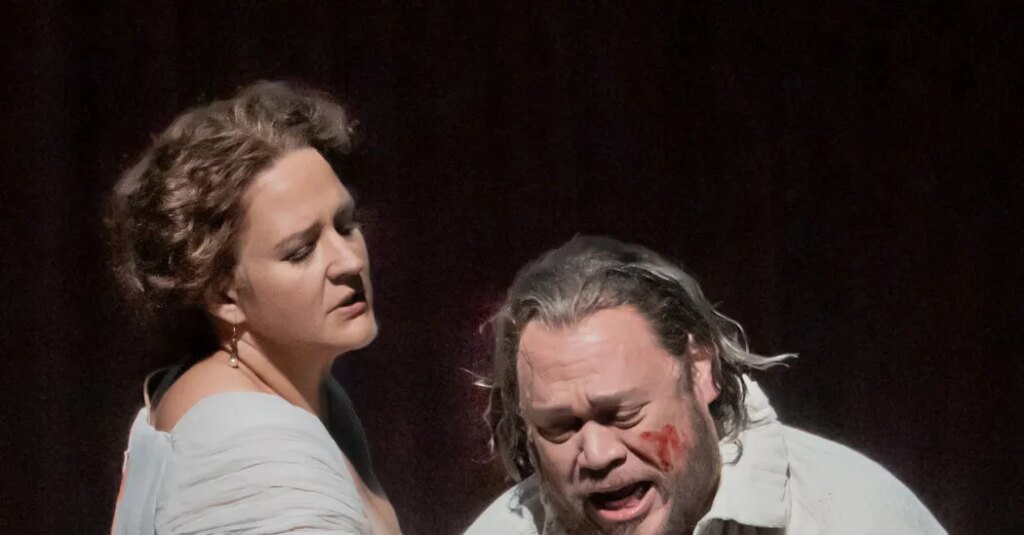
Against this backdrop, the baritone Quinn Kelsey gives a stupendous performance that hits a high-water mark in his Met career. He has already distinguished himself as a Verdian in “Rigoletto” and “Aida,” using his generous, earthy timbre to imbue his characters with disarming humanity. His Macbeth is an altogether more sophisticated creation. When he enters, remarking on a day that feels somehow both foul and fair, his voice has a noble roundness and philosophical contemplativeness. His voice retains its refined grain as it rises through his range in gorgeous swells. This Macbeth is a good soul in a rotted landscape.
By Shakespearean standards, “Macbeth” is uncomplicated, with a linear plot, an unambiguous moral perspective and a hero with a clear tragic flaw. At the same time, its facileness can make it feel inert; it’s hard to believe that much is at stake with a cartoonishly evil antihero. The average theatergoer spends more time deciding whether to park a little too close to a fire hydrant than Macbeth spends deciding to kill someone.
Kelsey’s triumph lies in the way he steadily charts each step in Macbeth’s decline. In the dagger soliloquy, a snarl creeps into his otherwise gallant sound, and his Macbeth roars with panic as venom overtakes his veins. After he murders King Duncan, his guilt-wracked voice peals forth in clear tones, the last gasp of a noble mind. Later scenes find him hollowed out, and by the time he sings Macbeth’s great Act IV aria “Pietà, rispetto, amore,” he is void of self-pity and full of self-recriminations, almost at peace in his self-loathing, his legacy deservedly tarnished. The Met restored the aria “Mal per me,” which Verdi cut when he revised the score, giving Macbeth an opportunity to regret his foolishness.
Kelsey’s highly individual technique fits the role particularly well. Verdi baritones often prize an unbroken legato, a steady emission of a rich, rounded, balanced sound. Kelsey is livelier, mixing straight tone with purring vibration and huskiness with brief, revelatory moments in the sun. His voice reacts dynamically to Macbeth’s struggles with the demons overtaking him.
Kelsey’s performance is woven into the foul-and-fair paradox of Proske’s production. Even Ran Arthur Braun’s fight choreography, both explosive and balletic, contributes to the unsettling effect of a dissembling world. Naturalistic attacks seemed to slow midair and land gracefully, and clashing swords gave off pretty sparks. The Met restored a portion of the often-cut ballet, pitting a gleeful re-enactment of Duncan’s murder (choreographed by Jorrell Lawyer-Jefferson) against the suavity of the conductor Yannick Nézet-Séguin and his Rolls-Royce of an orchestra.
Throughout the show, Nézet-Séguin pulled at the opera’s tensions. The strings swooned while the brasses obliterated everything before them. In the overture, pointed woodwinds and an oddly dusky harp played against type. The announcement of Duncan’s murder swirled with flashes of the hair-raising drama that Verdi would master in his late-career Requiem. Tiny details added shape, too, as when Nézet-Séguin rode the violin melody in Banquo’s aria while pushing the accompanying figures into the deep background, creating a sense of dimension in a piece that might otherwise sound pro forma.
Going into opening night, all ears were on Lise Davidsen’s Lady Macbeth. With her poise, stamina and majestic tone, Davidsen has efficiently consolidated a position as the world’s leading dramatic soprano for German repertoire. Verdi’s opera, though, presents different challenges. Lady Macbeth has four big arias that test the entire span of a soprano’s vocal range and the thoroughness of her technique.
Davidsen’s sound was patently thrilling even as she negotiated the score’s difficulties with caution. She is a tasteful, circumspect singer, so she was never going to steamroll her way through the coloratura obstacle course of the letter scene. Her close attention to tempo and unity with the instruments that doubled her melody may have cost her some vocal presence. Having cleared those hurdles, her voice pealed on top with seraphic force, and her cadenza had freedom and imagination. “La luce langua” and the drinking song were also admirably sung despite some awkwardness.
Hands down, the highlight of Davidsen’s evening was the sleepwalking scene. As her Lady walked through a gallery of distorted mirrors, she saw clearly for the first time what she had done, singing sorrowfully but without indulgence. Her bedchamber, once a cloistered, claustrophobic space of thickly piled velvet, was almost unrecognizable, a scorched ruin. As her voice floated through its upper reaches, it caught the light. An artful decrescendo revealed her remorse, and in an inverse of Macbeth’s trajectory, Davidsen’s Lady finally found her nobility, rising to a lambent high D-flat before passing away.
Kelsey’s interpretation is so strong that he pulls all the characters into his orbit. Macbeth’s deputy, Banquo, and his rival, Macduff, are his dramatic and musical foils. Banquo, sung by Ryan Speedo Green with a strong, even, somewhat subdued vocal profile, is a good but not great man whose ordinariness means he passes below the radar of the meddlesome witches. As Macduff, the tenor Freddie De Tommaso injected Italian style and genuine vitality into the show, with a juicy timbre, pinging high notes and a few sobs and sighs. It was cathartic to feel the pained humanity of someone who wasn’t already half-dead on the inside.
In a dramatic sleight of hand, Macduff emerged from the chorus of refugees right after they finished a quiet, deeply felt rendition of “Patria oppressa.” Nameless and forgotten amid so much sound and fury, the chorus became the audience’s mirror, a reminder of the human stakes of unchecked ambition.
The post Review: At the Met, a Triumphant Baritone in a Dystopian ‘Macbeth’ appeared first on New York Times.