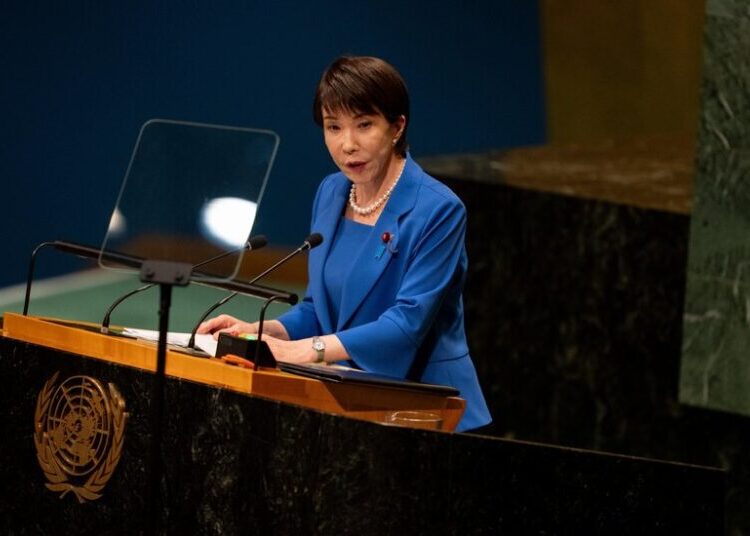
The United Nations has “kindly reminded” world leaders to keep their addresses this week to the General Assembly to 15 minutes. If history is any guide, many will be just as polite in ignoring the request.
Adhering to the clock is essential, the U.N. says, to schedule nearly 200 speakers over six days. It is also voluntary — a courtesy the organization acknowledges is rarely adhered to.
The chronic overrunning highlights a fundamental truth about the U.N.: It is a collection of sovereign states, and though it can cajole, it cannot force them to do anything.
“Part of being sovereign,” said David Bosco, an international relations expert at Indiana University Bloomington, “means no one gets to tell them when to shut up.”
When speakers surpass 15 minutes, there is no Oscars-style orchestra playing them off the stage or a cut to a commercial break. Delegates are informed that a light sits at the podium to assist with the “timely delivery” of speeches. They can ignore it, and historically they do.
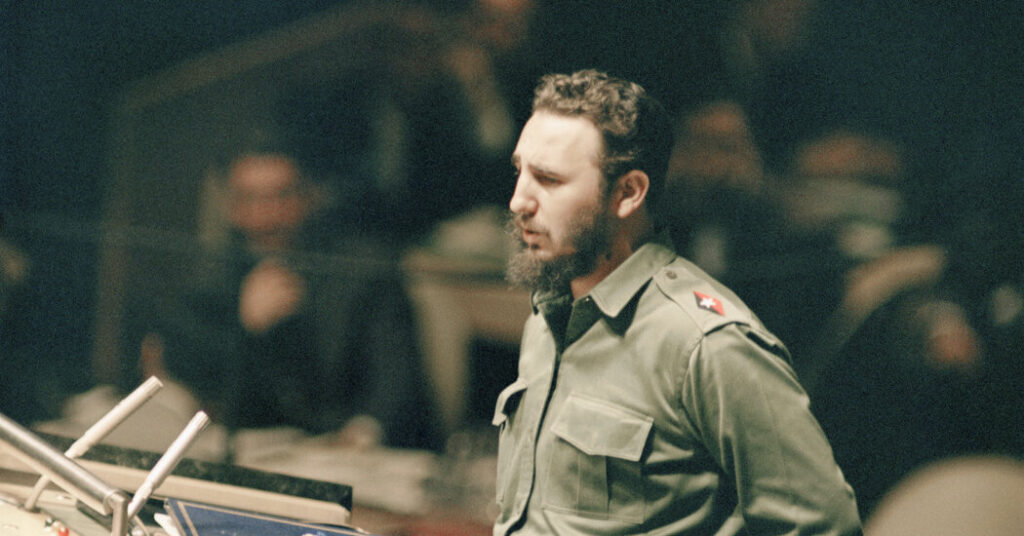
Fidel Castro holds the General Assembly record for his four-and-a-half-hour address on Sept. 26, 1960. Wearing olive military fatigues, Mr. Castro lashed out at global capitalism, defended Cuba’s Soviet alliance and aired grievances about New York. (The overall U.N. record belongs to V.K. Krishna Menon, an Indian defense minister, who spoke for nearly eight hours across Security Council meetings in 1957 to defend India’s position on the disputed Kashmir territory.)
Most speakers on Tuesday, the first day of the General Assembly meeting, exceeded the allotted time. They included President Trump, who spoke for well over half an hour in an address in which he said he was weighing whether to strike a deal with Iran or “annihilate” it.
The General Assembly address is “essentially an ego trip for presidents and prime ministers,” said Richard Gowan, an analyst at the International Crisis Group. Once on the stage, “many of them cannot really hold back.”
Many speakers in fact aim their remarks at the audience back home, analysts said — a practical strategy, as speeches are often delivered to a largely empty hall. “Mostly they are just shouting into the void,” Mr. Gowan said.
A handful of leaders — including U.S. presidents and, more recently, President Volodymyr Zelensky of Ukraine and Prime Minister Benjamin Netanyahu of Israel — routinely command news media interest or prompt protest. But most statements fade quickly from memory.
The speeches that linger in U.N. lore are remembered less for their rhetoric than their theatrics.
In 1960, the Soviet premier, Nikita Khrushchev, banged (or maybe waved) his shoe from his desk in the hall in response to the speech by the Philippines’ delegate, who claimed the Soviet Union had deprived Eastern Europe of political and civil rights. In 1974, Yasir Arafat, chairman of the Palestine Liberation Organization, addressed the session while wearing a gun holster. (A spokesman said Mr. Arafat did not carry a gun into the hall.)
In 2006, President Hugo Chávez of Venezuela draped a handkerchief over the timer light before declaring that the rostrum “smells of sulfur” after a speech the day before by President George W. Bush. Three years later, the Libyan leader, Col. Muammar el-Qaddafi, spoke for 100 minutes, tearing pages from a copy of the U.N. Charter. .
Paul Heinbecker, a former Canadian ambassador to the United Nations, relayed a diplomatic adage that he said could apply to just about any General Assembly session: “Everything had been said but not yet been said by everybody.”
The post It’s Not the Oscars: U.N. Speakers Love to Ignore Its 15-Minute Rule appeared first on New York Times.